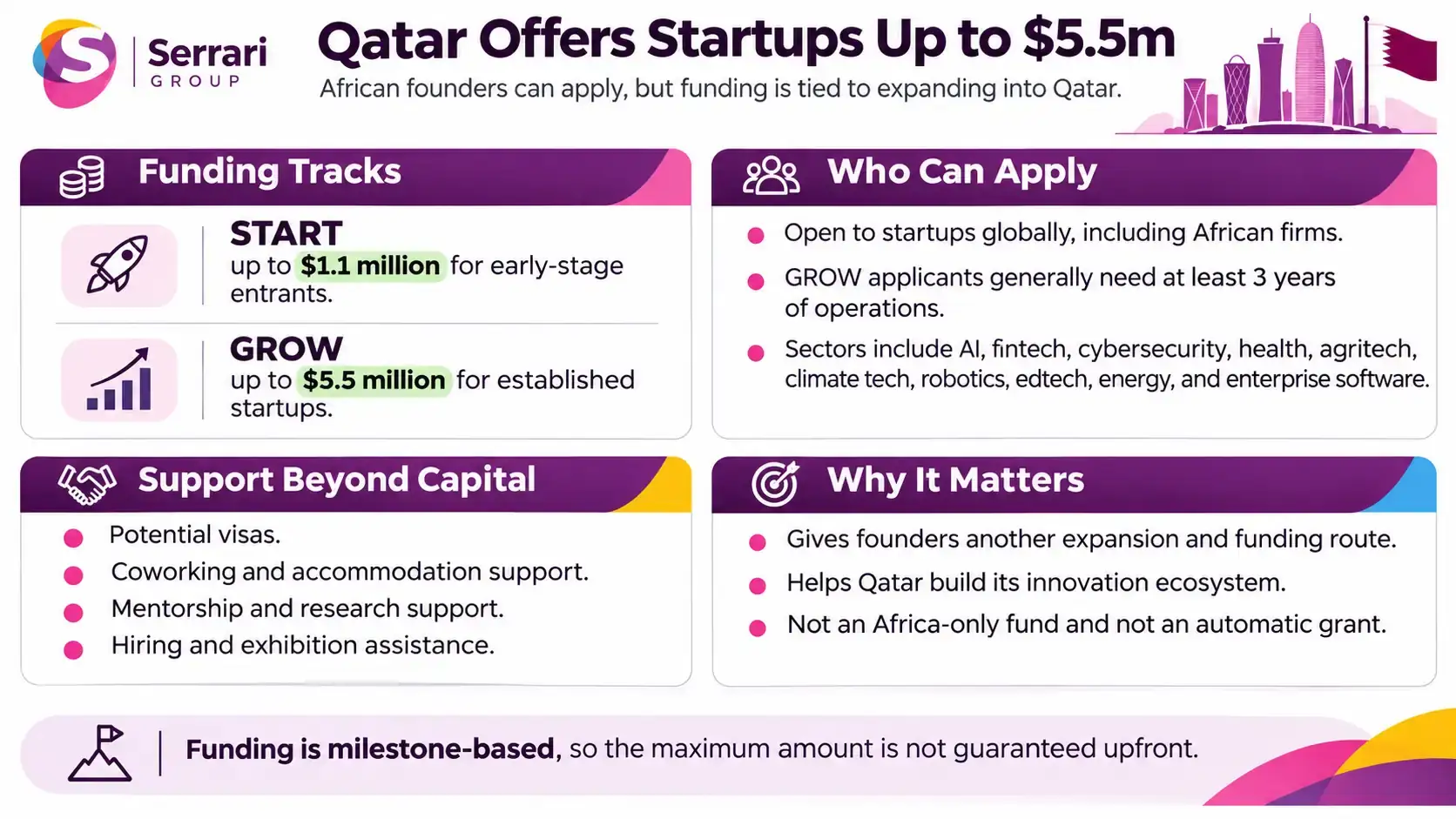
African technology startups can seek investments of up to $5.5 million through Qatar’s Startup Qatar Investment Program, but the offer is conditional on establishing or expanding a business in Qatar, rather than a financing scheme set aside for Africa. Managed by Qatar Development Bank, the initiative offers up to $1.1 million to qualifying early-stage businesses and up to $5.5 million to established companies, with funding released against agreed milestones. For founders in Kenya, Nigeria, Egypt, South Africa and elsewhere, the opportunity comes at a time when expansion capital remains selective. Qatar, meanwhile, is using investment and business incentives to attract technologies, companies and talent that can help diversify its economy beyond hydrocarbons.
Key Overview
- Two investment tracks: START offers up to $1.1 million for startups launching in Qatar; GROW offers up to $5.5 million for established startups entering the market.
- Not Africa-exclusive: Companies worldwide can apply, including eligible businesses founded or operating in African markets.
- Growth-stage threshold: GROW applicants need at least three years of operations, a credible growth outlook, financial stability and an adequate funding history.
- Funding is conditional: The approved amount may be paid in instalments tied to agreed milestones; the ceiling is not a guaranteed award.
- Priority industries: Financial technology, artificial intelligence, cybersecurity, health, agriculture, climate technology and business software are among the target areas.
- Support beyond capital: Selected businesses may qualify for licensing support, subsidised workspaces, mentorship, talent assistance and relocation incentives.
Why Qatar Is Offering Millions to International Startups
Qatar’s investment programme is designed to attract technology businesses that will establish or enlarge operations within the country. That geographic condition matters: the government is not simply financing startups abroad because their products are promising. It wants commercially active companies, skilled workers, technology capabilities and a stronger domestic innovation ecosystem.
The strategy follows a familiar challenge for resource-rich economies. Revenue from oil and gas can fund major public investments, but long-term resilience also requires a broader base of private enterprises and higher-value services. Attracting startups in software, health technology and artificial intelligence gives Qatar a way to build commercial activity that need not depend directly on energy exports. It also positions the country as a possible base for entrepreneurs selling solutions across the Gulf and wider region.
The programme began in February 2024, when the original funding limits were $500,000 for firms establishing a presence and $5 million for established international startups. The current ceilings of $1.1 million and $5.5 million represent a larger potential commitment, but they should not be interpreted as evidence that every successful applicant will receive that amount or that new funds have been earmarked specifically for African applicants.
The wider Startup Qatar initiative was launched to bring together investment opportunities, incubation programmes, incentives and business-establishment services. That combination is important. Funding alone may help a startup survive temporarily; access to customers, permits, talent and commercial partners is more likely to determine whether its international expansion becomes sustainable.
How START and GROW Differ—and Who Qualifies
The published eligibility rules divide applicants by development stage. START is aimed at technology startups with a proof of concept or minimum viable product seeking to launch in Qatar. Applicants need a demonstrable market problem, a credible execution plan, a technology roadmap, a workable business model and leadership capable of delivering it. An idea without validation or a plausible route to customers is unlikely to be competitive merely because it falls within a priority sector.
GROW is intended for more established businesses. Its eligibility conditions include at least three years of operations under qualified management, a positive growth outlook, visible financial stability and an adequate investment history. A Kenyan fintech founded last year could therefore be suitable for START but would not meet GROW’s three-year operating-history requirement. A mature Egyptian software firm with paying customers and audited performance could potentially make a stronger case for GROW if it has a convincing Qatar expansion plan.
The larger track offers a ceiling of $5.5 million, not an automatic payment or unrestricted cash grant. Under the programme’s detailed questions and answers, awards depend on an assessment of financing needs and an approved investment plan, and funding may be disbursed in tranches against mutually agreed operating milestones. Founders must examine the final legal terms, including any equity ownership, investor rights, conditions and reporting obligations, before valuing the headline figure as a benefit.
Both tracks prioritise innovative, high-growth, knowledge-based ventures. Listed sectors include fintech, cybersecurity, AI and machine learning, agricultural technology, energy and climate technology, healthcare, education, robotics, property technology, supply-chain solutions and business-to-business software. The list is not exhaustive, so companies outside it may still qualify if their innovation and growth prospects are persuasive.
Why African Founders May Find the Opportunity Attractive
The principal attraction is the possibility of combining financing with a credible route to customers outside the company’s original market. African startups often develop products under difficult conditions: fragmented payment systems, limited access to venture capital, expensive business credit and uneven infrastructure. Those pressures can create adaptable technology, but scaling that technology across borders requires sales capacity, regulatory work and local market knowledge.
The funding environment helps explain the interest. One 2025 African venture-capital assessment recorded $3.9 billion across 506 equity and debt deals, with debt financing becoming increasingly important. A separate first-half 2026 funding review counted $1.15 billion across 224 announced deals, 12% below the comparable period of 2025. The methodologies differ, but both underscore a market in which founders cannot assume abundant or inexpensive expansion finance.
A Qatari foothold could be especially relevant for African enterprise-software developers, payments companies with appropriate licences, health technology firms and climate-related businesses with solutions applicable to Gulf customers. A business that sells logistics software to Kenyan distributors, for example, might find a new customer segment among regional supply-chain operators. The market case still has to be proved through customer research, pricing, partnerships and compliance; operating in Africa does not by itself guarantee product-market fit in Qatar.
An expansion could also diversify revenues and investor relationships, reducing dependence on a single domestic economy. However, Qatar’s relatively small population means that startups must consider whether the immediate local customer base is large enough or whether the country will function mainly as a platform for wider regional business development. A regional growth story is attractive only when the costs of building it can be supported by realistic contracts and sales prospects.
Context is everything. Stay ahead of shifting trends with today’s market updates, and uncover emerging opportunities using the Serrari Group Market Index and Marketplace. Then, take control of your own financial future by exploring our Money & Life Reset Transformation Blueprint ™ to build stronger habits, create better systems, and design a path toward lasting wealth.
Beyond Funding: What Relocation Support Actually Provides
The official benefits package includes potential waivers for registration and licence-renewal costs, flexible work and entrepreneur visa arrangements, subsidised coworking, support with hiring and internships, mentoring, research and development opportunities, exhibition participation and subsidised housing. These provisions target practical obstacles that can consume a startup’s budget before its first international sale.
But founders should not mistake a catalogue of possible benefits for a universal entitlement. Eligibility, duration and availability vary by service and provider. In particular, residency is governed by separate requirements. The entrepreneur residency pathway calls for endorsement from a recognised local incubator and supporting financial documentation; programme interest alone does not confer immigration status.
Business establishment also carries recurring costs. Teams may need office arrangements, legal advice, accounting, local hiring, regulatory approvals, customer support and travel. For regulated services, especially payments or health products, the relevant authorisations must be checked independently. Founders need to model those expenses against likely revenue and any actual financial incentives awarded.
The Commercial Risks Behind the $5.5 Million Headline
The largest danger is evaluating an international move around its maximum available funding rather than its business economics. Investments typically come with negotiated obligations, and milestones may include hiring, developing a product, entering the market or meeting operational targets. If a company builds its spending plan around the full ceiling but receives a smaller commitment or slower disbursements, it may face a cash shortage at precisely the moment its expenses are rising.
There is also a strategic trade-off. Founders who redirect management attention to a new market can weaken execution at home. Establishing an overseas entity may alter governance arrangements, tax exposure, intellectual-property decisions and shareholder expectations. Before proceeding, a startup should compare the cost of expansion with expected contracts, the availability of local partners and the consequences if the market takes longer than expected to develop.
The terms also determine whether the funding is economically attractive. A lower investment with reasonable ownership dilution and clear milestones can be better than a larger commitment with onerous control rights or commitments that distract from the core business. The programme should therefore be viewed as a potential investor and market-entry partner, not as free cash waiting to be claimed.
How African Startups Can Apply
The application guidance directs founders to the online investment programme process and identifies three core uploads: a pitch deck, founders’ profiles, and historical and projected financial information. Each of these document uploads currently has a 30 MB file-size limit. The application also seeks details of the founding team, the business, plans for Qatar and the founders’ level of commitment.
Companies should choose START or GROW based on their actual operating stage, not on the larger advertised amount. A credible submission will explain the problem being solved, show evidence that customers want the product, demonstrate how revenues will be generated and set out what establishing or expanding in Qatar will accomplish. GROW applicants should be prepared to explain their operating history and financial performance.
Applications can proceed through screening, founder interviews, due diligence and investment review. The timing is not guaranteed, and an application is not evidence of acceptance. Founders should confirm the currently applicable programme terms and any investment documents before making relocation commitments or publicly announcing financing.
The Bigger Picture: A New Funding Route, Not an Africa-Only Fund
Qatar’s larger funding ceilings represent a potentially meaningful opportunity for African startups that are commercially ready to establish a presence in the Gulf. They also reflect a wider contest among international business hubs to attract founders, jobs and technological capabilities. In that competition, public-backed capital and business incentives are instruments for building domestic economic capacity, not purely philanthropic assistance to companies overseas.
For African entrepreneurs, the correct question is not simply whether $5.5 million is available. It is whether a Qatar-based operation can generate enough market access, revenue and strategic advantage to justify the obligations of expanding there. Successful applicants could secure investment and new relationships, but no published programme-wide figure establishes how many African startups have already received awards. The opportunity is real; its value will be determined by the terms and by whether each startup can turn a proposed international presence into a sustainable business.
Sources: Qatar Development Bank / Startup Qatar / Invest Qatar / African Private Capital Association / Propel Africa / Tech in Africa
Your financial future isn’t something you wait for—it’s something you build.
The real question is: when do you begin?
Move beyond simply staying informed.
Navigate the markets with clarity—track trends through the Serrari Group Market Index, uncover opportunities in the Serrari Marketplace, and build practical knowledge with our Curated Wealth Builder Platform.
Stay connected to what truly matters.
Get daily insights on macro trends and financial movements across Kenya, Africa, and global markets—delivered through the Serrari Newsletter.
Growth opens doors.
Advance your career through professional programs including ACCA, HESI A2, ATI TEAS 7 , HESI EXIT , NCLEX – RN and NCLEX – PN, Financial Literacy!🌟—designed to move you forward with confidence.
See where money is flowing—clearly and in real time.
Track Money Market Funds, Treasury Bills, Treasury Bonds, Green Bonds, and Fixed Deposits, alongside global and African indexes, key economic indicators, and the evolving Crypto and stablecoin landscape—all within Serrari’s Market Index.