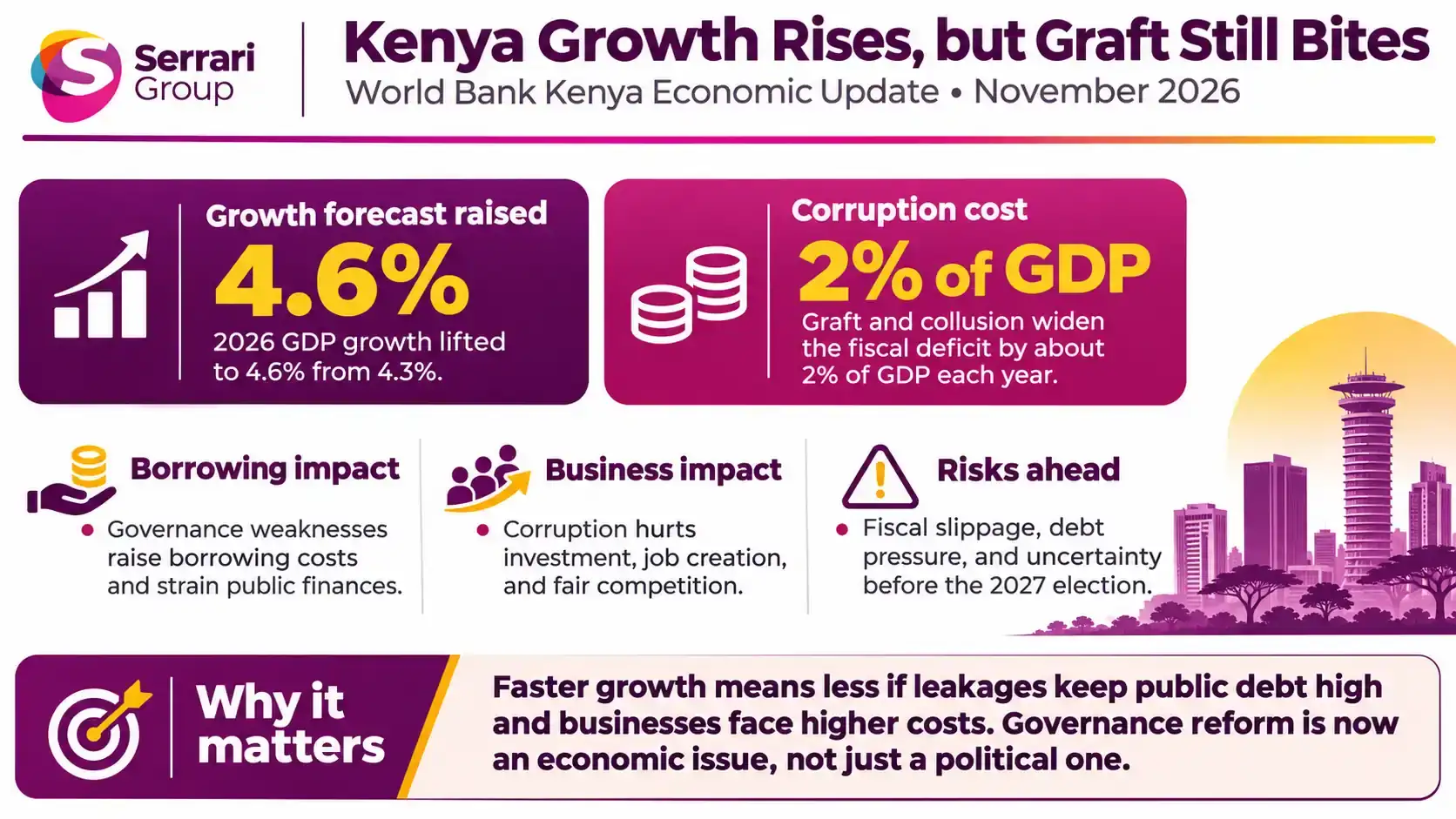
The World Bank has raised Kenya’s 2026 economic growth forecast to 4.6%, from 4.3%, after a stronger-than-expected first half of the year. But its November 4 assessment delivers a more troubling message: corruption and weak governance are preventing economic expansion from generating better jobs, stronger public services and higher incomes. The lender estimates that corruption and collusion widen the fiscal deficit by approximately 2% of gross domestic product annually, adding to borrowing requirements and the cost of public debt.
The contrasting findings expose Kenya’s economic dilemma. Output can expand while businesses struggle with bribery, public contracts become more expensive and debt payments absorb resources needed elsewhere. The government says procurement digitisation, conflict-of-interest rules and more predictable contractor payments are part of its response. With a general election due in August 2027, the practical test will be whether these reforms change how money is collected and spent—not simply whether the growth forecast improves.
Key Overview
- Growth forecast upgraded: The World Bank now expects 4.6% growth in 2026, compared with its earlier 4.3% projection, following stronger activity during the first half.
- Fiscal cost of graft: Corruption and collusion are estimated to add the equivalent of roughly 2% of GDP to the annual fiscal deficit; that is not a direct measurement of cash stolen.
- Business impact: Firms encounter bribery risks around tax administration, electricity connections and construction permits, raising costs and distorting competition.
- Debt implications: More expensive public contracts and weaker revenue administration increase borrowing needs, while governance concerns can raise the returns demanded by lenders.
- Government response: Officials point to electronic procurement, conflict-of-interest legislation, public-finance reforms and more predictable payment of contractors.
- Political test ahead: The August 2027 election could increase uncertainty and spending pressure at a time when fiscal discipline is essential.
Why the World Bank Is Warning Kenya Despite Faster Growth
The November 4 growth revision reflects better-than-anticipated economic performance in the first half of 2026. That is a reason for cautious optimism, but it does not settle whether Kenya is making its economy more productive or distributing the gains widely. A country can report positive gross domestic product growth while household purchasing power remains constrained and young workers find few stable, well-paying jobs.
The lender’s warning is therefore about the quality and durability of growth. When public spending is inefficient, firms spend time and money navigating arbitrary decisions, and investment choices depend on connections rather than returns, economic activity falls short of its potential. The result is not always a dramatic collapse. It can be years of respectable headline growth that produces too little improvement in productivity and living standards.
Kenya became a lower-middle-income economy in 2014, yet its latest development assessment still identifies weaknesses in the business environment and public finances as obstacles to private-sector-led growth. That makes governance more than a political concern. It influences whether an entrepreneur can build a factory, whether a county can deliver a project within budget and whether the Treasury borrows to create new assets or to cover avoidable losses.
What the 2% of GDP Corruption Estimate Actually Means
The World Bank estimates that corruption and collusion increase Kenya’s annual fiscal deficit by around two percentage points of GDP. This is a fiscal-impact estimate, not a ledger showing that an identical share of national output is handed over in bribes. The cost can arise through inflated procurement prices, weak revenue collection, poorly selected projects and spending that does not deliver the services paid for.
The distinction matters for public debate. A contract awarded at an excessive price can create a fiscal loss even where the precise amount exchanged corruptly is unknown. Tax exemptions or enforcement decisions influenced by favoritism can reduce revenue without producing a readily identifiable cash payment. Weak project oversight may cause delays, cost overruns or incomplete infrastructure, forcing the government to spend more to obtain the same result.
These effects become especially damaging when they recur. A larger deficit means additional borrowing or spending cuts, and borrowing produces interest obligations that extend into future budgets. The reported fiscal findings illustrate why the lender treats governance improvement as a potentially significant economic reform rather than simply a matter of punishing individual wrongdoing.
Why Corruption Raises the Cost of Kenya’s Debt
Investors assessing government bonds consider more than inflation and the benchmark interest rate. They also examine the government’s capacity to collect revenue, control expenditure and meet its obligations. Persistent governance weaknesses can undermine those expectations, causing creditors to demand a higher yield to compensate for uncertainty. The World Bank describes this as a governance-related premium on sovereign borrowing.
That creates a difficult cycle. Wasteful spending and revenue leakage can increase the amount the government needs to borrow. If investors simultaneously demand higher yields, the same financing requirement becomes more expensive. Interest payments then consume money that might otherwise fund roads, classrooms, hospitals or maintenance of existing infrastructure.
The October macroeconomic assessment identifies elevated public debt, fiscal slippage and corruption among the risks facing Kenya. Not every movement in bond yields is caused by graft: monetary policy, global financial conditions, inflation and liquidity also matter. Nevertheless, more credible procurement and budgeting could support confidence in Kenya’s public finances over time.
The central question for taxpayers is whether successive rounds of borrowing produce assets and services worth their cost. A lower interest bill would be helpful, but preventing waste before money is spent is a more direct way to improve the value obtained from public resources.
How Graft Makes Running a Business More Expensive
Corruption affects companies long before it appears in public-debt statistics. Entrepreneurs may face unofficial payment demands when obtaining permits, dealing with tax officials or connecting premises to electricity. Such demands act like unpredictable additional taxes, particularly for smaller firms that cannot afford lengthy delays or extensive compliance teams.
The latest reporting on enterprise experiences indicates that nearly 36% of firms reported at least one bribery request within the preceding year. The report also highlights pressures associated with tax meetings, electricity connections and construction permits. These are not minor administrative details: they directly influence whether a business can operate, expand or employ additional workers.
When access depends on favors, efficient businesses may lose contracts to less productive competitors with better connections. Honest firms may defer investment because they cannot confidently calculate the true cost or timing of a project. International investors also consider consistency and enforcement when deciding where to establish operations. The economic damage is therefore broader than the amount paid in an individual bribe.
Better governance can improve competition by making rules more predictable and reducing discretionary decisions. It can also help government procure goods and services at prices that more closely reflect quality and genuine market competition.
Context is everything. Stay ahead of shifting trends with today’s market updates, and uncover emerging opportunities using the Serrari Group Market Index and Marketplace. Then, take control of your own financial future by exploring our Money & Life Reset Transformation Blueprint ™ to build stronger habits, create better systems, and design a path toward lasting wealth.
Why the Growth Upgrade Does Not Guarantee Better Jobs
The revised 4.6% forecast reflects a stronger first half, but the full-year outcome remains a projection. Treasury Principal Secretary Chris Kiptoo has argued that the lender’s estimate is conservative and that the government expects growth of at least 5%. Both views depend on what happens during the rest of 2026, including consumer demand, investment and the effects of external shocks.
Even if the higher government forecast proves correct, the distribution of growth remains a separate test. Kenya has a large informal economy, and new activity does not automatically translate into secure employment with rising real wages. The private-sector diagnostic underscores the need to remove constraints that prevent productive businesses from expanding and creating better jobs.
Corruption is relevant because it alters incentives. Capital can flow toward companies best positioned to secure approvals or contracts rather than firms capable of generating the greatest productivity gains. Young businesses may never reach the scale needed to employ workers formally. Public investment can also fail to provide the transport, energy and other infrastructure that private firms need.
The result is a gap between national output statistics and household experience. Stronger governance would not solve every labor-market problem, but it could make investment more productive and allow more businesses to compete on performance rather than privileged access.
What Kenya’s Anti-Corruption Reforms Could Change
The government points to digital procurement, conflict-of-interest controls and more predictable contractor payments as evidence that it is addressing the problem. These reforms target important weaknesses. Electronic procurement can leave an auditable record of bidding, evaluation and awards, while conflict-of-interest rules can make it harder for officials to participate in decisions from which they or their associates may benefit.
A June 2026 reform-financing announcement detailed support for stronger public-finance management, electronic contracting, a Treasury Single Account and conflict-of-interest regulations. The program’s $750 million financing package demonstrates the scale of external support tied to improvements in accountability and public-service delivery.
However, launching a digital platform does not automatically eliminate manipulation. Tender specifications can still be tailored to preferred bidders, competition can be restricted before bids are entered and oversight bodies can fail to act on irregularities. Digital records become useful when procurement information is accessible, exceptions are justified and enforcement has consequences.
Similarly, a conflict-of-interest law is only as effective as its disclosure requirements, verification systems and penalties. The useful measure of reform is whether competitive bidding increases, project costs become more defensible, payment arrears decline and businesses report fewer demands for unofficial payments. Passing laws is an important starting point, not proof of an outcome.
Why the 2027 Election Raises the Stakes
Kenya is scheduled to hold its next general election in August 2027, creating an additional source of fiscal and investment uncertainty. Election periods can be associated with pressure to increase public spending, accelerate visible projects or delay politically difficult budget measures. Companies may also postpone investment while waiting for clarity on policy direction.
The World Bank has warned that fiscal slippage could worsen debt vulnerabilities and that election-related uncertainty may weigh on tourism and investment. This does not mean the election will necessarily disrupt growth; it means the government’s capacity to maintain predictable budgets and transparent procurement will be tested during a politically sensitive period.
The immediate importance of the November report is that reform cannot be postponed without cost. If revenue is collected inefficiently or procurement remains expensive, the fiscal position can deteriorate even when GDP is expanding. The closer the election approaches, the harder it may become to agree on spending restraint and institutional changes whose benefits take time to emerge.
The Bigger Picture: Kenya Needs Growth That Reaches Households
Kenya’s outlook contains genuine strengths, including an established financial sector, regional trade connections, entrepreneurial activity and opportunities in agriculture, services and technology. But these strengths cannot deliver their full potential if firms face unpredictable rules and public resources repeatedly fail to generate commensurate value.
The lender’s message is not that corruption explains every economic weakness. Infrastructure gaps, climate shocks, global commodity prices, skills mismatches and financing conditions also affect the country’s prospects. Rather, governance cuts across these challenges because it determines how effectively institutions respond to them. A well-designed road project or business incentive loses much of its value if procurement is distorted or implementation is poorly supervised.
For households, the benefits of reform could eventually appear as more dependable services, greater fiscal room for essential spending and an environment where productive businesses can create jobs. These outcomes will not materialize immediately, and the size of any gain cannot be guaranteed. They depend on implementation, scrutiny and sustained political commitment.
The central significance of the November 4 assessment is the contradiction between better near-term growth and weak foundations for lasting prosperity. Raising the 2026 forecast to 4.6% recognizes economic resilience. Estimating corruption’s fiscal cost at 2% of GDP explains why resilience alone is insufficient. The defining test ahead of the 2027 election is whether Kenya can convert governance promises into lower waste, stronger public finances and economic opportunities that people can feel in their incomes.
Sources: World Bank / Reuters / Kenya Broadcasting Corporation / The Star
Your financial future isn’t something you wait for—it’s something you build.
The real question is: when do you begin?
Move beyond simply staying informed.
Navigate the markets with clarity—track trends through the Serrari Group Market Index, uncover opportunities in the Serrari Marketplace, and build practical knowledge with our Curated Wealth Builder Platform.
Stay connected to what truly matters.
Get daily insights on macro trends and financial movements across Kenya, Africa, and global markets—delivered through the Serrari Newsletter.
Growth opens doors.
Advance your career through professional programs including ACCA, HESI A2, ATI TEAS 7 , HESI EXIT , NCLEX – RN and NCLEX – PN, Financial Literacy!🌟—designed to move you forward with confidence.
See where money is flowing—clearly and in real time.
Track Money Market Funds, Treasury Bills, Treasury Bonds, Green Bonds, and Fixed Deposits, alongside global and African indexes, key economic indicators, and the evolving Crypto and stablecoin landscape—all within Serrari’s Market Index.