




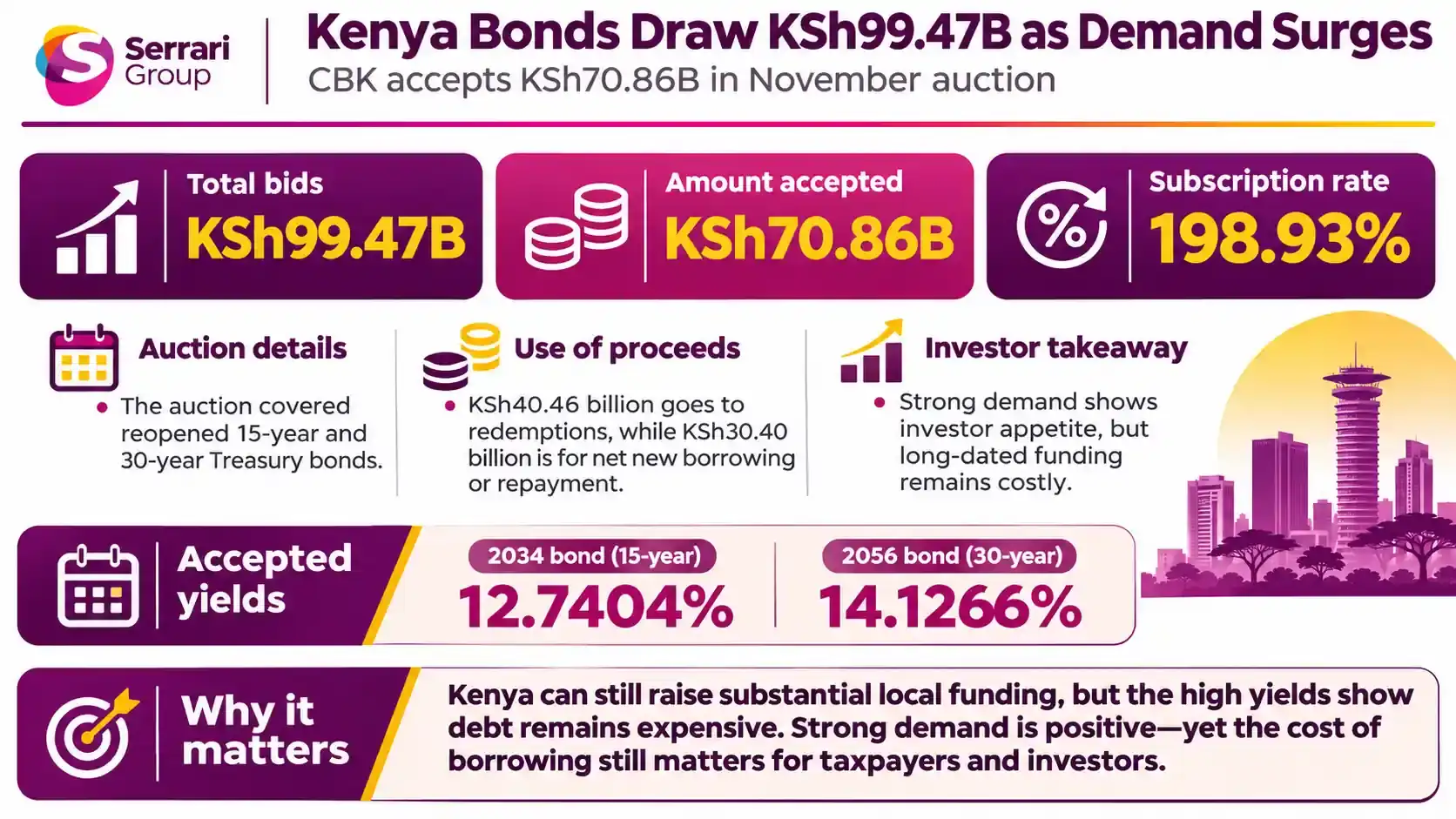
Kenya attracted KSh99.47 billion in bids for two reopened Treasury bonds at a November 4, 2026 auction, almost twice the KSh50 billion initially offered. The Central Bank of Kenya (CBK), acting for the National Treasury, accepted KSh70.86 billion, with investors demanding yields of 12.7404% on a bond maturing in 2034 and 14.1266% on one maturing in 2056. The result suggests substantial demand for government securities, but also exposes the cost of financing Kenya’s budget over long periods.
The decisive issue is what the borrowing achieves. Of the amount accepted, KSh40.46 billion was assigned to redemptions, while KSh30.40 billion represented new borrowing or net repayment in the auction statement. Investors submitted nearly KSh100 billion, but that is not the amount entering government coffers. The auction demonstrates that Kenya can attract domestic funding at prevailing rates while raising questions about interest costs, refinancing pressure, inflation and the availability of credit for businesses.
Key Overview
- Strong demand: Bids totaled KSh99.47 billion against KSh50 billion offered, a subscription rate of 198.93%, not the 268.3% stated in some reports.
- Amount accepted: CBK took KSh70.86 billion, or about 71% of bids submitted, and declined the balance.
- Two maturities: FXD3/2019/015 matures on July 10, 2034; FXD1/2026/030 matures on March 13, 2056.
- Accepted yields: The weighted average rates were 12.7404% and 14.1266%, respectively, above the bonds’ 12.34% and 12.50% coupon rates.
- Where proceeds go: KSh40.46 billion was designated for redemptions and KSh30.40 billion for net new borrowing or repayment.
- Investor implications: A higher yield is not the same as the coupon, and long-maturity bonds carry greater sensitivity to interest-rate changes.
Why Investors Offered Almost Twice the Target
The official auction results show KSh99.467 billion in bids against the KSh50 billion offer. That translates into 198.93% subscription. Strong demand is a meaningful sign that government debt remains attractive at current prices, but oversubscription does not establish that investors believe Kenyan sovereign debt is risk-free.
Treasury bonds offer scheduled coupon payments and a known redemption date, characteristics that can appeal to pension schemes, insurers, banks and individuals investing for future income. For institutions with long-dated obligations, government securities can help match future liabilities. Investors may also be attracted by yields that exceed current inflation, although their eventual real return depends on inflation over the entire holding period, taxation and the price actually paid.
The two securities were reopenings of existing issues rather than entirely new bond series. Reopenings add issuance to an existing line, helping concentrate trading in familiar securities and potentially improving liquidity. The offer terms show that the bonds had approximately 7.8 and 29.5 years remaining to maturity when sold. Their original 15-year and 30-year labels should not be mistaken for the remaining holding period.
Demand also needs interpretation alongside the offered yield. Investors will readily submit substantial bids when they believe the compensation is adequate. The more difficult test for the Treasury is whether it can continue borrowing at affordable rates while financing essential services and maturing debt.
What the Two Bonds Actually Raised
The shorter-dated FXD3/2019/015 attracted KSh37.07 billion in bids, of which CBK accepted KSh29.90 billion. Its subscription rate relative to the combined KSh50 billion offer was recorded as 74.14%. The longer-dated FXD1/2026/030 attracted KSh62.40 billion and secured KSh40.95 billion in accepted bids. Its corresponding performance rate was 124.80%. These bond-specific rates are calculated against the common offer amount and must not be interpreted as two separate KSh50 billion offers.
The 30-year issue accounted for approximately 63% of all bids and roughly 58% of accepted borrowing. That concentration indicates substantial appetite for long-dated paper at a yield above 14%, though the published figures do not identify individual bidders or establish their motivations.
CBK accepted KSh32.18 billion through competitive bidding and KSh38.68 billion from non-competitive bids. For the 2034 bond, non-competitive accepted bids were KSh22.73 billion compared with KSh7.17 billion in competitive bids. For the 2056 issue, accepted competitive bids reached KSh25.01 billion, while non-competitive bids were KSh15.95 billion.
This split matters because competitive investors specify a yield, while non-competitive investors agree to auction pricing without specifying a yield. It should not, however, be used to assume that all non-competitive bidders were individual retail savers: institutions can also participate through permitted channels.
Why CBK Did Not Accept Every Bid
Strong subscription does not require CBK to accept every offer. The government’s objective is to raise funds at a cost it considers acceptable while managing the maturity structure of public debt. Some competitive bids may demand rates above what the issuer is willing to pay, making rejection preferable to locking in more expensive obligations.
The auction’s pricing outcome illustrates that discipline. The market-weighted average bid rate was 12.8717% on the 2034 bond, versus 12.7404% for bids accepted. On the 2056 bond, the market average was 14.1711%, compared with 14.1266% accepted. The difference suggests CBK favored a lower-cost subset of the offers.
Across both bonds, the amount accepted was approximately 71.24% of the total bid value. The combined bid-to-cover measure reported by CBK was 1.40, representing bids received divided by bids accepted. It is a different measure from the 198.93% subscription rate, which uses the amount initially offered as its denominator. Confusing these metrics can make investor demand appear stronger or weaker than it was.
Accepting KSh70.86 billion against an initial KSh50 billion target also illustrates a trade-off: the Treasury can take advantage of abundant bids to secure more financing now, but it commits future budgets to service the additional debt.
Context is everything. Stay ahead of shifting trends with today’s market updates, and uncover emerging opportunities using the Serrari Group Market Index and Marketplace. Then, take control of your own financial future by exploring our Money & Life Reset Transformation Blueprint ™ to build stronger habits, create better systems, and design a path toward lasting wealth.
Why a 14.13% Yield Is Not a 14.13% Coupon
One of the most important details for investors is the difference between the coupon rate and yield to maturity. The 2034 bond carries a 12.34% annual coupon and the 2056 bond a 12.50% annual coupon, paid on the prescribed schedule. The accepted weighted average yields of 12.7404% and 14.1266% incorporate the prices at which the securities were allocated and the remaining payments to maturity.
A bond trading below face value can offer a yield higher than its coupon because an investor may receive both coupon income and a gain if the bond is redeemed at face value. That is particularly relevant to the long-dated issue. CBK’s auction results reported a price of KSh89.3921 per KSh100 at the average yield for the 2056 bond, compared with KSh101.8243 per KSh100 for the 2034 security. These are published auction pricing figures, not a guarantee of the price available to every future buyer.
Investors must also distinguish the clean price from the cash settlement amount, which may include accrued interest. Tax treatment changes net cash receipts. The bond prospectus specifies a 10% withholding tax for these issues.
An investor buying at auction and holding until maturity may experience a return close to the yield implied by the purchase price, subject to assumptions about coupon reinvestment and cash flows. Someone selling before maturity can realize a capital gain or loss because bond prices move when market interest rates change. The 2056 bond is especially exposed to that risk because its payments extend almost three decades into the future.
The Bigger Fiscal Story: Refinancing Versus New Money
Of the KSh70.86 billion accepted, KSh40.46 billion was assigned to redemptions and KSh30.40 billion to new borrowing or net repayment, according to the auction notice. The division explains why a headline celebrating KSh70 billion raised does not translate into an equal amount of additional budgetary resources. A substantial portion addresses debt coming due.
Refinancing old obligations is a normal part of public debt management. A government may issue new bonds to repay maturing securities, avoiding the need to fund every redemption from current tax collections. Extending maturities can smooth repayment demands, but it may also raise future interest expenditure if new borrowing carries higher rates than the debt being replaced.
This is why the terms matter as much as demand. Locking in funding until 2056 reduces near-term rollover pressure on that portion of borrowing, yet it means coupon payments continue for decades. A government may rationally prefer longer maturities for stability, but the cost must be evaluated against competing needs for public investment and essential services.
More broadly, sustained government borrowing can affect private credit markets. Banks buying large quantities of government bonds may have fewer incentives to extend riskier business loans, especially when sovereign yields are attractive. This is not automatic: banks’ lending depends on capital, deposit funding, borrower quality and overall loan demand. Still, heavy public borrowing can create competition for domestic savings, with consequences for enterprises seeking expansion capital.
What This Means for Kenyan Savers and Investors
The auction shows why government securities remain relevant to income-focused portfolios. Investors can choose maturities that correspond with future financial needs, seek regular coupons and diversify away from deposits or other instruments. However, choosing the highest quoted yield without considering duration, purchase price, tax and liquidity can be costly.
The 2034 bond has a much shorter remaining life than the 2056 issue. A person planning to fund education costs or a property purchase within the next decade may view the maturities differently from a pension scheme investing for liabilities several decades away. The longer bond could generate larger price gains if market yields fall, but it could also experience sharper losses if yields rise.
The DhowCSD bidding instructions explain how investors participate directly through the mobile application or investor portal. The offer required at least KSh50,000 for non-competitive bids, with a maximum of KSh50 million, while competitive bids required at least KSh2 million per CSD account per tenor. Non-competitive bidders do not select the yield themselves.
Successful bidders must also fund their allocations within the applicable settlement timetable. For these issues, settlement is scheduled for November 9, 2026, and the published offer notice gives instructions on retrieving payment information. Investors unable to hold to maturity should consider the availability and pricing of secondary-market buyers rather than assume they can always exit at face value.
Why the Next Auctions Matter
One successful auction does not settle the debate over Kenya’s debt sustainability. Future outcomes will reveal whether investors continue to offer funds at similar or lower yields, whether demand remains concentrated in long maturities, and how much new borrowing the government needs after refinancing existing securities.
The wider economic setting will matter. Inflation changes the purchasing power of coupons, monetary policy affects the opportunity cost of holding bonds, and fiscal revenue performance influences how much debt the government must issue. If yields fall, the Treasury may be able to refinance more cheaply, while existing bondholders could benefit from price increases. If yields rise, new investors might earn more income, but existing longer-dated bond prices could decline and government financing costs could increase.
The central lesson of the November 4 auction is therefore not merely that investors offered almost KSh100 billion. It is that Kenya attracted substantial financing at a meaningful price, rejected part of the demand and used much of the accepted amount to manage existing obligations. For taxpayers, the question is whether borrowing remains affordable and supports productive public spending. For savers, it is whether the advertised yield fits their time horizon and risk tolerance. Those questions will outlast the headline subscription figure.
Sources: Central Bank of Kenya / The News Booth / The Kenya Times / Kenyan Mirror
Your financial future isn’t something you wait for—it’s something you build.
The real question is: when do you begin?
Move beyond simply staying informed.
Navigate the markets with clarity—track trends through the Serrari Group Market Index, uncover opportunities in the Serrari Marketplace, and build practical knowledge with our Curated Wealth Builder Platform.
Stay connected to what truly matters.
Get daily insights on macro trends and financial movements across Kenya, Africa, and global markets—delivered through the Serrari Newsletter.
Growth opens doors.
Advance your career through professional programs including ACCA, HESI A2, ATI TEAS 7 , HESI EXIT , NCLEX – RN and NCLEX – PN, Financial Literacy!🌟—designed to move you forward with confidence.
See where money is flowing—clearly and in real time.
Track Money Market Funds, Treasury Bills, Treasury Bonds, Green Bonds, and Fixed Deposits, alongside global and African indexes, key economic indicators, and the evolving Crypto and stablecoin landscape—all within Serrari’s Market Index.