Zimbabwe — Africa’s largest lithium producer — has spelled out the conditions under which it will lift the sweeping export suspension it imposed on February 26, 2026, on lithium concentrates and other unprocessed minerals. In an April 2 letter from the Ministry of Mines and Mining Development to the country’s Chamber of Mines, the government said it will introduce individual export quotas for each producer, continue to charge a 10% export tax on lithium concentrates, and require miners to provide written commitments to build lithium sulphate processing plants before January 1, 2027 — the date a full ban on concentrate shipments comes into force. Producers will also have to publish annual financial statements, set up safety, health and environment departments, and install assay laboratories at every mine within three months. The framework is the most concrete signal yet that Harare is trying to convert its raw-mineral leverage into domestic value-added processing capacity, putting Chinese mining giants — which dominate the country’s lithium sector — on a tighter timeline to industrialise their operations.
Markets move fast; don’t get left behind. We’ve paired the Serrari Group Market Index with a curated Marketplace and a comprehensive Wealth Builder Course to ensure you have the data—and the skills—to act on it.
Key Overview
- Country: Zimbabwe (Africa’s top lithium producer)
- Issuing authority: Ministry of Mines and Mining Development (Minister Polite Kambamura)
- Letter date: April 2, 2026
- Original suspension date: February 26, 2026
- Conditions for resumption:
- Individual lithium concentrate export quotas per producer
- 10% export tax on lithium concentrates (continues until full ban)
- Mandatory written commitment to build lithium sulphate plants before January 1, 2027
- Mandatory publication of annual financial statements
- Compliance with labour, safety and environmental standards
- Assay laboratories at each mine within 3 months
- Safety, Health and Environment (SHE) departments at each mine
- Monthly progress reports through a ministerial committee
- Hard cutoff: Full ban on lithium concentrate exports takes effect January 1, 2027
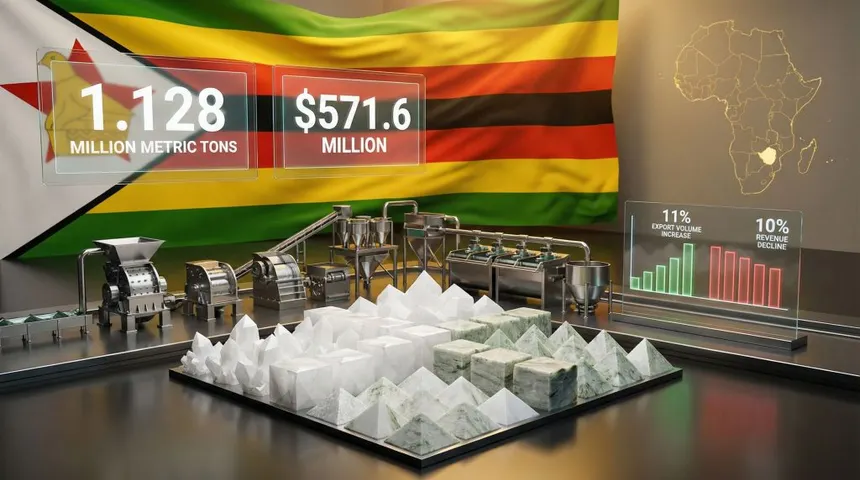
- 2025 exports: 1.128 million metric tons of lithium-bearing spodumene concentrate (up 11% YoY)
- Share of China’s lithium concentrate imports (2025): ~15%
- Key Chinese players: Zhejiang Huayou Cobalt, Sinomine, Chengxin Lithium, Yahua, Tsingshan
- Existing processing plant: Huayou’s $400 million lithium sulphate facility
- Announced future investment: Sinomine $500 million lithium sulphate plant at Bikita
A Framework Letter, Not Yet a Reopening
The April 2 letter from Mines Minister Polite Kambamura — addressed to the Chamber of Mines and copied to all lithium companies — does not, in itself, lift Zimbabwe’s lithium concentrate export suspension. What it does is set out the menu of obligations producers must accept before the government issues approvals to ship again. The letter, seen by Reuters and reported on April 8, makes clear that “approved lithium concentrate export quotas will be communicated to each producer,” meaning every mine will receive an individual ceiling on what it can ship.
Mining Zimbabwe published the full text of the ministerial letter, which adds significant operational detail beyond what was carried in the wire reports. According to the publication, Kambamura’s letter requires producers to commit in writing to monthly progress reports through a committee to be set up by the Minister, to set up assay laboratories at each producing mine within three months of the date of the letter, and to establish Safety, Health and Environment (SHE) departments at each mine to address work-related accidents and environmental issues. The letter also notes that “new/future investments in the lithium sector will have the conditions applied on a case-by-case basis.”
The structure of the framework — quotas plus tax plus plant commitments plus reporting — is recognisable as a textbook beneficiation push. Mining publication Miningmx, summarising the development, noted that Zimbabwe will require producers to commit to local processing facilities before it lifts the suspension on unprocessed mineral exports, with individual export quotas to be communicated to each producer.
A 10% export tax on lithium concentrates will, in the meantime, continue to be levied — and crucially, it will continue only until the full ban on concentrate shipments takes effect on January 1, 2027. The economic logic is straightforward: producers are being given a narrow window to ship under quota, paying tax, while simultaneously committing capital to build the downstream processing facilities that will make those exports unnecessary by the time the deadline arrives.
Why the Ban Was Imposed in the First Place
The April 2 framework only makes sense in the context of the original February 26 suspension, which itself came after years of escalating Zimbabwean policy on raw mineral exports. As Al Jazeera reported at the time, Zimbabwe’s mines ministry imposed an immediate ban on exports of all raw minerals and lithium concentrates in late February, after the government alleged “malpractices and leakages” in the exportation of minerals.
The original ministerial letter, which was dated February 17 and addressed to the Chamber of Mines, said Zimbabwe would “realign export processes” due to concerns about “continued malpractices during the exportation of minerals” and described the review as “part of a broader effort to curb leakages and enhance efficiency within our systems.”
The export ban on lithium concentrates had originally been scheduled to come into effect in January 2027 — a deadline the government hoped would push mining companies to begin processing and refining the mineral locally. The February 26 announcement effectively pulled that deadline forward by about 10 months. According to a Boston University Global Development Policy Center analysis, the immediate ban came after investigations revealed stockpiles of mineral ores at the Port of Beira in Mozambique — a finding that confirmed the government’s longstanding concerns that loopholes in earlier restrictions were allowing raw ore to continue flowing abroad.
The Center’s report noted that “the sudden announcement of the lithium concentrate export ban underscores the fragmented nature of mineral governance in Zimbabwe,” with ambitious policy signals not yet matched by an integrated strategy for industrial development, infrastructure expansion or regulatory enforcement.
Context is everything. While you follow today’s updates, use the Serrari Group Market Index and Marketplace to spot emerging shifts. Need to sharpen your edge? Our Wealth Builder Course turns these insights into a professional-grade strategy.
Africa’s Top Lithium Producer, China’s Top African Supplier
The stakes are high because Zimbabwe is by some distance Africa’s most important lithium producer, and by an even larger margin, the most strategically important non-Australian source of spodumene concentrate for Chinese refineries. According to figures cited by MINING.com, the country exported 1.128 million metric tons of lithium-bearing spodumene concentrate in the year ended December 2025, up 11% from the year before.
Most of that material flows to China. According to commodity research firm SunSirs, over 90% of Zimbabwe’s lithium concentrate is exported to China, where in 2025 it accounted for between 15.5% and 19% of China’s total lithium concentrate imports — second only to Australia. The Chinese end of the supply chain is dominated by the same vertically integrated lithium giants that own the Zimbabwean mines: Zhejiang Huayou Cobalt, Sinomine Resource Group, Chengxin Lithium, Yahua and Tsingshan Holding Group.
Boston University’s research found that Chinese private companies have invested over $1 billion in acquiring and developing lithium projects in Zimbabwe since 2021, and noted that across all currently operating lithium mines in Zimbabwe, there is significant Chinese involvement in all six. Chinese companies are responsible for approximately 60% of the world’s lithium refining capacity and 70% of lithium-ion battery production, according to the same analysis, and Zimbabwe has emerged as a critical upstream node in that supply chain.
The result is that Zimbabwe’s beneficiation push is, in practice, a negotiation between the Zimbabwean government and a small number of large Chinese state-affiliated and private mining groups. The terms set out in the April 2 letter — quotas, taxes, plant commitments, reporting — are the levers through which Harare is trying to extract more value from a relationship in which the physical product flow has historically gone almost entirely in one direction.
The Processing Race: Sulphate Plants on the Clock
The most significant requirement in the April 2 framework is the demand for written commitments on dedicated timelines to set up lithium sulphate plants before January 1, 2027. Lithium sulphate is an intermediate product that can be refined into battery-grade lithium hydroxide or lithium carbonate, and building a sulphate plant locally captures a meaningful share of the value chain that has historically been exported alongside the concentrate.
Some Chinese operators are already well advanced. Huayou Cobalt has recently built a $400 million plant to further process lithium concentrates into lithium sulphate at its Arcadia mine. According to Fastmarkets, Huayou Cobalt commissioned the Zimbabwean lithium sulfate plant in October 2025 with a designed capacity of 50,000 tonnes per year. Sinomine has announced plans for a $500 million lithium sulphate plant at its Bikita mine, and Yahua has signalled similar investments at Kamativi.
But not every operator is at the same stage. As MINING.com reported in early March, Fitch’s BMI unit observed that Zimbabwe’s first major lithium processing facility — Huayou’s plant — would only have the capacity to process lithium concentrates produced at the company’s own Arcadia mine. As a result, other miners without access to processing are likely to opt to temporarily scale back production, the firm said. BMI revised down its 2026 Zimbabwe mine production forecast to 131,100 tonnes in lithium carbonate equivalent, with growth expected to resume in 2027 as additional processing capacity comes online — including the planned sulphate plants at Sinomine’s Bikita mine and at the state-owned Kamativi mine.
The infrastructure challenge is non-trivial. As African Mining Online noted in a March analysis, transitioning from a concentrate plant to a full-scale chemical conversion facility is not a marginal upgrade — it requires a leap in capital expenditure, complex metallurgical engineering, and “massive amounts of reliable baseload power.” The publication pointed out that Zimbabwe’s energy grid is hydro-dominant and climate-exposed, with the Kariba Dam — which supplies the bulk of the nation’s electricity — subject to chronic low water levels and recurrent load shedding.
This is the practical constraint that hangs over the entire beneficiation strategy: even with willing investors and a clear regulatory framework, Zimbabwe’s ability to operate large-scale chemical conversion plants depends on power infrastructure that does not yet reliably exist.
A Page from the Indonesia Playbook — and the Platinum Cautionary Tale
Zimbabwe’s lithium framework borrows visibly from the Indonesia nickel model, in which Jakarta banned raw nickel exports in 2020 and forced foreign investors — overwhelmingly Chinese — to build domestic smelters. As SunSirs noted in its analysis, Zimbabwe’s policy goal is explicitly to follow Indonesia’s nickel mine model by promoting the completion of mineral processing and deep processing of lithium mines locally rather than overseas.
But Zimbabwe also has a less encouraging precedent of its own. African Mining Online noted that for industry veterans, the current lithium standoff feels distinctly like “déjà vu” of Zimbabwe’s long-standing tug-of-war with its Platinum Group Metals (PGM) sector. Over the last decade, the Zimbabwean government repeatedly threatened to ban or heavily tax the export of raw platinum and PGM concentrates, with the goal of forcing operators like Zimplats, Mimosa and Unki (now operating under Valterra Platinum) to build domestic refineries. In practice, the publication noted, the platinum precedent serves as a stark warning: “decrees and export bans do not automatically spawn heavy infrastructure. They often result in compromised cash flows, stalled investments, and grudging, partial compliance that falls short of the government’s ultimate industrialisation goals.”
Compounding the complexity is the central bank’s foreign currency retention rule, which forces exporters to surrender 30% of their US dollar earnings in exchange for the local currency. The publication reported that as of early 2026, the Zimbabwean government reportedly owed Valterra Platinum over $100 million in unpaid export proceeds due to sovereign cash flow constraints — a precedent that lithium investors are likely watching closely as they decide how much capital to commit to new sulphate plants.
What the Quota Reopening Means for the Global Market
The most immediate question for global lithium markets is how big the quotas will be. The original February ban sent shockwaves through battery supply chains, with the most-traded lithium carbonate contract on the Guangzhou Futures Exchange rising more than 6% on the day after the announcement, according to Reuters reporting carried by IOL.
Fitch’s BMI raised its 2026 Chinese lithium price forecasts in response to the ban, expecting lithium carbonate and hydroxide monohydrate prices to average $13,500/tonne and $13,000/tonne respectively, as the market moves to rebalance from a protracted period of oversupply. The unit characterised Zimbabwe’s ban as a “temporary dent” rather than a long-term structural shock, in part because Chinese operators had been preparing for the originally scheduled 2027 deadline and had already deployed processing capacity — but the early ban still tightens the market in the near term.
The April 2 letter introduces a new variable: the quotas themselves. By granting export approvals on a producer-by-producer basis, Zimbabwe retains continuous leverage over the sector. Producers that are slow to commit to local processing, or that fall short on financial transparency, safety standards or environmental compliance, can have their quotas restricted or withheld. The framework essentially converts what would have been a binary ban-or-no-ban regime into a granular, ongoing negotiation between the ministry and each individual operator.
For Chinese buyers of Zimbabwean concentrate, the practical effect is that supply will resume — but at lower volumes and with more conditions attached, and only until January 1, 2027, when concentrate shipments will be banned outright. After that, the only way to extract value from Zimbabwean lithium will be to ship lithium sulphate or higher-value products, which is precisely the outcome the Zimbabwean government wants.
The Test Now Is Implementation
As Boston University’s analysts noted, the February 2026 export ban marks an “inflection point” for Zimbabwe’s lithium mining sector. Whether the country actually captures more value — and whether the framework holds together politically and operationally — will depend less on the elegance of the April 2 letter than on the harder question of whether Zimbabwe can deliver the infrastructure, governance and regulatory enforcement needed to make the policy work.
The next few months will be revealing. Producers will need to negotiate their individual quotas, decide whether to commit to lithium sulphate plant construction, and begin meeting the new disclosure and compliance requirements. The Chamber of Mines, which did not immediately respond to media requests for comment, will be central to translating the ministerial letter into operational reality.
For now, what is clear is that Zimbabwe has chosen a middle path between the absolute ban it imposed in February and the full reopening that miners had hoped for. Quotas, taxes and binding commitments to local processing form the structure of that middle path. Whether it leads to the industrial transformation Harare is aiming for, or to the kind of grudging partial compliance that has characterised the platinum sector, will be the story of the next two years in African mining.
Your financial future isn’t something you wait for—it’s something you build.
The real question is: when do you begin?
Move beyond simply staying informed.
Navigate the markets with clarity—track trends through the Serrari Group Market Index, uncover opportunities in the Serrari Marketplace, and build practical knowledge with our Curated Wealth Builder Course.
Stay connected to what truly matters.
Get daily insights on macro trends and financial movements across Kenya, Africa, and global markets—delivered through the Serrari Newsletter.
Growth opens doors.
Advance your career through professional programs including ACCA, HESI A2, ATI TEAS 7 , HESI EXIT , NCLEX – RN and NCLEX – PN, Financial Literacy!🌟—designed to move you forward with confidence.
See where money is flowing—clearly and in real time.
Track Money Market Funds, Treasury Bills, Treasury Bonds, Green Bonds, and Fixed Deposits, alongside global and African indexes, key economic indicators, and the evolving Crypto and stablecoin landscape—all within Serrari’s Market Index.