Vietnamese businesses are increasingly adopting circular economy practices as rising production costs, stricter environmental regulations and growing ESG expectations reshape the country’s manufacturing sector. Supported by new government policies and local initiatives, companies are investing in resource efficiency, recycling and sustainable production to strengthen competitiveness while advancing Vietnam’s green growth and net-zero ambitions.
Key Overview
- Vietnamese companies are accelerating circular economy adoption.
- Rising costs and stricter ESG requirements are driving the transition.
- Ho Chi Minh City is expanding eco-industrial parks and recycling initiatives.
- New EPR regulations require producers to recycle products and packaging.
- Circular economy practices are improving competitiveness and supporting green growth.
Vietnamese Businesses Embrace Circular Economy
Vietnamese businesses are rapidly integrating circular economy practices into their operations as they respond to rising production costs, tightening environmental regulations and growing sustainability expectations from international markets.
The transition is reshaping Vietnam’s manufacturing sector, with companies focusing on reducing waste, improving resource efficiency and lowering greenhouse gas emissions to remain competitive in global supply chains.
Experts say the shift is no longer driven solely by environmental concerns but has become an important business strategy that strengthens resilience, reduces costs and creates new market opportunities.
Rising Costs and ESG Expectations Drive Change
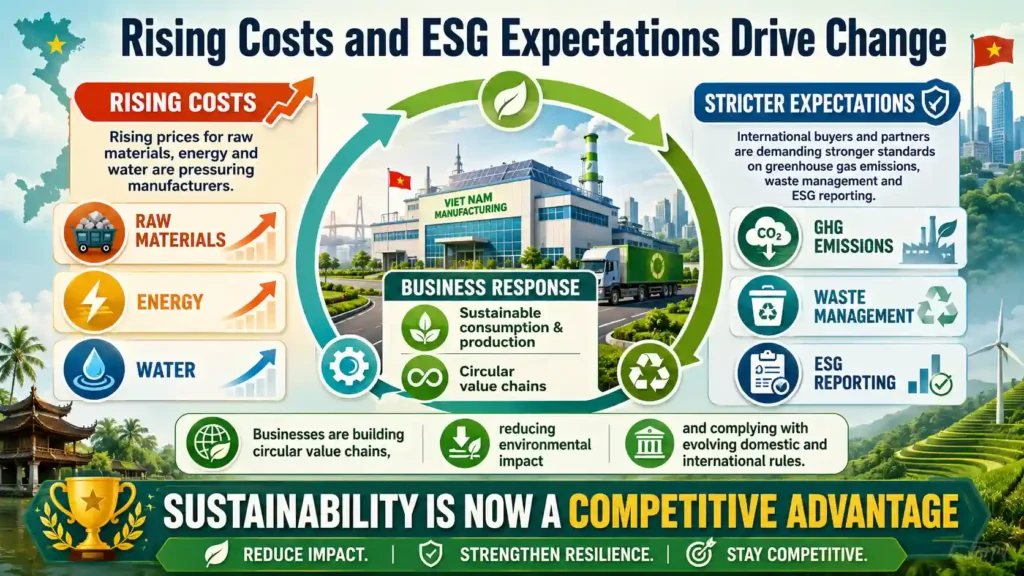
According to Associate Professor Dr. Le Thi Kim Oanh, Dean of the Faculty of Environment at Van Lang University, increasing prices for raw materials, energy and water are placing pressure on manufacturers’ profit margins.
At the same time, international buyers and business partners are introducing stricter requirements on greenhouse gas emissions, waste management and environmental, social and governance (ESG) reporting.
As a result, sustainable consumption and production (SCP) practices are becoming essential for businesses seeking to build circular value chains, reduce environmental impacts and comply with evolving domestic and international regulations.
Companies are increasingly viewing sustainability as a competitive advantage rather than simply a compliance obligation.
Ho Chi Minh City Promotes Eco-Industrial Development
Ho Chi Minh City has made the circular economy a central pillar of its long-term green development strategy.
Authorities are transforming export processing zones and industrial parks into eco-industrial parks, encouraging businesses to share resources, improve energy efficiency and reduce emissions through industrial symbiosis.
Many industrial zones have expanded waste separation at source, increased recycling activities and implemented Extended Producer Responsibility (EPR) programmes aimed at reducing landfill disposal and supporting a zero-waste economy.
Local authorities are also supporting businesses through technology upgrades, workforce training, technical consultancy, access to green finance and trade promotion initiatives.
Businesses Invest in Sustainable Operations
Both multinational and domestic companies are strengthening their sustainability strategies.
HEINEKEN Vietnam, working with the Ministry of Agriculture and Environment, WWF-Vietnam and local partners, has achieved its goal of replenishing 100% of the water used at three breweries located in Tien Giang, Hanoi and Ho Chi Minh City.
The company says collaboration among governments, businesses and communities is essential to addressing environmental and social challenges while creating long-term value.
Meanwhile, domestic manufacturer Rita Vo Group is increasing investment in manufacturing through the expansion of Rita Vo Wood, which produces engineered wood materials.
The company views the investment as part of its strategy to strengthen domestic production, develop proprietary brands and contribute to Vietnam’s sustainable economic development.
Context is everything. Stay ahead of shifting trends with today’s market updates, and uncover emerging opportunities using the Serrari Group Market Index and Marketplace. Then, take control of your own financial future by exploring our Money & Life Reset Transformation Blueprint ™ to build stronger habits, create better systems, and design a path toward lasting wealth.
New Regulations Strengthen Circular Economy
Vietnam has significantly strengthened its legal framework supporting circular economy practices.
The 2020 Law on Environmental Protection established the circular economy as a national development priority, while Decree No 110/2026/ND-CP and Circular No 24/2026/TT-BNNMT have reinforced regulations governing Extended Producer Responsibility.
Under the updated rules, producers and importers must recycle designated products and packaging or contribute financially toward recycling systems for products that are difficult to recover.
Experts believe businesses should view EPR as an opportunity to redesign products, improve material efficiency and strengthen long-term competitiveness instead of treating it solely as a regulatory requirement.
Resource Efficiency Creates Competitive Advantage
Industry experts say businesses should move beyond traditional waste management approaches and instead focus on managing resources more efficiently.
By redesigning products, recovering materials and creating industrial partnerships where waste from one company becomes raw material for another, manufacturers can reduce costs while lowering carbon emissions.
Authorities are also encouraging wider adoption of cleaner production technologies, renewable energy, water recycling, eco-design and digital transformation to improve productivity and sustainability.
These measures are expected to strengthen Vietnam’s manufacturing competitiveness while supporting more resilient supply chains.
Supporting Green Economic Growth
The Department of Industry and Trade in Ho Chi Minh City plans to continue supporting businesses by addressing challenges related to financing, production sites, administrative procedures, market access and input costs.
The department will also promote science, technology and innovation and improve the business environment to enhance productivity and strengthen the city’s long-term economic competitiveness.
As global markets increasingly prioritise sustainable production, Vietnam’s circular economy strategy is expected to help businesses meet international standards while attracting greater levels of green investment.
Outlook
Vietnam’s accelerating adoption of circular economy practices reflects a broader transformation of its industrial sector toward sustainable, resource-efficient growth. With stronger government policies, expanding eco-industrial parks and tighter Extended Producer Responsibility regulations, businesses are increasingly integrating recycling, cleaner production and eco-design into their operations. As international markets continue demanding higher environmental standards, companies that embrace circular business models are likely to improve competitiveness, attract green investment and strengthen supply chain resilience. The continued collaboration between government, industry and financial institutions is expected to play a crucial role in helping Vietnam achieve its long-term goals of net-zero emissions, sustainable industrial development and a more resilient green economy.
FAQs
1. What is driving Vietnam’s shift toward a circular economy?
Rising production costs, stricter environmental regulations, ESG requirements and growing demand for sustainable products are encouraging businesses to adopt circular economy practices.
2. What is Extended Producer Responsibility (EPR)?
EPR requires producers and importers to recycle designated products and packaging or contribute financially toward recycling systems for difficult-to-recycle materials.
3. How is Ho Chi Minh City supporting the transition?
The city is developing eco-industrial parks, expanding recycling initiatives, supporting technology upgrades and improving businesses’ access to green finance and technical assistance.
4. How can circular economy practices benefit businesses?
They help reduce production costs, improve resource efficiency, lower emissions, strengthen compliance with international standards and enhance long-term competitiveness in global markets.
Sources: Vietnam Law and Legal Forum magazine, Vietnamnet global, Vietnam+ (VietnamPlus)
Your financial future isn’t something you wait for—it’s something you build.
The real question is: when do you begin?
Move beyond simply staying informed.
Navigate the markets with clarity—track trends through the Serrari Group Market Index, uncover opportunities in the Serrari Marketplace, and build practical knowledge with our Curated Wealth Builder Platform.
Stay connected to what truly matters.
Get daily insights on macro trends and financial movements across Kenya, Africa, and global markets—delivered through the Serrari Newsletter.
Growth opens doors.
Advance your career through professional programs including ACCA, HESI A2, ATI TEAS 7 , HESI EXIT , NCLEX – RN and NCLEX – PN, Financial Literacy!🌟—designed to move you forward with confidence.
See where money is flowing—clearly and in real time.
Track Money Market Funds, Treasury Bills, Treasury Bonds, Green Bonds, and Fixed Deposits, alongside global and African indexes, key economic indicators, and the evolving Crypto and stablecoin landscape—all within Serrari’s Market Index.