
The US 30-year Treasury yield is hovering around 5.26%, testing levels not seen since 2007 as investors demand greater compensation for holding long-term U.S. government debt. The increase comes as annual federal interest payments reach approximately $1.25 trillion, equivalent to about 3.15% of GDP and the highest share since 1991. Despite weaker employment data reducing expectations for Federal Reserve tightening, long-term Treasury yields remain elevated, highlighting concerns over inflation, persistent fiscal deficits and Washington’s growing borrowing requirements.
Key Overview
The widening gap between short- and long-term US Treasury bonds is becoming an important signal for financial markets. The two-year Treasury yield remains around 4.2%, while the 30-year yield is near 5.3%. This suggests pressure on long-term borrowing costs extends beyond Federal Reserve policy expectations, with investors increasingly focused on inflation, Treasury debt supply and rising debt servicing costs.
US 30-Year Treasury Yield Tests 2007 Levels
The US 30-year Treasury yield is hovering around 5.26%, placing America’s longest benchmark government bond near levels last experienced almost two decades ago.
The 10-year Treasury yield is also elevated at approximately 4.65%, while the two-year yield remains near 4.2%.
Normally, weaker economic data would push Treasury yields lower as investors anticipate easier monetary policy. However, that relationship is currently being tested.
The July employment report showed payrolls declining by 23,000, reducing expectations that the Federal Reserve will raise rates again in September. Traders cut the probability of a September rate increase to roughly 44% from 67% a week earlier.
Despite that shift, long-term yields remain stubbornly high, suggesting investors are increasingly pricing longer-term inflation and fiscal risks into the bond market.
$1.25 Trillion Interest Bill Raises Fiscal Concerns
The consequences of elevated yields are becoming increasingly visible in federal finances.
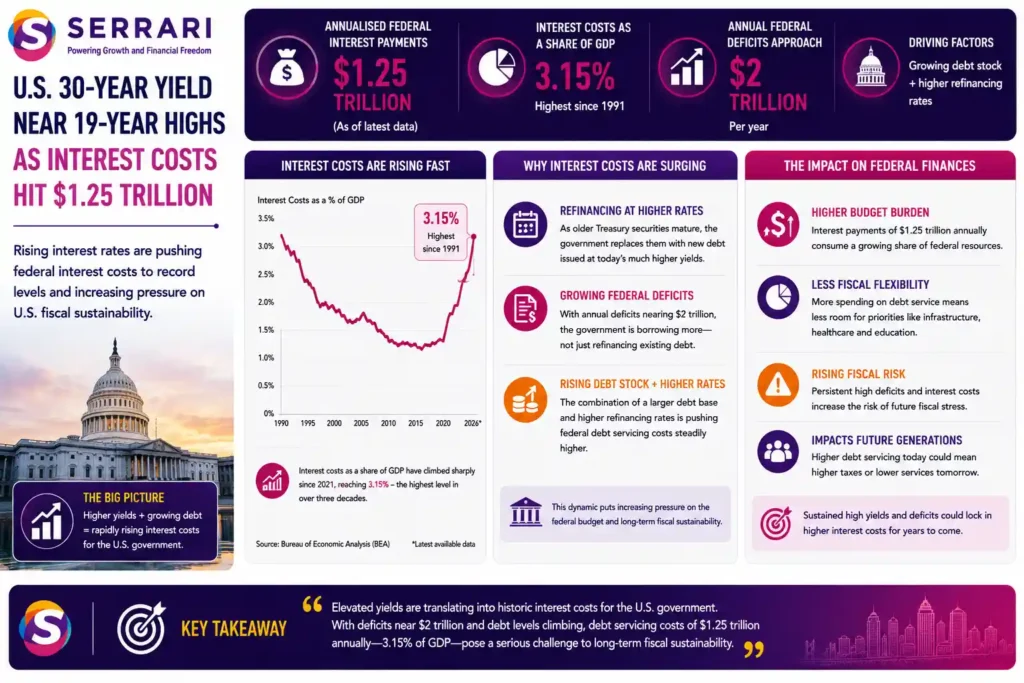
Annualised federal interest payments have reached approximately $1.25 trillion, according to Bureau of Economic Analysis data. Interest costs now represent around 3.15% of U.S. GDP, their highest share since 1991.
The increase has accelerated since 2021 as interest rates moved away from historically low levels.
The mechanism is straightforward. When older Treasury securities mature, Washington frequently needs to replace them with new debt. Bonds originally issued at low interest rates are therefore gradually being refinanced at today’s significantly higher yields.
At the same time, annual federal deficits are approaching $2 trillion, meaning the government is not simply refinancing existing obligations but adding more government debt.
The combination of a growing debt stock and higher refinancing rates is pushing federal debt servicing costs upward.
Long-Term Yields Diverge From Fed Expectations
The difference between shorter and longer Treasury yields provides another indication that fiscal concerns are influencing the market.
The two-year Treasury yield, which is particularly sensitive to expectations for Federal Reserve policy, remains around 4.2%. The US 30-year Treasury yield, meanwhile, is approaching 5.3%.
That widening gap suggests investors want additional compensation for committing money to U.S. government securities for several decades.
Those risks include future inflation, continued federal deficits, rising Treasury issuance and uncertainty about the purchasing power of future fixed-interest payments.
Even if the Federal Reserve eventually reduces short-term interest rates, long-term Treasury yields do not necessarily have to decline by the same amount. Persistent inflation or fiscal concerns could keep longer-term borrowing costs elevated.
Bond Investors Question Inflation Outlook
Inflation remains central to the debate.
Veteran investor Ed Yardeni has argued that the weak July employment report has not materially changed the scenario reflected in long-term yields because markets continue to see inflation remaining above the Federal Reserve’s 2% target.
The concern is that so-called “bond vigilantes” could push yields higher if investors believe monetary policy is becoming too accommodative before inflation has been brought under control.
Higher inflation reduces the real value of fixed payments received from bonds. Investors therefore generally demand higher nominal yields when they expect inflation to remain persistent.
This makes Federal Reserve credibility particularly important for the long end of the Treasury market.
Treasury Signals Possible Changes to Bond Auctions
The Treasury Department has also attracted attention after changing language in its quarterly debt guidance.
Previous guidance referred to “potential future increases” in auction sizes. The wording was subsequently changed to “potential future changes,” which some bond investors interpreted as opening the door to smaller long-term bond auctions.
A BMO Capital Markets survey showed that 61% of clients expect the next 30-year auction size to shrink rather than expand.
Reducing long-bond issuance could relieve some supply pressure on the market, but it would not eliminate Washington’s financing requirements.
If fewer long-term bonds are issued, more borrowing may need to be concentrated in Treasury bills or shorter-maturity securities unless the US fiscal deficit declines.
Context is everything. Stay ahead of shifting trends with today’s market updates, and uncover emerging opportunities using the Serrari Group Market Index and Marketplace. Then, take control of your own financial future by exploring our Money & Life Reset Transformation Blueprint ™ to build stronger habits, create better systems, and design a path toward lasting wealth.
Long-Duration Treasury Investors Face Losses
Rising long-term interest rates are also creating significant losses for investors holding existing long-duration bonds.
Bond prices and yields move in opposite directions. When market yields rise, older securities offering lower coupons become less attractive and their prices decline.
The iShares 20+ Year Treasury Bond ETF, commonly used to track long-duration U.S. government bonds, is testing multi-decade support and could approach its lowest levels since 2003 if the sell-off continues.
The decline illustrates that while Treasury securities carry extremely low credit risk, long-duration government bonds can still experience significant market losses when interest rates rise sharply.
Bessent Faces Challenge of Lowering Borrowing Costs
Treasury Secretary Scott Bessent has previously described Treasury yields as an important measure of economic and fiscal success, with the administration seeking lower long-term borrowing costs through spending restraint and reduced inflation.
However, the 10-year yield currently sits near 4.65%, higher than when President Donald Trump’s second term began.
That creates a difficult challenge for Washington.
The Treasury must finance substantial deficits while attempting to avoid overwhelming markets with new supply. Investors ultimately determine what yield they require to hold that debt.
Debt-management decisions can influence the maturity composition of federal borrowing, but they cannot eliminate the underlying financing requirement created by persistent deficits.
Higher Treasury Yields Affect the Wider Economy
The Treasury sell-off has implications beyond the federal government’s finances because Treasury yields serve as benchmarks for borrowing costs throughout the economy.
Mortgage rates, corporate bonds and other forms of financing are influenced by government bond yields.
Persistently high long-term Treasury rates can therefore increase borrowing costs for households and businesses even if the Federal Reserve eventually lowers short-term rates.
Higher government interest costs can also contribute to larger fiscal deficits, requiring additional federal borrowing and potentially creating further pressure on Treasury markets.
Outlook for the US 30-Year Treasury Yield
The US 30-year Treasury yield approaching 5.3% reflects more than expectations for the next Federal Reserve decision. It represents a combination of inflation uncertainty, enormous federal borrowing requirements and concerns about the long-term trajectory of U.S. finances.
Weak employment data has reduced expectations for further monetary tightening, yet long-term yields remain elevated. That divergence suggests fiscal considerations are playing an increasingly important role in Treasury pricing.
With annual federal interest payments already running near $1.25 trillion, Washington has a strong incentive to contain borrowing costs.
Ultimately, the direction of the bond market will depend heavily on whether inflation returns sustainably toward the Federal Reserve’s 2% target and whether investors gain confidence that federal deficits can be controlled.
FAQs
Why is the US 30-year Treasury yield so high?
The US 30-year Treasury yield is elevated because investors are demanding greater compensation for inflation risk, heavy government borrowing, fiscal deficits and uncertainty surrounding long-term monetary policy.
How much is the U.S. government paying in interest?
Annualised federal interest payments have reached approximately $1.25 trillion, equivalent to around 3.15% of U.S. GDP.
Why haven’t weak jobs data pushed Treasury yields sharply lower?
Long-term yields depend on more than Federal Reserve expectations. Inflation, government borrowing and Treasury supply can keep yields elevated even when expectations for short-term rates decline.
What happens if 30-year Treasury yields keep rising?
Further increases could raise federal borrowing costs, reduce long-duration bond prices and contribute to higher mortgage and corporate financing costs across the U.S. economy.
Your financial future isn’t something you wait for—it’s something you build.
The real question is: when do you begin?
Move beyond simply staying informed.
Navigate the markets with clarity—track trends through the Serrari Group Market Index, uncover opportunities in the Serrari Marketplace, and build practical knowledge with our Curated Wealth Builder Platform.
Stay connected to what truly matters.
Get daily insights on macro trends and financial movements across Kenya, Africa, and global markets—delivered through the Serrari Newsletter.
Growth opens doors.
Advance your career through professional programs including ACCA, HESI A2, ATI TEAS 7 , HESI EXIT , NCLEX – RN and NCLEX – PN, Financial Literacy!🌟—designed to move you forward with confidence.
See where money is flowing—clearly and in real time.
Track Money Market Funds, Treasury Bills, Treasury Bonds, Green Bonds, and Fixed Deposits, alongside global and African indexes, key economic indicators, and the evolving Crypto and stablecoin landscape—all within Serrari’s Market Index.