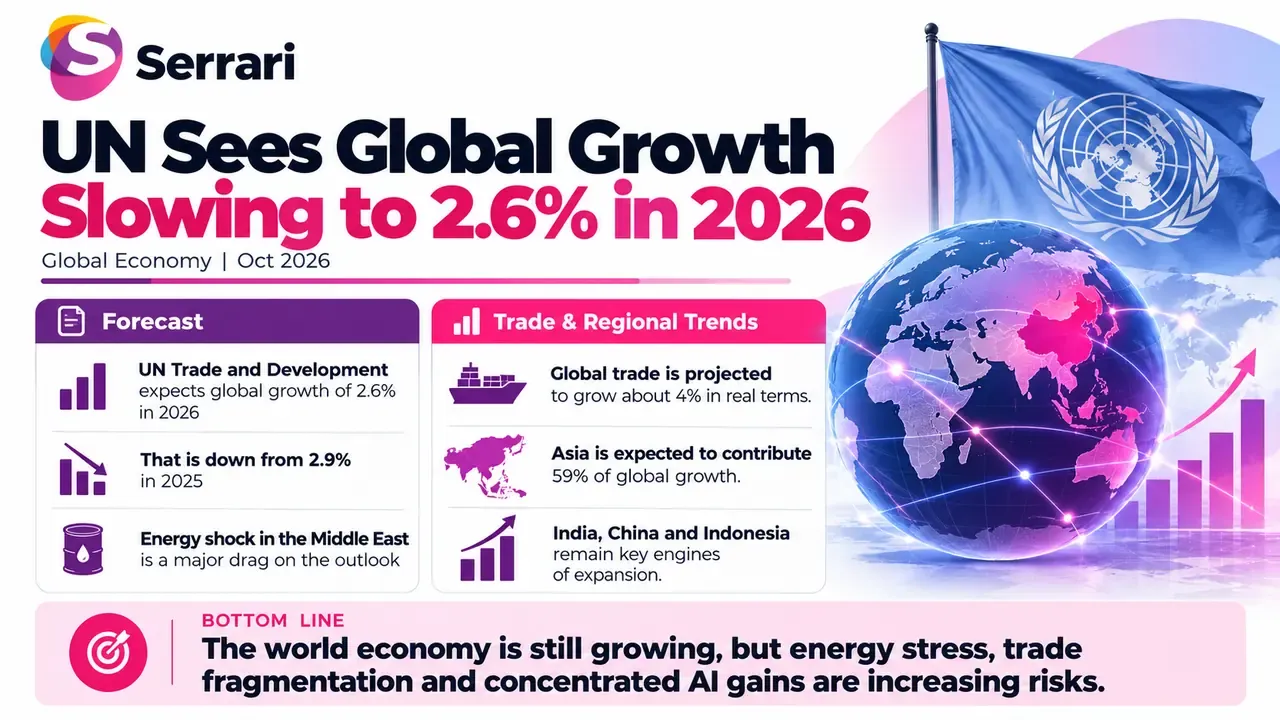
The world economy is expected to grow by just 2.6% in 2026, slowing from 2.9% in 2025 as the Middle East energy shock, trade restrictions and financial uncertainty weigh on activity. The October 9 global development report from UN Trade and Development (UNCTAD) projects continued expansion in world trade but warns that the benefits of new technologies and investment are becoming increasingly concentrated. Asia is set to account for most of the world’s economic growth, while many developing economies face tighter financing and more difficult routes into advanced industries.
Key Overview
- Global economic growth is projected to ease to 2.6% in 2026, from 2.9% in 2025.
- Asia is expected to generate 59% of worldwide growth, led by strong expansion across major Asian economies.
- Trade in goods and services is forecast to increase by approximately 4% in real terms, even as higher energy prices also lift trade values.
- Direct trade between China and the United States has fallen by more than 20% since 2024, reflecting shifting commercial relationships.
- Artificial intelligence is driving technology trade, but economic gains and financial exposures are concentrated among relatively few firms and countries.
Energy Shock Weakens the Global Outlook
The 2026 economic assessment identifies the Middle East conflict as a major test of global resilience. Brent crude rose from around $70 to more than $110 a barrel in the weeks following the outbreak of hostilities, increasing costs for transport, production and energy imports.
Import-dependent economies face particular pressure because higher fuel bills can worsen inflation, weaken external balances and reduce households’ spending power. The agency expects growth across developing economies to slow from 4.7% in 2025 to 4.0% in 2026, even as conditions differ substantially between energy exporters and importers.
Financial risks are also building. UNCTAD reports that capital-flow volatility has doubled since the conflict began, while official development assistance is projected to fall by almost 7% this year. These pressures can limit the resources available for infrastructure, job creation and other development priorities.
Asia Accounts for Most of the World’s Expansion
Asia is forecast to contribute 59% of global economic growth in 2026, according to the regional projections released with the report. India is expected to expand by 7.3%, China by 4.5% and Indonesia by 5.2%. Vietnam, Uzbekistan and other Asian economies are also projected to record relatively rapid growth.
Strong demand for semiconductors, servers and other advanced computing products has reinforced East Asia’s position in global manufacturing. However, the report warns that economies without comparable technological capabilities may struggle to benefit from this investment cycle.
Context is everything. Stay ahead of shifting trends with today’s market updates, and uncover emerging opportunities using the Serrari Group Market Index and Marketplace. Then, take control of your own financial future by exploring our Money & Life Reset Transformation Blueprint ™ to build stronger habits, create better systems, and design a path toward lasting wealth.
Trade Grows, but Fragmentation Creates Barriers
World trade reached a record $35 trillion in 2025, and trade in goods and services is projected to grow about 4% at constant prices in 2026. That real growth figure measures activity after adjusting for price changes; it should not be confused with the rise in trade measured in dollars, which is also being pushed up by higher energy prices.
Meanwhile, changing trade relationships are reshaping supply chains. Direct China–US trade has contracted by more than one-fifth since 2024, although East Asian economies have expanded trade with both partners. Export controls, investment screening and tighter technology requirements can make advanced sectors harder for new exporters to enter.
AI Investment Brings Growth and Concentration Risks
Artificial intelligence remains a major source of demand for merchandise trade, especially advanced chips and computing equipment. But the analysis of technology value chains finds that value is unevenly distributed. In one advanced AI server-rack case study, post-tax profits account for 68% of traced value added, while workers receive less than 15%.
UNCTAD also cautions that financial markets are increasingly exposed to a small group of companies associated with the AI boom. Strong investment may support growth, but a change in earnings expectations could expose investors to a sharp reassessment of valuations.
How Other Global Forecasts Compare
The World Bank’s June outlook projected 2.5% global growth in 2026, with a downside scenario of just 1.3% if energy disruptions intensified alongside financial stress. The IMF’s July forecast was somewhat stronger at 3.0%, reflecting different assumptions and forecast methods.
Across these assessments, the central challenge remains similar: preserving economic activity while limiting exposure to energy disruptions, trade fragmentation and concentrated technology investment. UNCTAD recommends diversifying energy supply, strengthening regional trade links and developing local industries capable of capturing more value from international commerce.
Sources: UN Trade and Development / World Bank / International Monetary Fund / Reuters
Your financial future isn’t something you wait for—it’s something you build.
The real question is: when do you begin?
Move beyond simply staying informed.
Navigate the markets with clarity—track trends through the Serrari Group Market Index, uncover opportunities in the Serrari Marketplace, and build practical knowledge with our Curated Wealth Builder Platform.
Stay connected to what truly matters.
Get daily insights on macro trends and financial movements across Kenya, Africa, and global markets—delivered through the Serrari Newsletter.
Growth opens doors.
Advance your career through professional programs including ACCA, HESI A2, ATI TEAS 7 , HESI EXIT , NCLEX – RN and NCLEX – PN, Financial Literacy!🌟—designed to move you forward with confidence.
See where money is flowing—clearly and in real time.
Track Money Market Funds, Treasury Bills, Treasury Bonds, Green Bonds, and Fixed Deposits, alongside global and African indexes, key economic indicators, and the evolving Crypto and stablecoin landscape—all within Serrari’s Market Index.