Tanzania is exploring nuclear technology as part of a long-term strategy to diversify its electricity supply, support industrialisation and reduce reliance on hydropower and natural gas. The government is discussing small nuclear power plants with Russia’s state-owned Rosatom, while electricity demand is projected to reach 8,000 megawatts by 2030 and 70,000 megawatts by 2050. Developing the technology will require investment, skilled personnel, regulatory capacity and rigorous safety oversight.
Key Overview
- Current generation capacity: 4,646MW.
- Peak electricity demand: Approximately 2,271MW.
- Projected demand by 2030: 8,000 megawatts.
- Projected demand by 2050: 70,000 megawatts.
- Proposed technology: Small modular reactors (SMRs).
- Potential international partner: Russia’s Rosatom.
- Main challenges: Financing, nuclear safety, technical expertise and regulatory readiness.
Tanzania Considers Nuclear Power for Future Electricity Needs
Tanzania is considering nuclear technology as an additional source of electricity as it prepares for rising demand from households, businesses, industrial facilities and major infrastructure projects.
The country’s energy strategy currently includes hydropower, natural gas and diesel, with solar and wind also part of its broader energy mix. Nuclear power is being explored as a potential source of reliable electricity that could complement these technologies and reduce the risks associated with dependence on individual sources.
The government is considering small modular reactors, or SMRs, as part of its long-term plans. These reactors are designed around smaller generating units that can potentially be deployed in stages, although their suitability depends on project costs, technical requirements, regulatory approval and the availability of financing.
President Samia Suluhu Hassan discussed the country’s ambitions at the St Petersburg International Economic Forum in Russia in June 2026, saying Tanzania was interested in building small nuclear power plants through discussions involving Rosatom.
The proposal remains part of Tanzania’s future energy planning. The country has not yet begun generating electricity from a commercial nuclear power plant.
Rising Demand Creates Pressure to Expand Generation
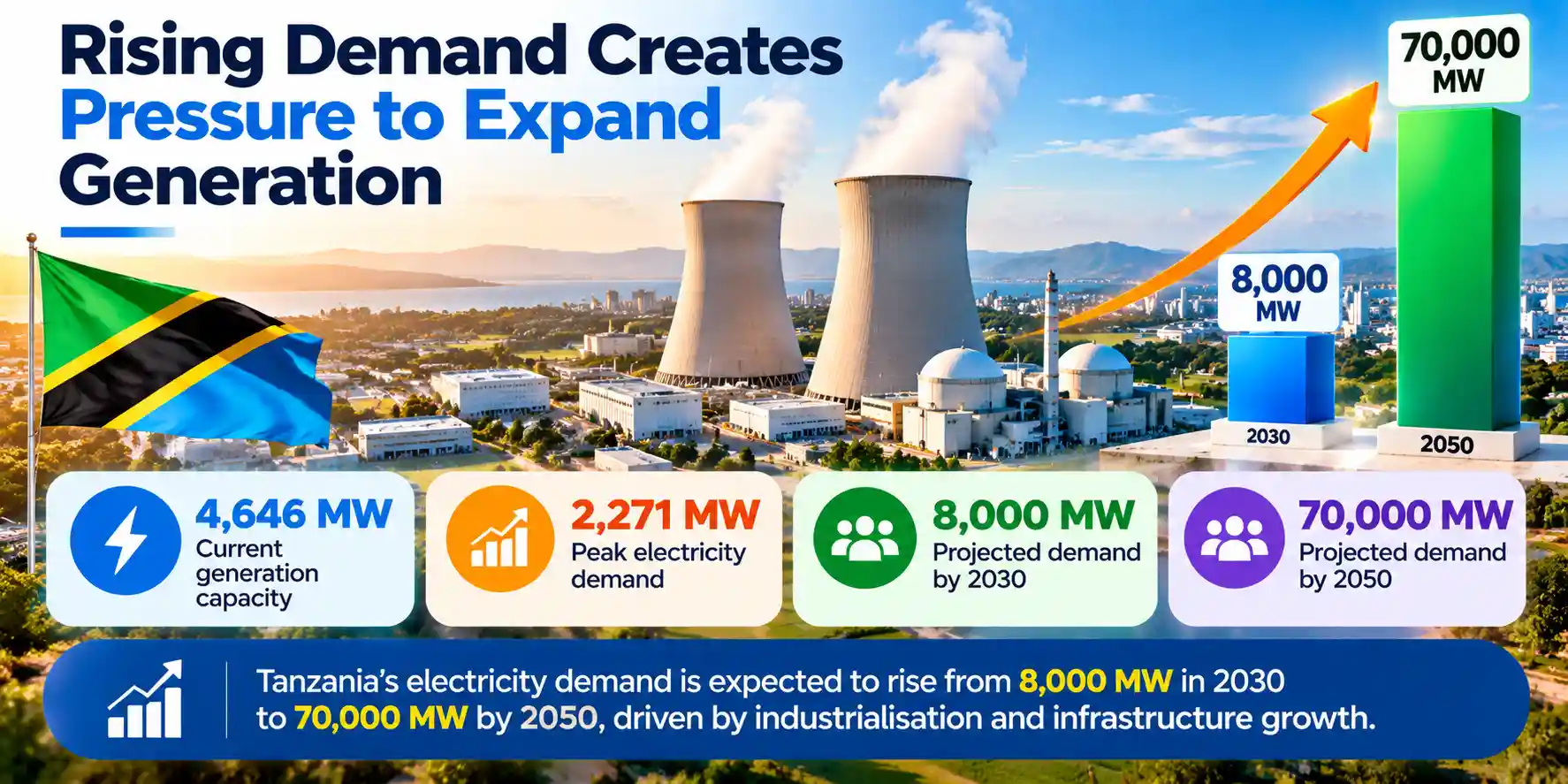
Tanzania’s electricity requirements are expected to increase substantially as its economy industrialises and infrastructure expands. The reported projections put demand at 8,000 megawatts by 2030, rising to 70,000 megawatts by 2050.
Current generation capacity stands at 4,646MW, compared with peak demand of approximately 2,271MW.
Although current capacity exceeds the reported peak demand, the government is considering additional generation options to support future consumption and potentially export electricity to neighbouring countries.
The commissioning of the 2,115MW Julius Nyerere Hydropower Plant on the Rufiji River has significantly increased the role of hydropower in the national system. The two reports state that hydropower now accounts for more than 60 per cent of capacity.
However, hydropower output can be affected by changing rainfall patterns and drought. Diversifying generation could help manage this exposure while supporting industries that need a dependable electricity supply.
Natural Gas and Hydropower Remain Important
Natural gas has historically played a major role in Tanzania’s electricity generation. The country has estimated reserves of 57 trillion cubic feet, and gas previously accounted for over 40 per cent of grid capacity.
Tanzania Electric Supply Company (TANESCO) currently uses hydropower, natural gas and diesel to generate electricity. Adding nuclear power could introduce another source of generation, potentially reducing reliance on hydrological conditions and helping meet future demand.
The Ministry of Energy’s Permanent Secretary, Felchesmi Mramba, has emphasised the importance of diversification, stating that climate change has demonstrated the risks of relying on one energy source. He has also highlighted the need for reliable electricity for industrial activity and the Standard Gauge Railway.
Nuclear power could provide steady electricity with low operational carbon emissions, but its overall environmental and economic performance would depend on construction, fuel supply, waste management, safety and decommissioning. It would also need to be evaluated alongside renewable energy, storage and grid investments.
Context is everything. Stay ahead of shifting trends with today’s market updates, and uncover emerging opportunities using the Serrari Group Market Index and Marketplace. Then, take control of your own financial future by exploring our Money & Life Reset Transformation Blueprint ™ to build stronger habits, create better systems, and design a path toward lasting wealth.
Russia Partnership and Nuclear Technology Discussions
Russia is a potential partner in Tanzania’s nuclear ambitions through Rosatom, its state-owned nuclear corporation. Nuclear cooperation featured in President Samia’s talks with Russian President Vladimir Putin at the Kremlin on 3 June 2026.
The discussions covered opportunities to expand economic cooperation, including energy and geological exploration. Tanzania has also expressed interest in developing a broader portfolio of energy sources to support its industrialisation agenda.
The government has been working to attract foreign capital, with foreign direct investment increasing to about US$5 billion in 2025, compared with nearly US$3 billion in 2021.
However, nuclear power projects typically require substantial upfront investment and long development timelines. Any agreement would need to address financing, technology selection, construction responsibilities, fuel arrangements, waste management and regulatory oversight before a plant could be built and operated.
Building Nuclear Expertise and Safety Capacity
Developing local expertise will be essential if Tanzania proceeds with nuclear power. The Tanzania Atomic Energy Commission has stated that preparations are being undertaken in line with international nuclear safety standards.
The International Atomic Energy Agency (IAEA) has also indicated its willingness to support training and projects that strengthen Tanzania’s nuclear capabilities. Such support could help develop the technical workforce, regulatory systems and institutional knowledge required to oversee nuclear facilities safely.
A nuclear programme involves more than constructing a power plant. It requires qualified engineers and operators, independent safety regulation, emergency preparedness, secure fuel management, radioactive waste arrangements and long-term financial planning.
These requirements will shape how quickly Tanzania can move from exploring nuclear technology to making an investment decision and, eventually, generating electricity.
Outlook
Tanzania’s interest in nuclear power reflects a broader effort to prepare for rising electricity demand while diversifying its generation mix. Small modular reactors are being considered alongside hydropower, natural gas, solar and wind as potential contributors to long-term energy security.
The next steps will involve assessing technical and financial feasibility, developing local expertise and establishing the regulatory and safety capacity needed for any future project. Discussions with Rosatom and support from the IAEA could contribute to this process, but the scale, cost and timing of nuclear development remain uncertain.
The key question is whether Tanzania can turn its nuclear ambitions into a safe, affordable and deliverable energy project that complements its existing power sources.
Frequently Asked Questions
1. Why is Tanzania considering nuclear power?
Tanzania wants to diversify electricity generation, support industrialisation and prepare for projected increases in electricity demand while reducing reliance on individual energy sources.
2. What are small modular reactors?
Small modular reactors are nuclear reactors designed around smaller generating units that can potentially be deployed in stages. Their suitability depends on technical, financial, regulatory and safety assessments.
3. Is Tanzania already generating nuclear electricity?
No. Nuclear power remains under consideration as part of the country’s long-term energy strategy. Tanzania currently generates electricity using hydropower, natural gas and diesel.
4. What challenges must Tanzania address before building a nuclear plant?
The country will need financing, trained personnel, regulatory capacity, safety systems, emergency preparedness and plans for fuel management and radioactive waste.
Your financial future isn’t something you wait for—it’s something you build.
The real question is: when do you begin?
Move beyond simply staying informed.
Navigate the markets with clarity—track trends through the Serrari Group Market Index, uncover opportunities in the Serrari Marketplace, and build practical knowledge with our Curated Wealth Builder Platform.
Stay connected to what truly matters.
Get daily insights on macro trends and financial movements across Kenya, Africa, and global markets—delivered through the Serrari Newsletter.
Growth opens doors.
Advance your career through professional programs including ACCA, HESI A2, ATI TEAS 7 , HESI EXIT , NCLEX – RN and NCLEX – PN, Financial Literacy!🌟—designed to move you forward with confidence.
See where money is flowing—clearly and in real time.
Track Money Market Funds, Treasury Bills, Treasury Bonds, Green Bonds, and Fixed Deposits, alongside global and African indexes, key economic indicators, and the evolving Crypto and stablecoin landscape—all within Serrari’s Market Index.