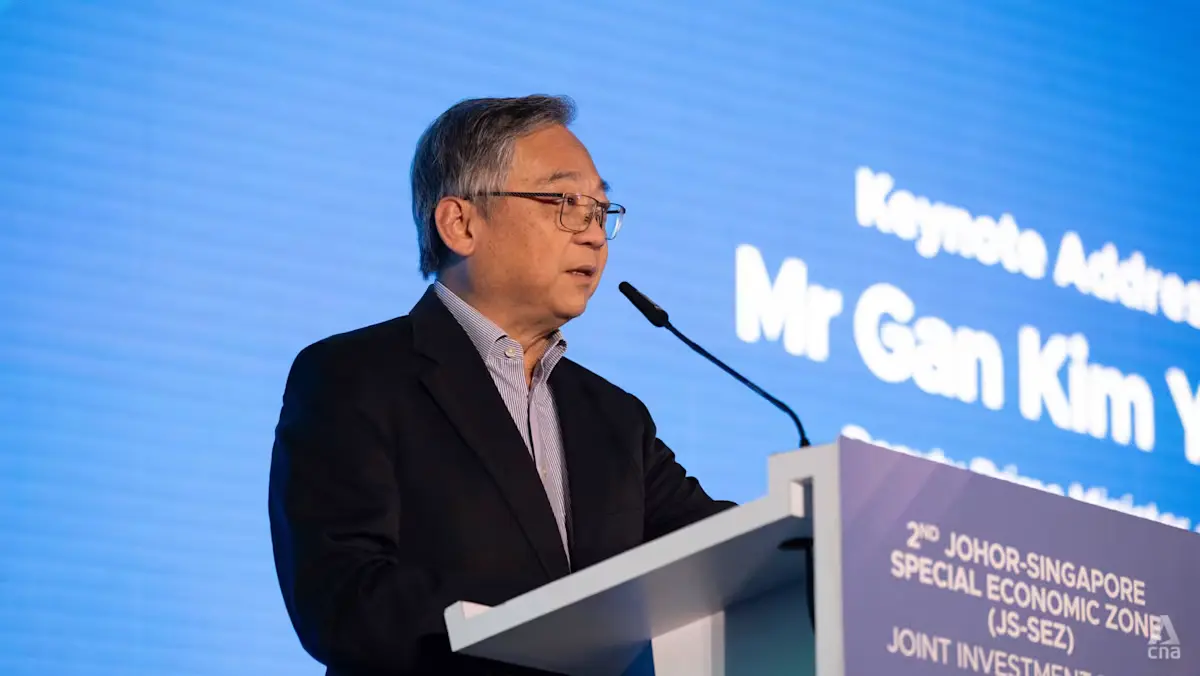
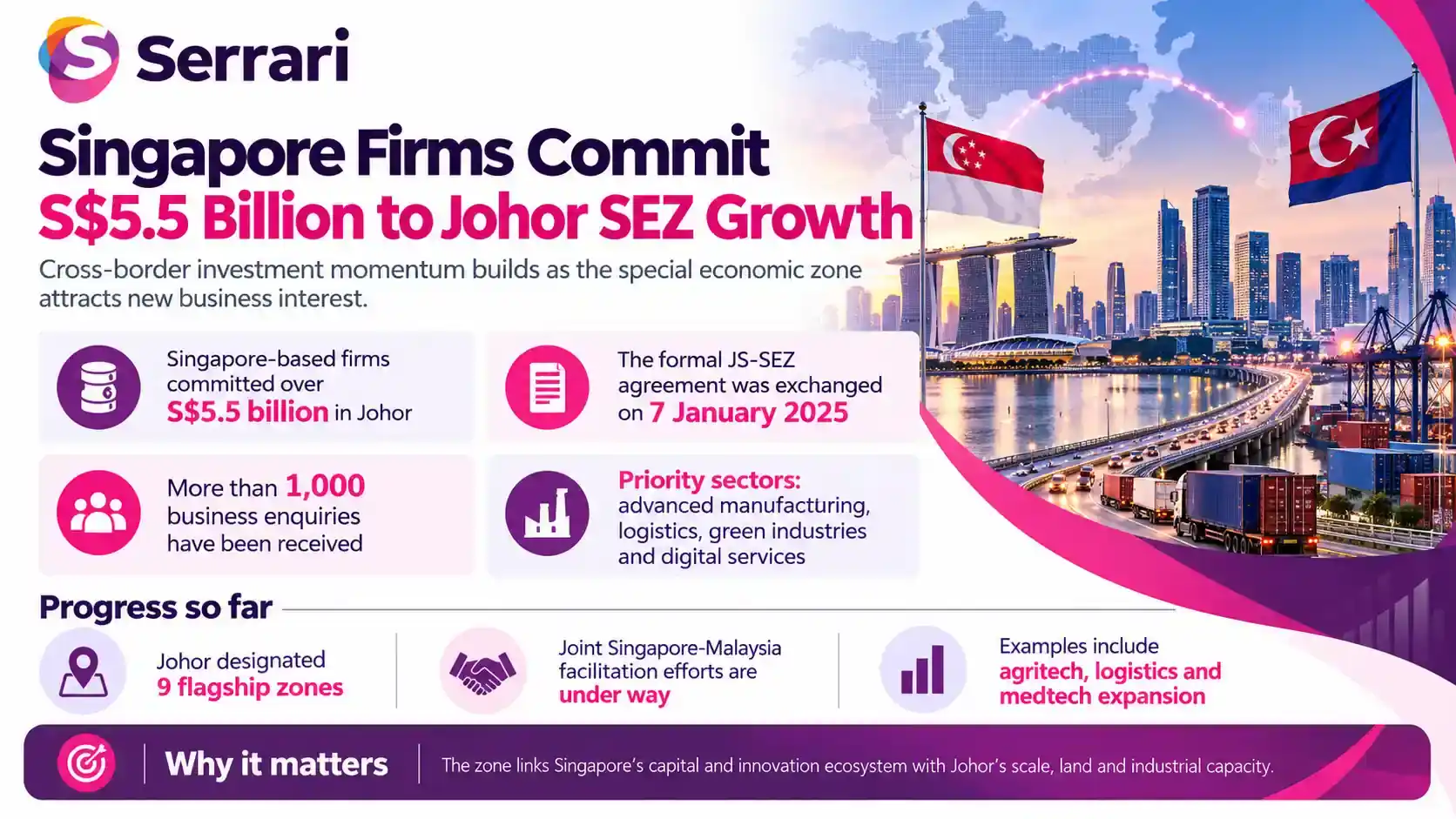
Singapore-based companies had committed more than S$5.5 billion in investments in Johor by October 14, 2025, highlighting growing business interest in the Johor-Singapore Special Economic Zone (JS-SEZ). The announcement came during the second joint investment forum in Singapore, where officials outlined progress in attracting businesses, simplifying cross-border operations and developing strategic industries. The commitments signal investor confidence, although they should not be confused with investment spending already completed.
Key Overview
- Over S$5.5 billion in investments had been committed by Singapore-based firms since a January 2024 cooperation memorandum.
- The formal JS-SEZ agreement was exchanged on January 7, 2025, to strengthen economic integration.
- More than 900 participants attended the October 2025 investment forum.
- Businesses had submitted over 1,000 enquiries about opportunities in manufacturing, logistics, data centres and other sectors.
- Priority industries include advanced manufacturing, logistics, green industries and digital services, supported by nine flagship zones in Johor.
Investment Commitments Mark a Major Milestone
The investment commitments announced at the forum underscored the appeal of linking Singapore’s financing, technology and international networks with Johor’s industrial land, labour and operating capacity.
Deputy Prime Minister Gan Kim Yong said in his October 14 keynote address that the investments followed a memorandum of understanding signed in January 2024. The countries subsequently exchanged their formal economic-zone agreement on January 7, 2025.
Johor separately recorded more than RM104.5 billion in approved private investments between January 2024 and June 2025. That broader total covers a different investor group and measurement, so it is not directly comparable with the S$5.5 billion committed by Singapore-based firms.
Nine Flagship Zones Target Strategic Industries
The JS-SEZ development framework encompasses nine flagship zones and 11 target sectors, including manufacturing, logistics, energy, the digital economy, healthcare and food security.
Singapore and Malaysia are positioning the zone as a shared production and services ecosystem rather than simply a destination for lower-cost operations. Companies can keep headquarters, advanced research or financing functions in Singapore while expanding production, distribution and supporting activities in Johor.
For investors, this approach can diversify capacity and improve access to Southeast Asian markets, although its benefits depend on efficient customs procedures, infrastructure and workforce availability.
Context is everything. Stay ahead of shifting trends with today’s market updates, and uncover emerging opportunities using the Serrari Group Market Index and Marketplace. Then, take control of your own financial future by exploring our Money & Life Reset Transformation Blueprint ™ to build stronger habits, create better systems, and design a path toward lasting wealth.
Cross-Border Business Facilitation Gains Momentum
Singapore established a joint project office involving its trade ministry, investment agency and enterprise-development agency in April 2025. The cross-border investment support programme works alongside Malaysian counterparts to guide businesses through expansion and regulatory questions.
By the October forum, the partner agencies had received over 1,000 enquiries. Measures to simplify the movement of goods included streamlined transshipment permits, while Johor had introduced investment incentives and a dedicated facilitation centre.
These reforms are intended to reduce administrative friction, but enquiries themselves are not equivalent to approved or operational projects.
Agriculture, Logistics and Medical Technology Lead Examples
One proposed project involved Singapore agritech business Archisen, which planned a 200-acre modern agricultural hub in Sedenak with Malaysian partner Southern Catalyst. The initiative would extend indoor-farming techniques to support food production.
The investment forum report also highlighted Kuehne+Nagel’s integrated Singapore-Johor logistics network and ResMed’s manufacturing activities on both sides of the border.
Such arrangements illustrate the potential for complementary operations. Larger manufacturers can also create opportunities for local small and medium-sized suppliers through procurement, transport and business services.
Outlook for Regional Trade and Investment
The JS-SEZ demonstrates how neighbouring economies can combine complementary capabilities to attract investment. For Singapore, the arrangement provides additional room for industrial expansion while retaining higher-value functions. For Johor, it offers prospects for capital inflows, technology partnerships and skilled employment.
The next test is converting announced commitments and business enquiries into completed facilities, sustained jobs and measurable cross-border efficiencies. Continued regulatory coordination will be central to delivering those outcomes.
Sources: Singapore Ministry of Trade and Industry / Enterprise Singapore / Singapore Economic Development Board / The Business Times
Your financial future isn’t something you wait for—it’s something you build.
The real question is: when do you begin?
Move beyond simply staying informed.
Navigate the markets with clarity—track trends through the Serrari Group Market Index, uncover opportunities in the Serrari Marketplace, and build practical knowledge with our Curated Wealth Builder Platform.
Stay connected to what truly matters.
Get daily insights on macro trends and financial movements across Kenya, Africa, and global markets—delivered through the Serrari Newsletter.
Growth opens doors.
Advance your career through professional programs including ACCA, HESI A2, ATI TEAS 7 , HESI EXIT , NCLEX – RN and NCLEX – PN, Financial Literacy!🌟—designed to move you forward with confidence.
See where money is flowing—clearly and in real time.
Track Money Market Funds, Treasury Bills, Treasury Bonds, Green Bonds, and Fixed Deposits, alongside global and African indexes, key economic indicators, and the evolving Crypto and stablecoin landscape—all within Serrari’s Market Index.