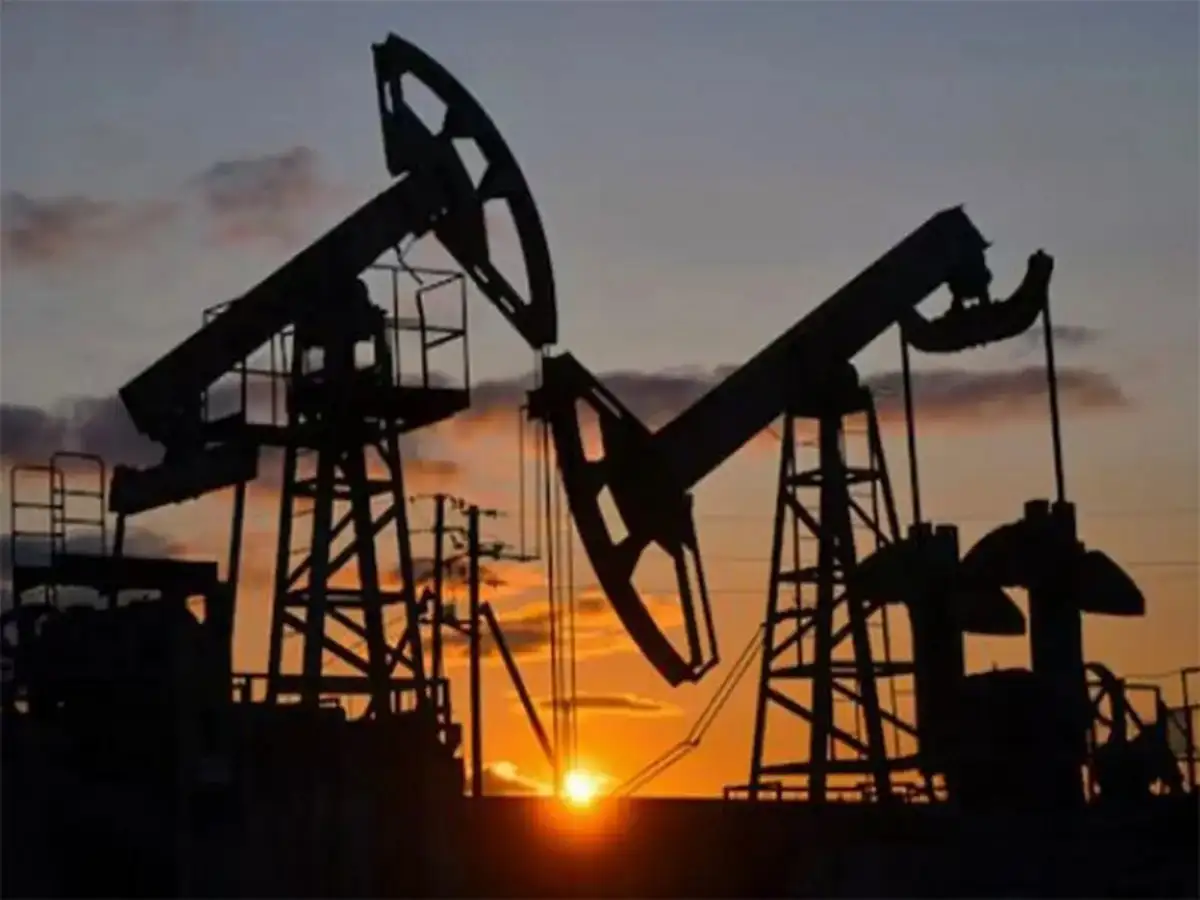
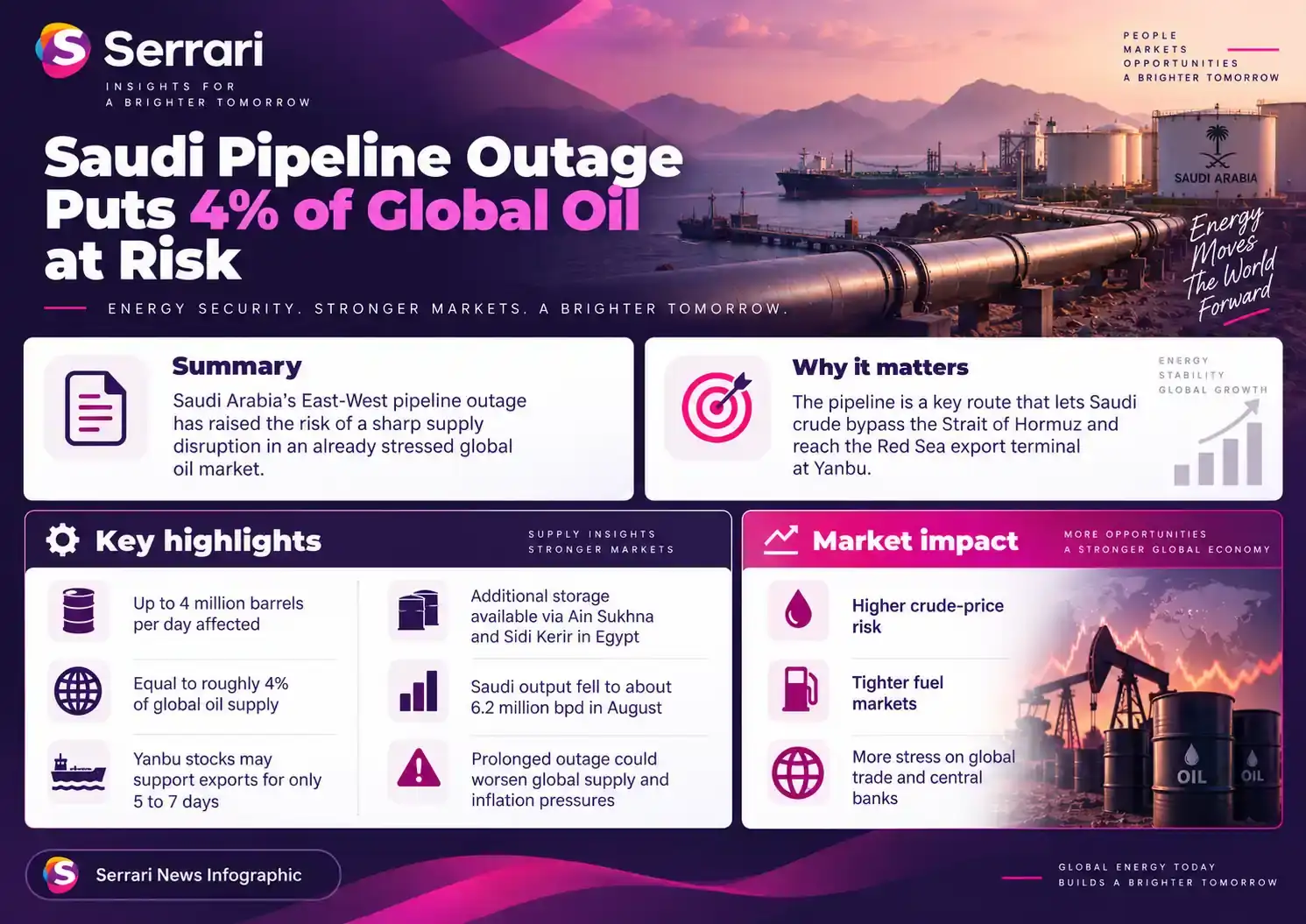
Saudi Arabia’s shutdown of its strategic East-West crude pipeline has put as much as 4% of global oil supply at risk, adding another major pressure point to an energy market already strained by disruptions across the Middle East. The pipeline normally allows Saudi crude to bypass the Strait of Hormuz and reach the Red Sea port of Yanbu, but it was shut as a precaution after multiple attacks on September 10.
Industry sources estimate that Saudi Arabia has enough crude stored at Yanbu to maintain exports for only five to seven days without fresh pipeline flows, meaning a prolonged disruption could force the kingdom to reduce shipments from the Red Sea and tighten an already constrained global market.
Key Overview
The East-West pipeline has recently carried around 4 million barrels per day to Yanbu, equivalent to roughly 4% of world oil supply. Although its maximum capacity is higher, the route has become especially important because conflict has sharply reduced traffic through the Strait of Hormuz.
Saudi Arabia can temporarily support exports from storage in Yanbu and through Egyptian terminals at Ain Sukhna and Sidi Kerir. However, those inventories are finite, meaning a prolonged outage could quickly translate into lower Saudi exports and higher global crude prices.
East-West Pipeline Became Saudi Arabia’s Critical Bypass
The East-West pipeline crosses Saudi Arabia from its eastern oil-producing region to the Red Sea coast. Earlier in 2026, Aramco said the route had been ramped up to a maximum capacity of 7 million barrels per day as shipping constraints through Hormuz intensified.
That made the pipeline one of the most important pieces of emergency energy infrastructure in the world. Instead of sending crude through the Persian Gulf and the Strait of Hormuz, Saudi Arabia could move barrels westward by pipeline and load them onto tankers at Yanbu.
The Saudi energy ministry confirmed that the pipeline was shut down as a precaution after attacks in the Riyadh and Madinah regions, while technical teams assessed the damage and safety of the system.
Export Stocks Could Run Low Within Days
The immediate concern is not Saudi Arabia’s underground reserves but the amount of crude already positioned at export terminals. Traders and buyers familiar with Saudi flows estimate Yanbu has enough inventories to maintain current exports for only five to seven days.
Industry estimates put Yanbu storage capacity at around 35 million barrels. Saudi Arabia also has access to additional crude storage in Egypt through the SUMED system, including about 18.4 million barrels at Ain Sukhna and 19.5 million at Sidi Kerir, providing another buffer for exports.
Those facilities cannot replace a sustained 4 million-barrel-per-day pipeline flow indefinitely. Without a restart, the kingdom would eventually have to reduce export volumes from the Red Sea.
Repair Timeline Remains Uncertain
Saudi authorities have not publicly provided a detailed repair timetable. Industry sources cited in current reporting have offered widely different estimates, ranging from a possible partial restart during repairs to a disruption lasting five or six weeks.
That uncertainty is critical for oil markets. A short outage could largely be absorbed through inventories, alternative routing and reduced exports for a limited period. A multi-week disruption would be much harder to offset because available storage would continue to decline while other Middle Eastern export routes remain constrained.
Aramco’s international storage network offers additional flexibility, but the East-West pipeline remains central to maintaining large Saudi export volumes without relying on Hormuz.
Context is everything. Stay ahead of shifting trends with today’s market updates, and uncover emerging opportunities using the Serrari Group Market Index and Marketplace. Then, take control of your own financial future by exploring our Money & Life Reset Transformation Blueprint ™ to build stronger habits, create better systems, and design a path toward lasting wealth.
Global Oil Supply Is Already Under Pressure
The outage comes as global supply has already fallen sharply. The latest market assessment projects world oil production to decline by 5.7 million barrels per day in 2026 to an average of 100.7 million barrels per day, with the expected recovery in Gulf supply pushed into 2027.
Saudi production has been particularly affected. Output fell to around 6.2 million barrels per day in August from roughly 10.9 million barrels per day in February, reaching levels not seen for more than three decades.
Global observed oil inventories have also been falling rapidly. The same September assessment showed stocks fell by 95 million barrels in August alone, bringing cumulative withdrawals since February to more than 500 million barrels.
Oil Prices Rise as Supply Risks Deepen
The latest disruption has already added another risk premium to crude prices. Brent climbed above $107 per barrel on September 14 as traders reacted to the Saudi pipeline outage, continued disruption around Hormuz and mounting security concerns near the Bab el-Mandeb Strait.
Higher oil and refined-fuel prices are feeding into inflation through transport, manufacturing and food-distribution costs. That is also complicating monetary policy because central banks face the prospect of weaker economic activity alongside renewed price pressures.
The risk is particularly acute for diesel, where global supply has already tightened more severely than crude. Refinery disruptions, lower Middle Eastern exports and reduced Russian product flows have pushed fuel markets into an unusually stressed position.
What Happens Next Matters for Global Supply
The immediate focus is now on whether Saudi Arabia can restore at least partial pipeline operations before export stocks at Yanbu are depleted. A quick restart would ease pressure on the market, while a prolonged shutdown could remove several million barrels per day from accessible global supply.
The situation also demonstrates how heavily the oil market now depends on alternative routes around traditional maritime choke points. With Hormuz already constrained and security risks increasing near the Red Sea, the East-West pipeline has shifted from being a strategic backup to a core part of Saudi Arabia’s export system.
Sources: Reuters / Saudi Press Agency / Saudi Aramco / International Energy Agency / SUMED
Your financial future isn’t something you wait for—it’s something you build.
The real question is: when do you begin?
Move beyond simply staying informed.
Navigate the markets with clarity—track trends through the Serrari Group Market Index, uncover opportunities in the Serrari Marketplace, and build practical knowledge with our Curated Wealth Builder Platform.
Stay connected to what truly matters.
Get daily insights on macro trends and financial movements across Kenya, Africa, and global markets—delivered through the Serrari Newsletter.
Growth opens doors.
Advance your career through professional programs including ACCA, HESI A2, ATI TEAS 7 , HESI EXIT , NCLEX – RN and NCLEX – PN, Financial Literacy!🌟—designed to move you forward with confidence.
See where money is flowing—clearly and in real time.
Track Money Market Funds, Treasury Bills, Treasury Bonds, Green Bonds, and Fixed Deposits, alongside global and African indexes, key economic indicators, and the evolving Crypto and stablecoin landscape—all within Serrari’s Market Index.