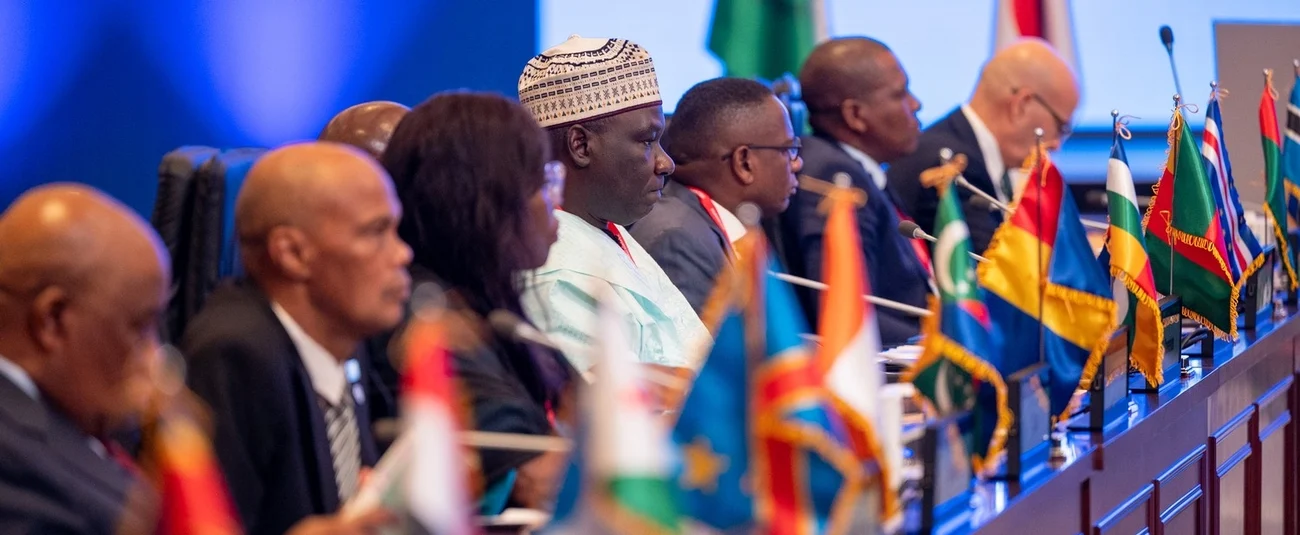
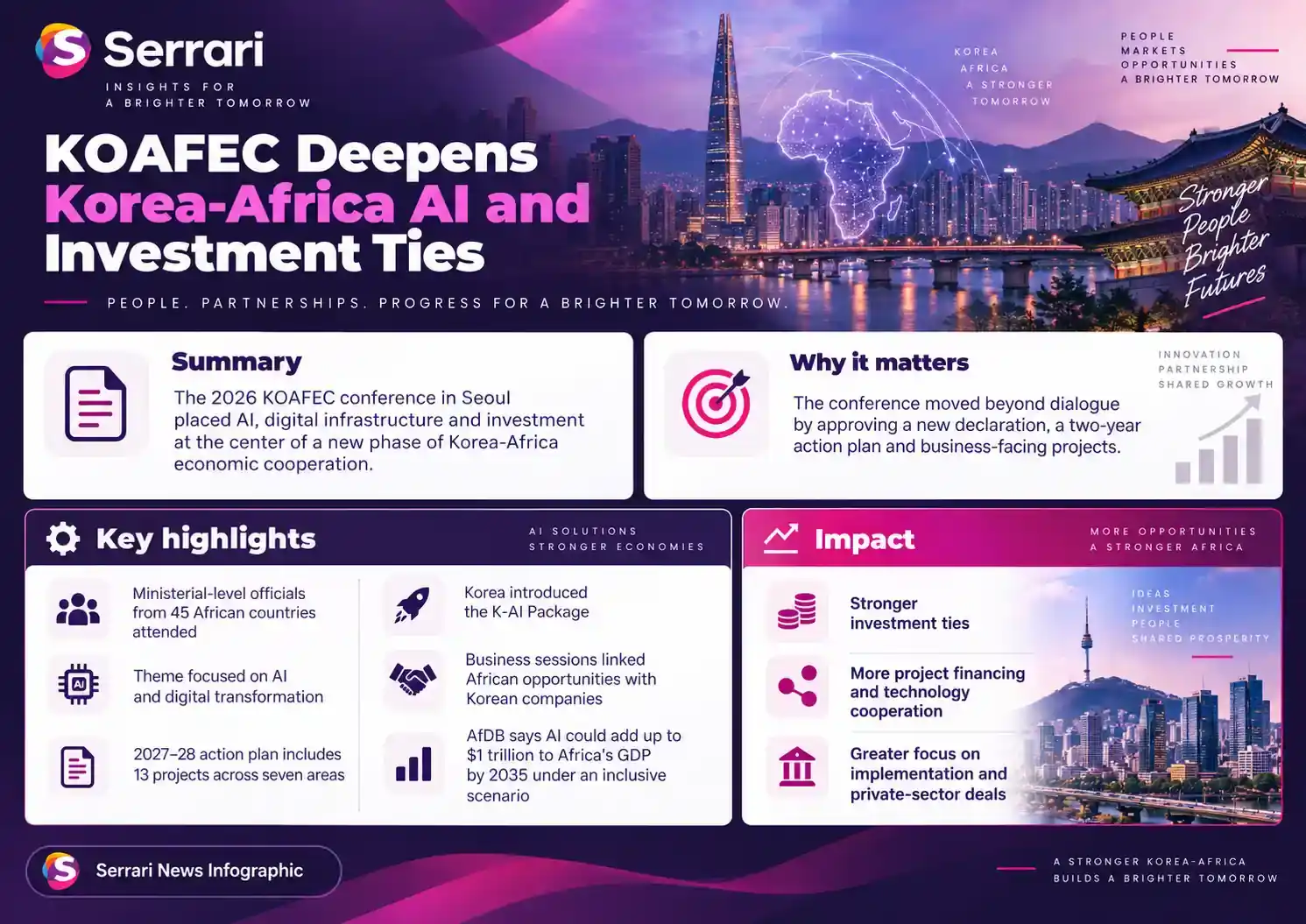
Korea and African governments have set out a more investment-focused phase of their economic partnership, placing artificial intelligence, digital infrastructure and private-sector projects at the centre of the agenda. The eighth Korea-Africa Economic Cooperation Ministerial Conference in Seoul brought together ministerial-level officials from 45 African countries as KOAFEC marked 20 years since the initiative was launched.
Held under the theme “Harnessing AI and Digital Infrastructure for Africa’s Transformation,” the conference moved beyond broad policy dialogue by adopting a new joint declaration, approving a two-year action plan and connecting African governments directly with Korean technology, infrastructure and investment companies.
Key Overview
The 2026 KOAFEC Joint Declaration places AI and digital infrastructure alongside industrialisation, education, healthcare and agriculture as priority areas for deeper cooperation. The accompanying 2027–28 Action Plan approved 13 projects across seven areas, including AI and digital transformation, urban development, education, agriculture, energy, environment and healthcare.
Korea also introduced its K-AI Package, which combines development financing with AI solutions, data centres, power infrastructure and sector-specific applications. The aim is to turn Korea’s technology capabilities and Africa’s development needs into investable projects rather than stand-alone technology demonstrations.
AI Moves to the Centre of Korea-Africa Cooperation
One of the clearest shifts at KOAFEC was the decision to treat AI infrastructure as part of Africa’s wider development agenda. Korea identified three main areas for cooperation: expanding AI infrastructure, deploying AI solutions across industries and building AI talent.
The K-AI Package combines infrastructure financing with technology, linking AI data centres and power facilities with applications in areas such as agriculture, healthcare, transportation, energy and water management.
Conference discussions also looked at smart agriculture, AI-assisted disease diagnosis and the electricity and data-centre capacity required for large-scale adoption. That reflects a recognition that AI development depends not only on software but also on reliable power, computing infrastructure, connectivity and skilled workers.
Thirteen Projects Give the Action Plan a Practical Base
The two sides approved 13 KOAFEC Trust Fund projects across seven development areas, creating a pipeline for cooperation during 2027 and 2028. Korean institutions and technology companies are expected to participate as implementation partners.
Another initiative gives African startups access to GPU- and NPU-based cloud infrastructure through K-AI Cloud Vouchers. The programme is designed to help startups build AI products suited to local African needs while collaborating with Korean technology providers.
The broader KOAFEC platform already has a record of using relatively small amounts of project-preparation capital to unlock larger investment. Around $50 million in trust-fund support has helped create an investment pipeline exceeding $6 billion, while roughly $4 billion in financing has been mobilised across sectors including energy, agriculture, infrastructure and digital transformation.
Private-Sector Deals Become a Bigger Priority
The second day of the conference focused heavily on turning government agreements into commercial opportunities. Around 200 participants joined the Business Innovation Forum, including approximately 90 Korean companies interested in African markets.
The discussions covered power infrastructure, data centres, national AI strategies, startup ecosystems and industrial applications. Korea said it intends to combine multiple development-finance tools to help companies convert opportunities into bankable projects.
During the investment-promotion programme, Kenya highlighted the Konza Technopolis project, while Tanzania presented plans for AI and digital clusters in Dar es Salaam and Dodoma.
Around 80 Korean companies attended the investment-promotion session, and 22 companies took part in direct business meetings with African governments and organisations. Discussions covered infrastructure, transport, construction and other investment areas.
Context is everything. Stay ahead of shifting trends with today’s market updates, and uncover emerging opportunities using the Serrari Group Market Index and Marketplace. Then, take control of your own financial future by exploring our Money & Life Reset Transformation Blueprint ™ to build stronger habits, create better systems, and design a path toward lasting wealth.
Africa’s AI Opportunity Could Reach $1 Trillion
The investment push comes amid growing expectations about the economic potential of AI across Africa. A major development study estimates that inclusive AI deployment could add up to $1 trillion to African GDP by 2035 under an inclusive deployment scenario.
Agriculture, wholesale and retail, manufacturing, finance and healthcare are expected to capture a large share of those potential productivity gains. However, achieving that outcome will depend on improvements in data availability, computing infrastructure, workforce skills, financing and governance.
That helps explain why KOAFEC is combining AI investment with electricity, data centres, training and private-sector finance rather than treating digital transformation as an isolated policy area.
Critical Minerals Add Another Investment Dimension
Technology was not the only strategic focus. African officials also used the Seoul meetings to promote the continent’s mineral resources and industrial opportunities.
The African Development Bank presented five regional critical-minerals projects to Korean investors, alongside guarantee, co-financing and risk-mitigation instruments intended to improve project bankability.
The investment pitch focused on moving Africa further up global value chains by processing and refining more minerals locally instead of primarily exporting raw materials. For Korea, which has major manufacturing, battery and technology industries, closer access to African mineral value chains could also support supply-chain diversification.
KOAFEC Shifts From Dialogue Toward Implementation
The 2026 conference suggests Korea-Africa economic cooperation is moving into a more commercially oriented phase. AI, digital infrastructure, critical minerals, energy and industrial investment are increasingly being tied to specific projects, funding mechanisms and business partnerships.
The next test will be implementation. The value of the new action plan will depend on whether the 13 approved projects move from policy documents into financed infrastructure, local technology deployment, skills development and sustainable private investment across African markets.
Sources: Ministry of Finance and Economy Republic of Korea / African Development Bank
Your financial future isn’t something you wait for—it’s something you build.
The real question is: when do you begin?
Move beyond simply staying informed.
Navigate the markets with clarity—track trends through the Serrari Group Market Index, uncover opportunities in the Serrari Marketplace, and build practical knowledge with our Curated Wealth Builder Platform.
Stay connected to what truly matters.
Get daily insights on macro trends and financial movements across Kenya, Africa, and global markets—delivered through the Serrari Newsletter.
Growth opens doors.
Advance your career through professional programs including ACCA, HESI A2, ATI TEAS 7 , HESI EXIT , NCLEX – RN and NCLEX – PN, Financial Literacy!🌟—designed to move you forward with confidence.
See where money is flowing—clearly and in real time.
Track Money Market Funds, Treasury Bills, Treasury Bonds, Green Bonds, and Fixed Deposits, alongside global and African indexes, key economic indicators, and the evolving Crypto and stablecoin landscape—all within Serrari’s Market Index.