Global oil prices climbed above $100 per barrel as continued fighting in the Middle East raised concerns about prolonged disruptions to oil supplies. Brent crude rose 3.36% to settle at $101.21 per barrel, while US crude gained 3.25% to $96.05. Oil prices have risen more than 65% this year, increasing energy costs and putting inflation back in focus for central banks.
Key Overview
- Brent crude rose 3.36% to settle at $101.21 per barrel.
- US crude increased 3.25% to $96.05 per barrel.
- Brent returned above $100 for the first time since July.
- Both Brent and US crude are up more than 65% this year.
- Disruptions around the Strait of Hormuz, Red Sea and Bab al-Mandab Strait are raising supply concerns.
- Higher oil prices are increasing the cost of gasoline and diesel.
- The US EIA raised its Brent forecast to $91 per barrel for this year and $74 next year.
Oil Prices Return Above $100
Global oil prices have climbed back above $100 per barrel as fighting in the Middle East increases concerns over prolonged disruptions to oil supplies.
Brent crude, the global oil benchmark, rose 3.36% on Wednesday to settle at $101.21 per barrel. It was Brent’s first time reaching the $100 level since July and its highest closing price since May 22.
US crude also advanced, rising 3.25% to $96.05 per barrel, its highest closing level since May 22.
Brent reached $100 early Wednesday following a series of conflict and war developments on Tuesday, including the US striking Iranian oil tankers and Iran-backed Houthis attacking Saudi Arabia.
Oil prices have moved sharply throughout the year as traders respond to developments in the conflict and monitor tanker traffic through the Strait of Hormuz.
Both Brent and US crude are now up more than 65% this year, increasing energy costs globally.
Middle East Supply Disruptions Remain in Focus
Oil exports from the Middle East have declined since the US and Israel launched their war against Iran in February.
The Strait of Hormuz remains central to the market outlook. A fifth of the world’s oil supply had flowed through the waterway, which had been throttled by Tehran in response to the conflict.
The US military has managed to restore some shipping traffic through Hormuz, but other important trade routes have also experienced disruption.
Iran-backed Houthi rebels in Yemen have attacked tankers in the Red Sea. The group also launched attacks on Saudi energy facilities this week, setting oil sites ablaze and raising concerns about a significant expansion of the conflict involving the key US ally.
The developments have increased market concerns over whether disruptions could eventually affect broader oil production and exports.
The United States has shifted toward a strategy of squeezing the Iranian economy through a maritime blockade, while recent days have brought further violent flare-ups in the region.
Strait of Hormuz Remains Critical to Oil Markets
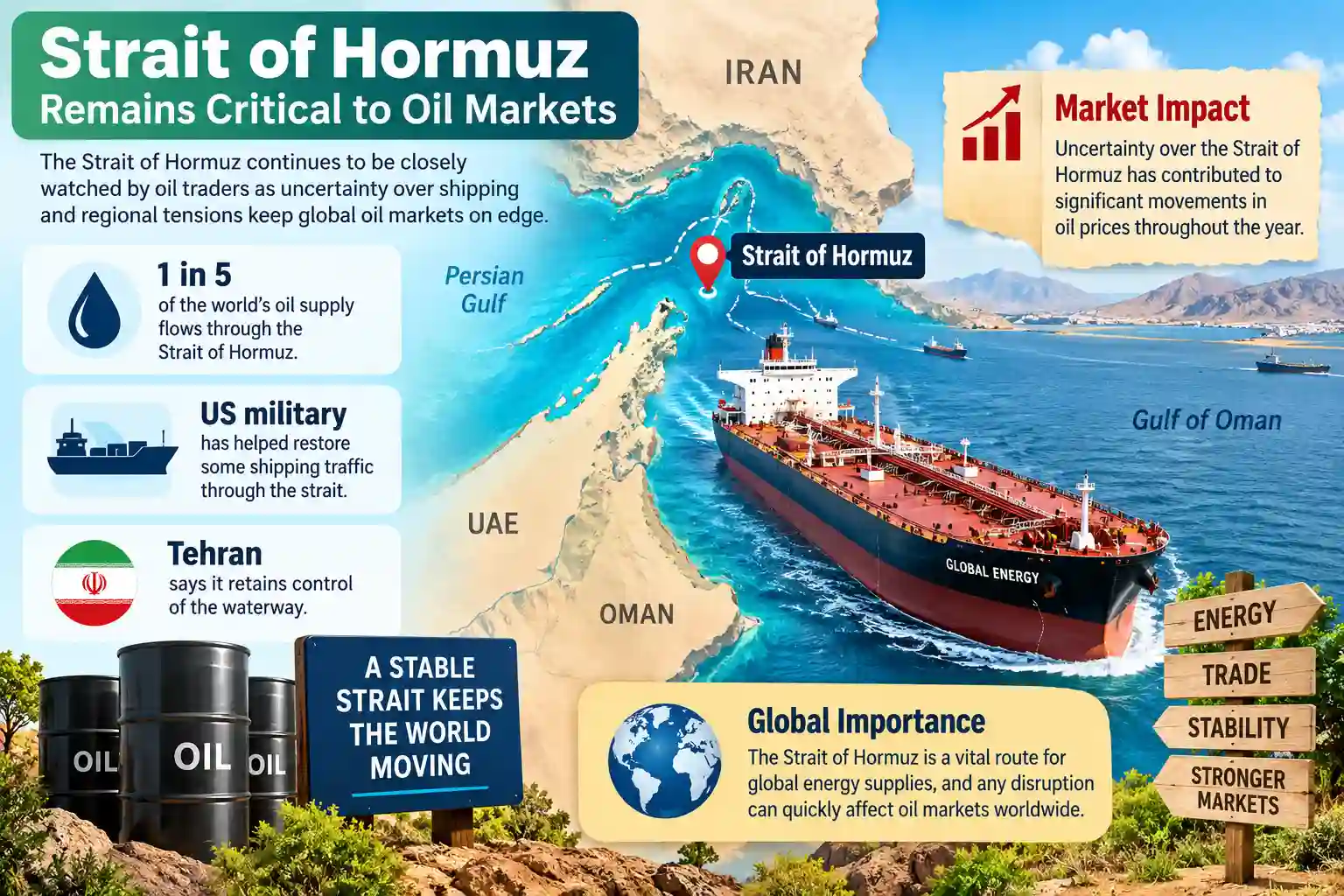
Alt text: Infographic showing the Strait of Hormuz as a critical global oil route, with one-fifth of world oil supply passing through the waterway.
The Strait of Hormuz continues to be closely watched by oil traders trying to assess the potential scale of supply disruptions.
The United States is attempting to help oil tankers move through the strait, while Tehran says it retains control.
The uncertainty has contributed to significant movements in oil prices throughout the year.
After rising sharply in April and May, Brent crude fell as low as $72 per barrel in June after the US and Iran said they had reached an agreement to reopen the Strait of Hormuz.
Brent subsequently resumed its climb as the conflict persisted. It topped $100 again in July before fluctuating and then returning above that level on Wednesday.
The oil market is therefore continuing to react to shipping activity through Hormuz and expectations over whether the disruptions will result in larger supply shortages.
Red Sea and Bab al-Mandab Add to Market Risks
Fighting has also spread to the Red Sea and the Bab al-Mandab Strait, adding another layer of uncertainty for oil markets.
The Bab al-Mandab Strait, located off the coast of Yemen, connects the Red Sea with the Gulf of Aden. Houthi attacks in the area have targeted oil tankers and contributed to concerns about regional trade disruptions.
The group’s attacks on Saudi oil infrastructure have also increased market anxiety over the potential for greater disruptions to oil production.
For traders, the combination of shipping disruptions and attacks on energy infrastructure has made it increasingly difficult to determine how much oil supply could ultimately be affected.
Context is everything. Stay ahead of shifting trends with today’s market updates, and uncover emerging opportunities using the Serrari Group Market Index and Marketplace. Then, take control of your own financial future by exploring our Money & Life Reset Transformation Blueprint ™ to build stronger habits, create better systems, and design a path toward lasting wealth.
China Oil Demand Also Being Watched
While supply disruptions remain a major concern, analysts are also monitoring demand.
China, the world’s largest oil importer, has helped limit upward pressure on oil prices by reducing its imports in recent months, according to analysts.
A recovery in Chinese imports could provide additional support for oil prices.
This means that the future direction of the market will depend not only on developments around Middle Eastern oil supply and shipping routes, but also on whether demand from major oil-consuming economies increases.
Higher Oil Prices Put Inflation Back in Focus
The renewed rise in crude prices is also affecting consumers.
Higher oil prices have pushed up the prices of oil products, including gasoline to diesel, increasing costs for consumers and businesses.
The increase is also putting inflation back in focus for central banks as they assess the effect of higher energy prices on broader economies.
With Brent and US crude both more than 65% higher this year, further supply disruptions could place additional pressure on energy costs.
US Raises Oil Price Forecasts
The US Energy Information Administration raised its oil price forecasts on Wednesday as the market responds to the continuing conflict and supply concerns.
Brent crude is now expected to average $91 per barrel this year and $74 per barrel next year, according to the EIA, the Energy Department’s forecasting arm.
The new forecasts are higher than the agency’s previous projections of $87 per barrel this year and $69 next year.
The revisions reflect the changing oil market outlook as traders continue to assess supply disruptions, shipping activity and demand.
Outlook
Oil markets remain highly sensitive to developments across the Middle East, particularly around the Strait of Hormuz, Red Sea and Bab al-Mandab Strait.
Brent’s return above $100 highlights how quickly concerns over supply disruptions can affect global crude prices. Meanwhile, the possibility of stronger Chinese oil imports could add further upward pressure if demand increases.
The EIA’s revised forecasts also indicate a higher expected oil price environment than previously anticipated, although the outlook remains dependent on how the conflict and oil transportation disruptions develop.
FAQs
1. What is the current Brent crude oil price?
Brent crude settled at $101.21 per barrel after rising 3.36% on Wednesday.
2. Why have oil prices risen above $100?
Oil prices have risen as fighting in the Middle East has raised concerns about prolonged disruptions to oil supplies and tanker traffic through important regional waterways.
3. How much have oil prices risen this year?
Both Brent crude and US crude are up more than 65% this year.
4. What is the EIA’s latest Brent oil price forecast?
The US Energy Information Administration expects Brent crude to average $91 per barrel this year and $74 next year, up from its previous forecasts of $87 and $69, respectively.
Your financial future isn’t something you wait for—it’s something you build.
The real question is: when do you begin?
Move beyond simply staying informed.
Navigate the markets with clarity—track trends through the Serrari Group Market Index, uncover opportunities in the Serrari Marketplace, and build practical knowledge with our Curated Wealth Builder Platform.
Stay connected to what truly matters.
Get daily insights on macro trends and financial movements across Kenya, Africa, and global markets—delivered through the Serrari Newsletter.
Growth opens doors.
Advance your career through professional programs including ACCA, HESI A2, ATI TEAS 7 , HESI EXIT , NCLEX – RN and NCLEX – PN, Financial Literacy!🌟—designed to move you forward with confidence.
See where money is flowing—clearly and in real time.
Track Money Market Funds, Treasury Bills, Treasury Bonds, Green Bonds, and Fixed Deposits, alongside global and African indexes, key economic indicators, and the evolving Crypto and stablecoin landscape—all within Serrari’s Market Index.