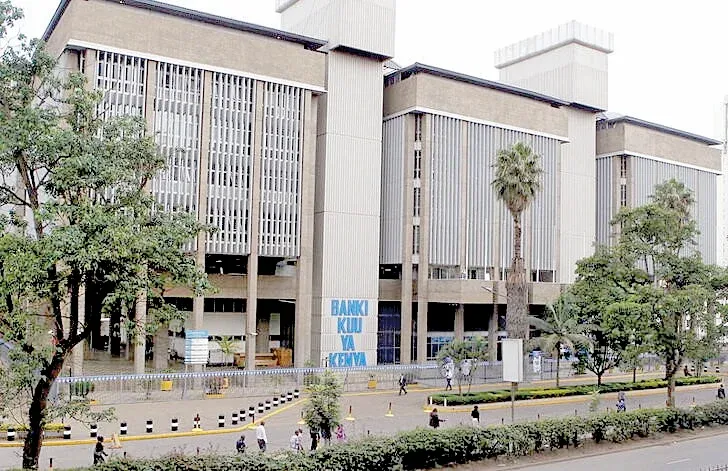
Kenya’s banking regulator has proposed a significant overhaul of prudential rules that would require banks to build additional capital during periods of excessive credit growth and prepare detailed plans for recovering from severe financial stress. The reforms form part of a wider review of prudential and risk-management rules intended to strengthen the resilience of Kenya’s banking sector and align supervision more closely with international standards.
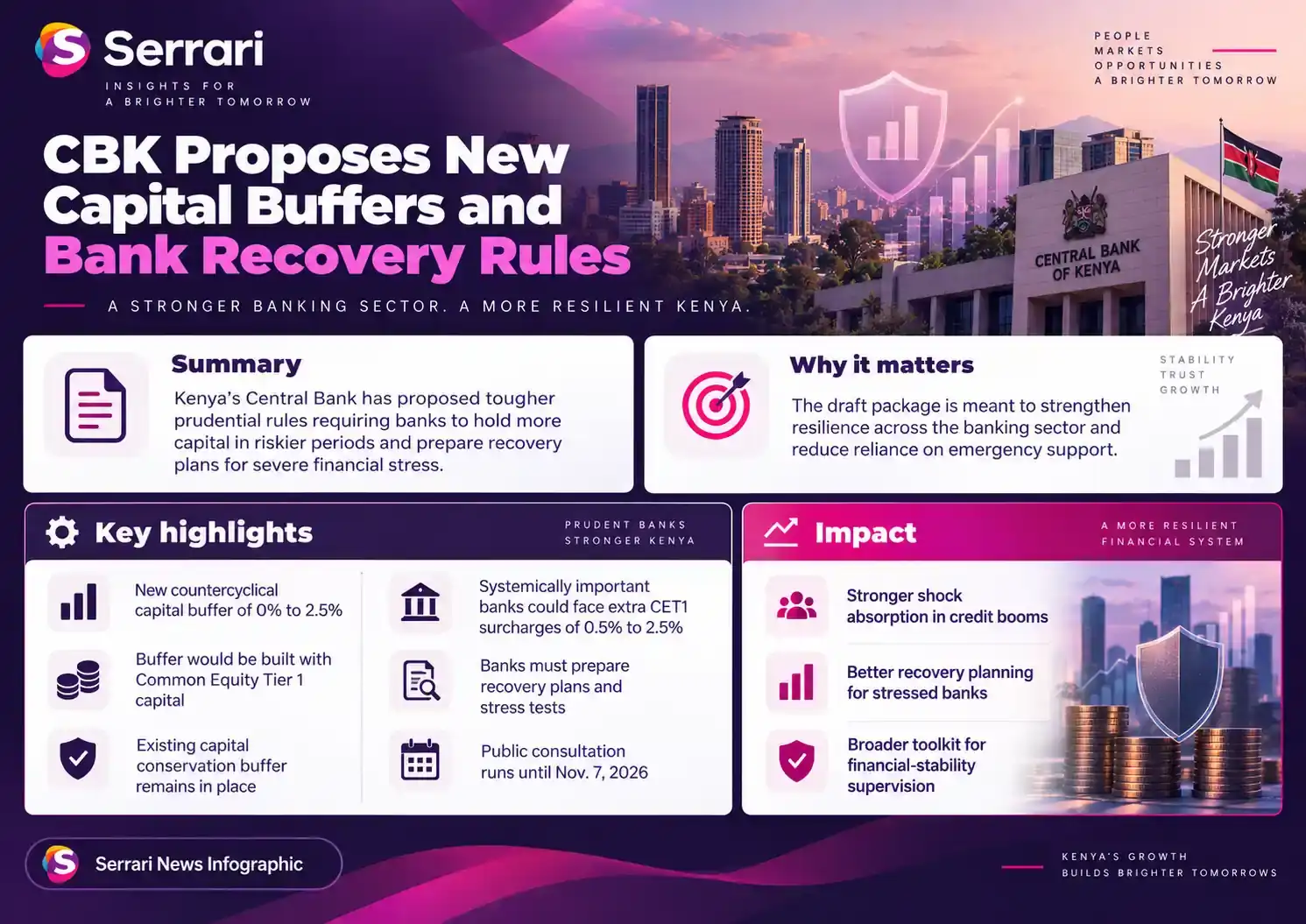
A central proposal is a Countercyclical Capital Buffer, or CCyB, of between 0% and 2.5% of risk-weighted assets. The buffer would be activated when excessive credit expansion is contributing to system-wide risk and would have to be met using Common Equity Tier 1 capital.
Key Overview
The CCyB would sit above banks’ ordinary minimum capital requirements and the existing 2.5% Capital Conservation Buffer. Banks considered systemically important could face an additional CET1 surcharge of between 0.5% and 2.5%, depending on the level of risk their failure could pose to Kenya’s financial system.
The proposals also push banks to prepare for severe financial stress without relying on a government bailout or extraordinary central-bank assistance. Recovery planning would focus on credible actions that can restore capital, liquidity and long-term viability before a bank becomes non-viable.
New Buffer Targets Risks From Rapid Credit Growth
The proposed CCyB is designed to make banks accumulate additional loss-absorbing capital when lending expands rapidly enough to create broader financial vulnerabilities. Under the international capital-buffer framework, countercyclical buffers can be increased during periods of rising system-wide risk and released when those risks decline or crystallise.
Kenya’s draft follows that principle, setting the buffer within a 0% to 2.5% range. CBK would normally provide banks with 12 months’ notice before an increase takes effect, although the implementation period could be shortened if financial risks were building rapidly.
The buffer is intended to build loss-absorbing capacity during strong credit cycles that can later support resilience when conditions deteriorate.
Existing Capital Requirements Would Remain Important
The new buffer would be layered onto Kenya’s broader capital framework rather than replacing existing requirements. Banks already maintain capital above statutory minimums, including the 2.5% Capital Conservation Buffer designed to absorb losses during periods of stress.
The revised framework also strengthens the emphasis on Common Equity Tier 1, the highest-quality form of regulatory capital. The revised structure would give supervisors a clearer view of banks’ loss-absorbing capital.
CBK would also retain the ability to impose additional institution-specific requirements where standard calculations do not adequately capture a bank’s risks. These Pillar II measures could address concentrated exposures or risks not fully captured by standard calculations.
Systemically Important Banks Face Extra Requirements
The regulatory overhaul also introduces a dedicated framework for Domestic Systemically Important Banks. These are institutions whose distress or disorderly failure could significantly disrupt Kenya’s financial system and wider economy.
Depending on their systemic importance, designated banks could be required to hold an additional CET1 surcharge ranging from 0.5% to 2.5% of risk-weighted assets.
The framework would also allow more intensive supervision. Systemically important banks could face more frequent examinations, closer engagement with boards and stronger expectations around internal capital and liquidity assessments.
CBK could also restrict expansion or the introduction of new products where those activities would increase a bank’s systemic risk. This would allow supervision to address activities that could make a future failure more damaging.
Context is everything. Stay ahead of shifting trends with today’s market updates, and uncover emerging opportunities using the Serrari Group Market Index and Marketplace. Then, take control of your own financial future by exploring our Money & Life Reset Transformation Blueprint ™ to build stronger habits, create better systems, and design a path toward lasting wealth.
Recovery Plans Aim to Reduce Reliance on Bailouts
A second major pillar is recovery planning. Banks would need to identify credible actions they could take if severe stress damaged their capital, liquidity or profitability.
The proposed approach makes clear that recovery strategies should not be built around assumptions that the government will provide funding or that extraordinary central-bank liquidity will automatically be available. Instead, banks would be expected to identify measures such as raising capital, retaining earnings, reducing risk, selling assets, restructuring businesses or improving liquidity.
The revised risk-management framework also strengthens stress testing, requiring institutions to assess their ability to withstand extreme but plausible shocks and use those results in capital, contingency, recovery and resolution planning.
For systemically important banks, recovery and resolution preparedness would be subject to even closer supervisory attention, including formal planning and regular review.
What Happens if Recovery Measures Fail?
Recovery planning is intended to intervene before a bank reaches the point of failure. If those measures prove insufficient, the wider crisis-management framework is designed to allow authorities to manage a distressed institution while limiting disruption to depositors, payment systems and the financial sector.
Potential resolution approaches can include transferring viable operations, using a bridge institution, restructuring liabilities or imposing losses on eligible investors and creditors through bail-in mechanisms rather than automatically shifting losses to taxpayers.
The approach is intended to make bank failures more orderly and reduce reliance on taxpayer support.
Public Consultation Runs Until November
The proposals are not yet final. CBK opened the package for public participation on September 10 and is seeking comments on the revised prudential guidelines, risk-management guidelines, guidance notes and D-SIB framework.
The consultation remains open until November 7, 2026, giving banks, industry groups and other stakeholders an opportunity to propose changes before the revised rules are finalised.
If adopted, the reforms would give CBK a broader toolkit for forcing banks to build resilience before risks become crises, while requiring institutions to demonstrate how they could recover or be resolved without destabilising the wider economy.
Sources: Central Bank of Kenya / Bank for International Settlements / The Kenyan Wall Street / Kenya Times
Your financial future isn’t something you wait for—it’s something you build.
The real question is: when do you begin?
Move beyond simply staying informed.
Navigate the markets with clarity—track trends through the Serrari Group Market Index, uncover opportunities in the Serrari Marketplace, and build practical knowledge with our Curated Wealth Builder Platform.
Stay connected to what truly matters.
Get daily insights on macro trends and financial movements across Kenya, Africa, and global markets—delivered through the Serrari Newsletter.
Growth opens doors.
Advance your career through professional programs including ACCA, HESI A2, ATI TEAS 7 , HESI EXIT , NCLEX – RN and NCLEX – PN, Financial Literacy!🌟—designed to move you forward with confidence.
See where money is flowing—clearly and in real time.
Track Money Market Funds, Treasury Bills, Treasury Bonds, Green Bonds, and Fixed Deposits, alongside global and African indexes, key economic indicators, and the evolving Crypto and stablecoin landscape—all within Serrari’s Market Index.