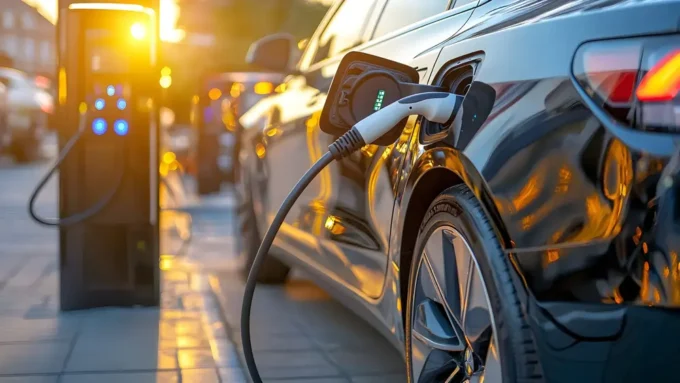
China’s electric vehicle exports surged by 140% in March, driven by rising global fuel prices and geopolitical tensions that have disrupted oil supply chains.
While international demand for EVs is accelerating—especially across Asia, Europe, and the U.S.—domestic EV sales in China are weakening due to subsidy cuts and reduced consumer spending.
This divergence highlights a key shift in the EV market: global demand is strengthening, but local market pressures remain a challenge.
Key Overview
- China EV exports rise 140% to 349,000 units in March
- Oil prices surge to $100+ per barrel amid Middle East tensions
- Strait of Hormuz disruption affects 10M+ barrels/day supply
- EV demand rises across Asia, Europe, and the U.S.
- EV wait times increase globally (e.g., Australia delays)
- UK sees record EV enquiries and sales growth
- U.S. EV demand rising as fuel hits $4/gallon
- China domestic EV sales fall 14% to 848,000 units
- BYD domestic sales drop 40%+
- Highlights global demand vs local slowdown divergence
China’s EV Exports Surge to Record Highs
China’s electric vehicle exports surged by 140% in March, reaching a record 349,000 units, marking the highest monthly export volume ever recorded.
This sharp increase reflects a rapidly expanding global appetite for electric vehicles, driven by a combination of economic pressures, shifting consumer preferences, and geopolitical developments. As traditional energy markets become more volatile, buyers across multiple regions are increasingly seeking alternatives that offer greater cost stability and long-term efficiency.
The surge in exports underscores China’s growing dominance as a global supplier of electric vehicles, particularly in price-competitive segments.
Chinese automakers have been able to scale production efficiently, enabling them to meet rising international demand while maintaining relatively competitive pricing. This has positioned them strongly in export markets, especially where affordability remains a key factor in EV adoption.
The growth has been particularly evident across key international markets, including Asia Pacific, Europe, and the United States, where demand for alternative fuel vehicles has intensified amid rising fuel costs and growing awareness of energy security risks.
China’s expanding export footprint highlights a structural shift in the global automotive supply chain, with Chinese manufacturers playing an increasingly central role.
Markets move fast; don’t get left behind. We’ve paired the Serrari Group Market Index with a curated Marketplace and a comprehensive Wealth Builder Course to ensure you have the data—and the skills—to act on it.
Fuel Price Shock Drives Global EV Demand
A major driver behind the surge in EV demand is the sharp increase in global oil prices, triggered by escalating geopolitical tensions in the Middle East.
The conflict has disrupted critical supply routes at the Strait of Hormuz, affecting more than 10 million barrels per day of crude oil supply and pushing international oil prices above $100 per barrel, up from approximately $70 before the disruption.
This sudden increase in fuel prices is acting as a powerful catalyst for accelerated EV adoption across global markets.
As gasoline and diesel costs continue to rise, the total cost of ownership for conventional vehicles becomes less attractive, prompting consumers to reconsider their options. Electric and hybrid vehicles, which offer lower running costs and reduced exposure to fuel price volatility, are increasingly being viewed as practical and economically viable alternatives.
The shift toward EVs is being driven not only by environmental considerations, but by immediate financial and economic pressures.
This trend is particularly pronounced in regions that rely heavily on imported fuel, where price fluctuations have a more direct impact on consumers. In such markets, the appeal of electrified vehicles is strengthened by their ability to provide greater cost predictability and energy independence.
Fuel price volatility is emerging as a key accelerant in the global transition toward electric mobility.
Rising Consumer Interest Across Global Markets
The shift in demand is becoming increasingly visible across global markets, with consumer interest in electric vehicles rising sharply in response to changing economic conditions.
Across Asia, showrooms have experienced a noticeable increase in foot traffic, as the region was among the first to feel the direct impact of rising fuel costs. Consumers are actively exploring EV and hybrid options, not only as environmentally friendly alternatives but as practical solutions to rising transportation expenses.
This surge in showroom activity reflects a broader shift in consumer mindset—from curiosity about EVs to active purchase consideration.
In Australia, the impact is even more pronounced, with wait times for electric vehicles extending significantly. Some models now require several months for delivery, compared to much shorter lead times previously.
Rising demand is beginning to outpace supply in certain markets, highlighting both strong momentum and emerging supply-side constraints.
Similarly, in the UK, Auto Trader reported a sharp increase in both new and used EV enquiries following the escalation of geopolitical tensions.
Consumer behaviour is increasingly being shaped by fuel price volatility and concerns over energy security, rather than solely environmental motivations.
This growing interest across multiple regions suggests that EV adoption is entering a more demand-driven phase, where external economic factors are accelerating decision-making.
The U.S. Market Shows Early Signs of Shift
In the United States, rising gasoline prices—now exceeding $4 per gallon nationwide—are beginning to influence consumer preferences and spark renewed interest in electric and hybrid vehicles.
While this increase has led to greater awareness and consideration of EVs, analysts at Morgan Stanley suggest that a sustained period of elevated fuel prices may be required before a significant and lasting shift in purchasing behaviour fully materialises.
This indicates that initial interest does not immediately translate into large-scale adoption, particularly in markets with entrenched vehicle preferences.
Historically, U.S. consumers have responded to fuel price shocks over longer timeframes, with purchasing decisions influenced by sustained cost pressures rather than short-term spikes.
The transition toward EV adoption in the U.S. is likely to be gradual, driven by persistent economic signals rather than immediate reactions.
This suggests that while momentum is building, structural demand shifts in the U.S. market may take time to fully develop and scale.
Context is everything. While you follow today’s updates, use the Serrari Group Market Index and Marketplace to spot emerging shifts. Need to sharpen your edge? Our Wealth Builder Course turns these insights into a professional-grade strategy.
Export Boom vs Domestic Slowdown in China
Despite strong export performance, China’s domestic EV market is showing clear signs of weakness, highlighting a divergence between global demand and local market conditions.
Overall EV and hybrid sales in China declined by 14% in March, falling to 848,000 units and marking the third consecutive monthly decline, as well as the first first-quarter drop since 2020.
This divergence underscores a growing imbalance between external demand strength and domestic consumption challenges.
The slowdown is largely attributed to reduced government subsidies, which have historically played a critical role in supporting EV adoption within China. At the same time, weaker consumer purchasing power has further constrained demand, particularly in more price-sensitive segments.
The removal of incentives is exposing underlying demand fragility in the domestic EV market.
The impact is especially evident in compact and lower-cost vehicle categories, where sales have declined more sharply, suggesting that affordability remains a key barrier for many consumers.
This contrast highlights a key dynamic shaping the global EV market: strong export growth can coexist with domestic demand challenges.
Overall, the situation reflects a more complex market environment, where global expansion opportunities are offset by local economic pressures, requiring manufacturers to adapt their strategies accordingly.
Major Automakers Face Mixed Performance
Leading manufacturers are experiencing mixed results as they navigate the rapidly shifting dynamics of the global electric vehicle market. While international demand continues to strengthen, domestic pressures and regional differences are creating uneven performance across key players.
BYD Company, China’s largest EV exporter, has reported strong global demand, with wait times for its key models extending to between two and three months. This increase in delivery timelines reflects rising interest from international buyers and growing pressure on production capacity.
Extended wait times signal robust global demand, but also highlight emerging supply constraints as manufacturers struggle to keep pace.
However, this strong export performance is being offset by significant weakness in the domestic market, where BYD’s sales have declined by more than 40%, reflecting softer consumer demand within China.
This sharp decline underscores how local economic conditions can significantly impact even the strongest global players.
A similar pattern is evident at Tesla, which reported a 9% increase in shipments from its Shanghai factory, indicating continued strength in export activity. At the same time, the company experienced a 24% decline in China sales, further highlighting the weakness in domestic demand.
The divergence between export growth and domestic slowdown highlights the increasingly fragmented nature of the global EV market.
Overall, these contrasting trends illustrate how automakers must balance global expansion opportunities with localized challenges, adapting their strategies to different market conditions.
Historical Parallels and Market Implications
Industry analysts have drawn comparisons between the current market environment and past oil crises, where sharp increases in fuel prices triggered long-term changes in consumer behavior and vehicle preferences.
During the oil shocks of the 1970s, for example, rising fuel costs led consumers—particularly in the United States—to shift toward smaller, more fuel-efficient vehicles. This shift played a significant role in the rise of Japanese automakers, whose vehicles were better suited to the new economic environment.
These historical parallels suggest that sustained fuel price increases can reshape the competitive landscape of the automotive industry.
However, experts caution that such transitions do not occur immediately. In past cycles, consumer behavior shifted gradually, often requiring prolonged periods of elevated fuel prices before resulting in meaningful changes in purchasing patterns.
Structural changes in vehicle demand tend to emerge over time, rather than as immediate responses to short-term price shocks.
This suggests that while current fuel price volatility is driving increased interest in electric vehicles, a sustained period of high prices may be necessary to trigger a deeper and more permanent shift in global demand.
The key question for the market is not whether demand will grow, but how long current conditions will persist—and whether they are strong enough to drive lasting change.
Outlook: A Turning Point for Global EV Adoption
Looking ahead, the current surge in EV demand may represent the early stages of a broader structural shift in the global automotive market.
In the short term, high fuel prices are likely to continue driving interest in electric and hybrid vehicles, particularly in fuel-sensitive markets.
Short-term demand is being driven by cost pressures rather than long-term behavioral change.
Over the medium term, sustained high energy prices could accelerate the transition toward electrified transport, especially if supported by policy measures and infrastructure development.
In the long term, the EV market is expected to continue expanding, but growth will depend on a combination of factors, including affordability, infrastructure, and economic conditions.
The key determinant will not just be demand, but how effectively automakers can scale production and capture market share during periods of disruption.
Ultimately, the current trend highlights a defining shift:
Electric vehicles are increasingly being driven not just by sustainability goals, but by economic necessity in a volatile energy landscape.
Your financial future isn’t something you wait for—it’s something you build.
The real question is: when do you begin?
Move beyond simply staying informed.
Navigate the markets with clarity—track trends through the Serrari Group Market Index, uncover opportunities in the Serrari Marketplace, and build practical knowledge with our Curated Wealth Builder Course.
Stay connected to what truly matters.
Get daily insights on macro trends and financial movements across Kenya, Africa, and global markets—delivered through the Serrari Newsletter.
Growth opens doors.
Advance your career through professional programs including ACCA, HESI A2, ATI TEAS 7 , HESI EXIT , NCLEX – RN and NCLEX – PN, Financial Literacy!🌟—designed to move you forward with confidence.
See where money is flowing—clearly and in real time.
Track Money Market Funds, Treasury Bills, Treasury Bonds, Green Bonds, and Fixed Deposits, alongside global and African indexes, key economic indicators, and the evolving Crypto and stablecoin landscape—all within Serrari’s Market Index.