















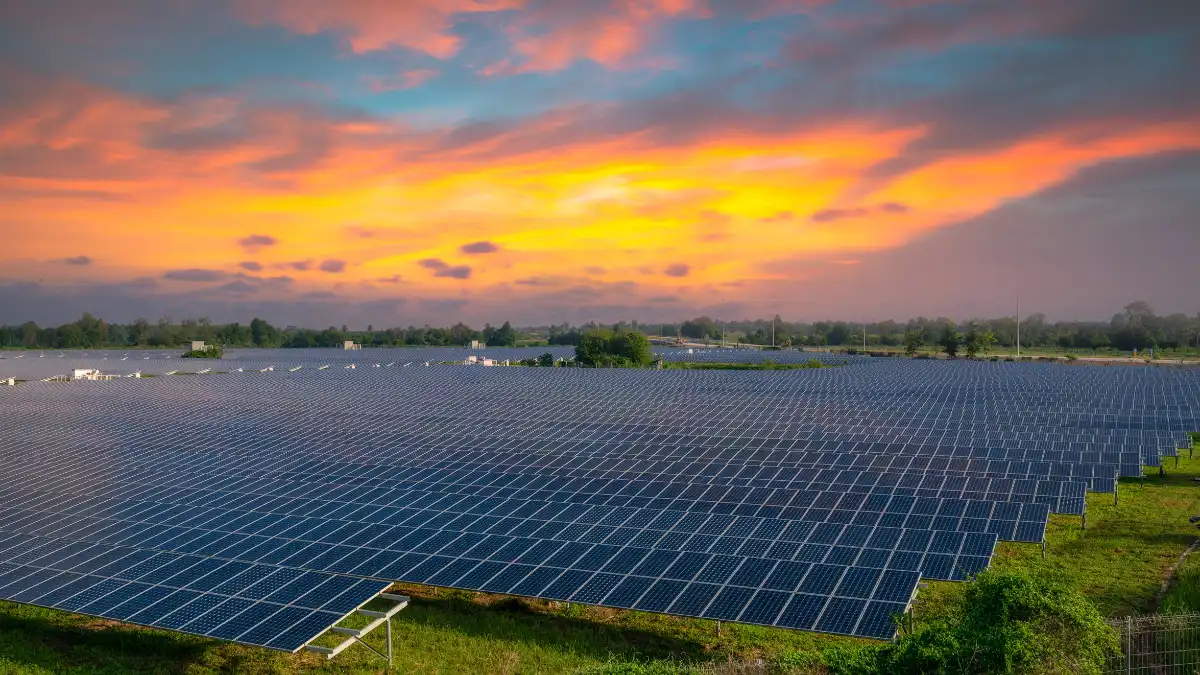
Indore has launched a 60MW solar power plant financed through green bonds, marking a significant step in municipal climate finance innovation. The project is expected to reduce electricity costs for urban services, lower carbon emissions, and generate additional revenue through carbon credits. By linking public participation with clean energy investment, the initiative sets a new precedent for how cities can fund and scale renewable infrastructure. It also highlights the growing role of local governments in driving India’s energy transition and advancing sustainable urban development.
Key Overview
- Indore commissions 60MW solar power plant
- Funded through ₹244 crore green bond issuance
- Total project cost: ₹271 crore
- Expected to save ₹4–5 crore monthly in power costs
- Generates 9.6 crore units annually
- Cuts 1.46 lakh tonnes of CO₂ emissions per year
A Landmark Green Bond-Financed Solar Project
Indore has taken a major step in advancing urban renewable energy adoption with the commissioning of a 60-megawatt solar power plant, inaugurated by Mohan Yadav. The project is widely recognized as one of India’s first municipal renewable energy initiatives financed through green bonds, marking a significant milestone in the evolution of climate finance at the city level.
Developed by the Indore Municipal Corporation, the solar facility reflects a growing shift in how urban infrastructure is being funded. Rather than relying solely on traditional government allocations or concessional financing, municipalities are increasingly turning to capital markets to raise dedicated climate finance. In this case, the use of green bonds not only enabled access to funding but also aligned the project with global sustainability standards, attracting environmentally conscious investors.
Beyond its financial structure, the project introduces an innovative public participation model, allowing citizens to indirectly contribute to and benefit from clean energy investments. This approach strengthens the link between urban residents and sustainability initiatives, fostering greater awareness, accountability, and long-term support for climate-focused development. It also positions Indore as a pioneer in integrating community-backed financing with renewable energy deployment, setting a precedent for other cities across India.
Markets move fast; don’t get left behind. We’ve paired the Serrari Group Market Index with a curated Marketplace and a comprehensive Wealth Builder Course to ensure you have the data—and the skills—to act on it.
Innovative Financing and Cost Efficiency
The solar project was developed at a total cost of approximately ₹271.16 crore, with ₹244 crore raised through green bonds issued as a public offering. This financing structure represents a significant shift toward market-based funding mechanisms for municipal infrastructure, reducing dependence on budgetary allocations and enabling faster project execution.
In addition to bond financing, the project received supplementary support from the central government, reinforcing its strategic importance within India’s broader clean energy transition. The combination of public capital and institutional backing highlights the growing role of blended finance models, where different funding sources are combined to reduce risk and enhance project viability.
One of the most immediate and tangible benefits of the solar plant is its impact on operational costs. The Indore Municipal Corporation currently spends approximately ₹25 crore per month on electricity, primarily to power the energy-intensive process of pumping water from the Narmada River to the city. By replacing a portion of this grid electricity with solar power, the project is expected to reduce monthly expenditure by around ₹4–5 crore, generating significant long-term savings.
These cost reductions not only improve the financial health of the municipal corporation but also free up resources that can be redirected toward other urban development priorities. Over time, the project is expected to deliver a strong return on investment, demonstrating how sustainable infrastructure can also be economically advantageous.
Powering Essential Urban Infrastructure
The solar plant has been developed as a captive energy source dedicated to powering critical municipal services, particularly water supply operations—one of the most energy-intensive functions of urban governance. By securing a reliable and cost-effective source of electricity, the project enhances the resilience and efficiency of essential public services.
Located in Khargone district on 211 acres of largely barren land, the project has been strategically sited to minimize land-use conflicts while enabling large-scale renewable energy deployment. This approach ensures that the expansion of clean energy infrastructure does not come at the expense of agricultural productivity or urban land availability.
The facility is expected to generate approximately 9.6 crore units of electricity annually, at an estimated cost of ₹3.50 per unit—significantly lower than conventional grid electricity, which typically ranges between ₹6 and ₹9 per unit. This substantial cost differential underscores the economic advantages of renewable energy, particularly for high-consumption municipal operations.
Beyond cost savings, the project also improves energy security and predictability, reducing exposure to fluctuating electricity prices and potential supply disruptions. By integrating renewable energy directly into core infrastructure systems, Indore is demonstrating how cities can build more sustainable, resilient, and self-reliant urban energy models.
Environmental Impact and Carbon Credit Potential
Beyond its financial and operational advantages, the project delivers significant environmental benefits, reinforcing Indore’s commitment to sustainable urban development. The solar plant is expected to prevent approximately 1.46 lakh tonnes of carbon dioxide emissions annually, making a meaningful contribution to both local climate targets and broader national decarbonization goals.
This reduction is particularly important in the context of urban infrastructure, where energy-intensive services—such as water supply, transportation, and waste management—are major contributors to emissions. By integrating renewable energy directly into these systems, the project demonstrates how cities can decarbonize core operations without compromising service delivery.
In addition to emissions reduction, the solar plant is projected to generate over ₹18 crore in carbon credit revenue, creating a new and sustainable income stream for the municipal corporation. This introduces a powerful financial dimension to environmental action, where emissions reductions are not only beneficial for the climate but also economically valuable.
The combination of cost savings from reduced electricity purchases and revenue from carbon credits highlights the growing importance of integrating climate finance mechanisms with infrastructure development. Such models enhance project viability, improve financial returns, and make sustainable investments more attractive to both public and private stakeholders.
Importantly, the plant operates with no direct emissions during its lifecycle, reinforcing its role as a clean and reliable energy source. This positions the project as a key component of Indore’s broader strategy to transition toward low-carbon, environmentally responsible urban systems.
Context is everything. While you follow today’s updates, use the Serrari Group Market Index and Marketplace to spot emerging shifts. Need to sharpen your edge? Our Wealth Builder Course turns these insights into a professional-grade strategy.
A Model for Municipal Climate Finance in India
Officials have emphasized that the project sets a new benchmark for urban local bodies across India, demonstrating how cities can effectively combine renewable energy deployment with innovative, market-based financing strategies. At a time when municipalities are under increasing pressure to deliver infrastructure while managing constrained budgets, the initiative offers a practical blueprint for unlocking capital and accelerating sustainable development.
By leveraging green bonds and adopting a public participation model, Indore is showcasing a scalable and replicable approach that other municipalities can adopt. Unlike traditional funding mechanisms that rely heavily on government allocations or external aid, this model taps into capital markets and citizen investment, broadening the funding base and strengthening financial resilience.
The project clearly illustrates how cities can:
- Reduce operational costs, improving long-term fiscal sustainability and freeing up resources for other urban priorities
- Enhance energy security, by reducing dependence on volatile grid electricity and external energy suppliers
- Lower carbon emissions, directly contributing to national and global climate commitments
- Attract private and citizen investment, creating a more inclusive and diversified financing ecosystem
The use of green bonds is particularly significant in this context. As global demand for ESG-aligned investment products continues to rise, municipalities now have an opportunity to access long-term, lower-cost capital while aligning infrastructure projects with environmental and sustainability objectives. This not only improves financing conditions but also enhances credibility among investors, who are increasingly prioritizing transparency and impact.
Beyond financing, the model also introduces a greater level of accountability and stakeholder engagement. By linking citizens to climate investments, it fosters a sense of ownership and trust in public projects—an important factor in ensuring long-term success and political support.
Moreover, the success of this initiative highlights the growing potential for municipal-level climate finance innovation, where local governments take a proactive role in structuring, financing, and delivering sustainable infrastructure. This represents a clear shift away from traditional top-down funding models toward more decentralized, flexible, and market-driven approaches.
As cities across India and other emerging markets face rising energy demand, climate risks, and infrastructure gaps, Indore’s model demonstrates that financial innovation can be as important as technological innovation. By integrating capital markets, policy alignment, and sustainability goals, municipalities can unlock new pathways for development—positioning themselves not just as service providers, but as active players in the global climate finance ecosystem.
Outlook: Scaling Urban Renewable Energy
The commissioning of the 60MW solar plant represents more than a standalone infrastructure project—it signals a broader transition toward decentralized, resilient, and financially sustainable urban energy systems.
In the near term, the focus will be on:
- Maximizing operational efficiency and cost savings, ensuring the project delivers its full financial potential
- Integrating solar generation into municipal services, particularly water supply and other energy-intensive operations
- Leveraging carbon markets, to generate additional revenue and strengthen financial performance
These priorities will be critical in demonstrating the long-term viability of the model and encouraging wider adoption.
Over the longer term, projects like this could catalyze a new wave of urban renewable energy initiatives across India, where cities adopt clean energy solutions supported by innovative financing mechanisms. As urbanization accelerates and energy demand continues to rise, the need for scalable, cost-effective, and sustainable infrastructure will become increasingly urgent.
Indore’s approach offers a compelling blueprint for addressing these challenges. By combining clean energy deployment, financial innovation, and public participation, the city is demonstrating how urban centers can simultaneously achieve economic efficiency and environmental sustainability.
Ultimately, this model highlights a broader transformation in how cities approach infrastructure—moving toward systems that are not only functional, but also financially resilient, environmentally responsible, and aligned with the future of sustainable development.
Your financial future isn’t something you wait for—it’s something you build.
The real question is: when do you begin?
Move beyond simply staying informed.
Navigate the markets with clarity—track trends through the Serrari Group Market Index, uncover opportunities in the Serrari Marketplace, and build practical knowledge with our Curated Wealth Builder Course.
Stay connected to what truly matters.
Get daily insights on macro trends and financial movements across Kenya, Africa, and global markets—delivered through the Serrari Newsletter.
Growth opens doors.
Advance your career through professional programs including ACCA, HESI A2, ATI TEAS 7 , HESI EXIT , NCLEX – RN and NCLEX – PN, Financial Literacy!🌟—designed to move you forward with confidence.
See where money is flowing—clearly and in real time.
Track Money Market Funds, Treasury Bills, Treasury Bonds, Green Bonds, and Fixed Deposits, alongside global and African indexes, key economic indicators, and the evolving Crypto and stablecoin landscape—all within Serrari’s Market Index.