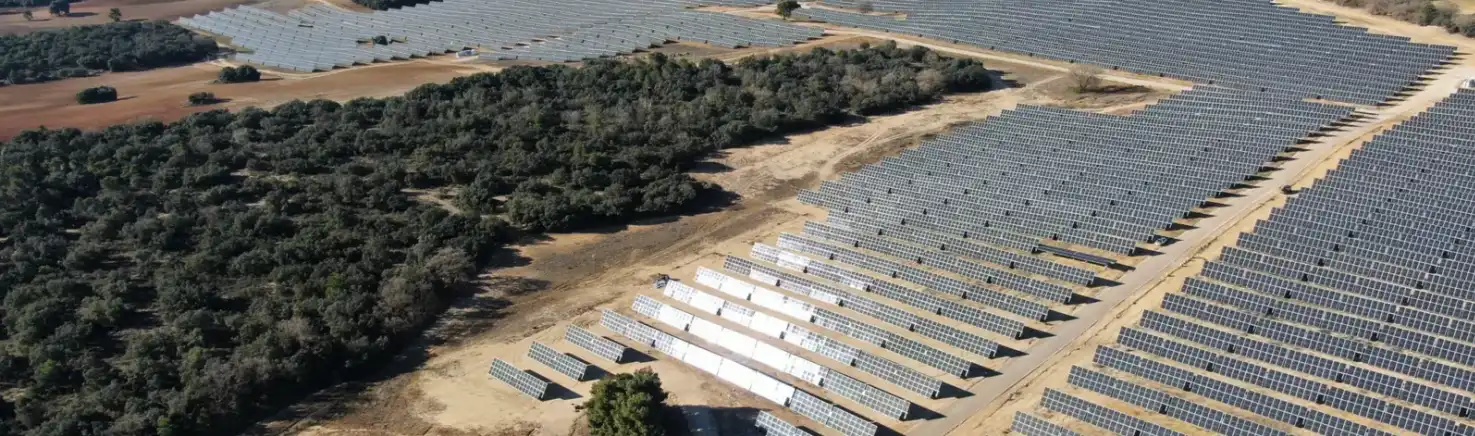
Grenergy has signed a 12-year tolling deal for a solar-plus-storage project in Spain, strengthening hybrid renewable models and securing long-term revenue stability. The agreement supports the integration of battery storage with solar generation, improving flexibility and grid reliability. By locking in predictable revenues, the project reduces exposure to electricity market volatility. It also reflects growing investor confidence in hybrid energy systems across Europe. Overall, the deal highlights the increasing role of storage-backed renewables in the energy transition.
Key Overview
- Grenergy signs 12-year tolling agreement
- Covers Escuderos hybrid project in Spain
- Project includes 200 MW solar + 680 MWh battery storage
- Contract begins July 2028
- Marks one of Europe’s largest hybrid BESS deals
A Landmark Hybrid Energy Deal in Europe
Grenergy has signed a 12-year financial tolling agreement for its flagship Escuderos hybrid project in Spain, marking one of the most significant battery energy storage transactions of its kind in Europe.
The project, located in Castilla-La Mancha, combines a 200 MW solar photovoltaic (PV) plant with a 680 MWh battery energy storage system (BESS), positioning it at the forefront of Europe’s rapidly expanding hybrid renewable energy sector. By integrating generation and storage within a single asset, the project is designed to maximize efficiency, improve grid flexibility, and enhance the overall value of renewable energy production.
The agreement has been secured with an unnamed international utility holding an investment-grade credit rating from Moody’s and Standard & Poor’s. This aspect is particularly important, as it reinforces the financial strength and credibility of the transaction, reducing counterparty risk and making the project more attractive to investors.
Set to commence in July 2028, the tolling contract establishes a long-term and predictable revenue framework while significantly reducing exposure to short-term electricity market volatility. The scale and duration of the agreement place it among the most notable tolling structures currently active in the European energy market, highlighting the growing maturity of storage-backed renewable projects.
More broadly, the deal reflects a shift in how renewable energy assets are financed and operated, with hybrid models increasingly favored for their ability to deliver both stable returns and operational flexibility.
Markets move fast; don’t get left behind. We’ve paired the Serrari Group Market Index with a curated Marketplace and a comprehensive Wealth Builder Course to ensure you have the data—and the skills—to act on it.
Understanding the Tolling Model in Energy Storage
The tolling agreement structure is a central component of the project’s financial and operational model. Under this arrangement, the utility effectively pays for access to the battery system’s capacity, while Grenergy retains responsibility for operating the storage asset and managing trading activities.
This model creates a clear division of roles: the utility secures access to flexible energy capacity, while Grenergy leverages its expertise to optimize battery performance and market participation. The contract covers approximately 80% of the battery system’s capacity, assuming 1.5 charge-discharge cycles per day, and establishes a pricing mechanism linked to the day-ahead electricity market.
The result is a predictable and stable revenue stream, which is critical for attracting long-term investment in energy storage projects. At the same time, the structure preserves upside potential by allowing the project to participate in additional revenue-generating activities.
Beyond the tolling payments, the Escuderos project is expected to generate income from multiple sources, including:
- Participation in ancillary services markets, such as frequency regulation and grid balancing
- Trading in wholesale electricity markets, capturing price differentials
- Potential capacity payments, depending on regulatory developments in Spain
This diversified revenue model enhances the project’s financial resilience and reduces reliance on any single income stream. It also reflects the evolving role of battery storage in energy markets, where assets are increasingly valued for their flexibility and ability to provide multiple services simultaneously.
Expanding Hybrid Renewable Energy in Spain
The Escuderos project represents Grenergy’s first major hybrid solar-plus-storage development in Spain, signaling the beginning of a broader expansion strategy in one of Europe’s most dynamic renewable energy markets.
The solar component of the project is already operational under a 12-year power purchase agreement (PPA) signed with Galp in 2020. The integration of battery storage significantly enhances the value of this asset by enabling energy shifting—storing excess solar generation during the day and dispatching it during periods of higher demand or higher prices.
Construction of the battery system is expected to begin in the second half of the year, with commissioning targeted for 2027. Once operational, the hybrid system will provide a more stable and controllable power output, improving both efficiency and grid reliability.
This hybrid approach is becoming increasingly important as renewable energy penetration rises across Europe. While solar and wind generation are essential for decarbonization, their variability presents challenges for grid management. By combining generation with storage, hybrid systems can:
- Smooth out fluctuations in power supply
- Reduce curtailment of renewable energy
- Enhance grid stability and reliability
- Improve the economic value of renewable assets
As a result, hybrid solar-plus-storage projects are emerging as a key solution for integrating large-scale renewables into modern power systems. For Spain—one of Europe’s leading solar markets—this model is likely to play a central role in the next phase of energy transition.
Building on a Proven Model from Chile
The Escuderos project forms part of a broader strategy by Grenergy to replicate a proven hybrid renewable energy model that it has already successfully deployed in Chile. The company’s Oasis platforms—including Oasis de Atacama and Oasis Central—combine large-scale solar generation with battery storage to deliver reliable, dispatchable clean energy, addressing one of the key limitations of standalone renewable assets.
These projects have established Grenergy as a leader in hybrid energy systems:
- Oasis de Atacama:
- 2 GW solar capacity
- 11 GWh storage
- €2 billion investment
- Oasis Central:
- 1.1 GW solar
- 4 GWh storage
- €900 million investment
Together, these platforms demonstrate how integrating solar and storage at scale can transform intermittent renewable generation into a more predictable and controllable energy supply. This is particularly valuable in markets with high solar irradiance, where excess generation during peak daylight hours can be stored and redistributed to match demand patterns.
Beyond technical performance, the Chilean projects have also validated the commercial viability of hybrid models. By combining long-term contracts, diversified revenue streams, and optimized energy dispatch, they provide a blueprint for structuring large-scale renewable investments.
By bringing this model to Spain, Grenergy aims to leverage its operational experience, financial structuring capabilities, and technological expertise to accelerate the development of a hybrid renewable portfolio across European markets. This transfer of knowledge is particularly important as Europe moves toward higher renewable penetration and requires more advanced energy solutions.
Context is everything. While you follow today’s updates, use the Serrari Group Market Index and Marketplace to spot emerging shifts. Need to sharpen your edge? Our Wealth Builder Course turns these insights into a professional-grade strategy.
Scaling Battery Storage Across Europe
In parallel with its hybrid developments, Grenergy is advancing its Greenbox platform, a standalone battery storage initiative with a pipeline exceeding 30 GWh across Europe. This platform reflects the company’s broader strategy to position itself not only as a renewable energy producer but also as a key player in energy storage infrastructure.
The pipeline spans multiple strategic markets, including:
This geographic diversification highlights both the scale of opportunity and the growing demand for storage solutions across different regulatory and market environments. Each of these countries is experiencing increasing renewable energy penetration, creating a need for flexible systems that can balance supply and demand.
Battery storage is rapidly becoming a cornerstone of modern power systems, playing a critical role in:
- Balancing supply and demand in real time
- Managing peak loads and reducing grid stress
- Supporting grid stability through frequency and voltage control
- Enabling higher penetration of renewables by mitigating intermittency
As renewable capacity continues to expand across Europe, the importance of storage will only increase. Without sufficient storage, excess renewable energy can be curtailed, and grid instability can become a growing concern.
As a result, investments in battery storage infrastructure are no longer optional—they are becoming essential components of the energy transition, enabling the shift toward cleaner, more resilient, and more efficient power systems.
Outlook: Hybrid Projects Drive the Next Phase of Energy Transition
The Escuderos tolling agreement underscores a broader transformation in the energy sector, where integrated renewable and storage solutions are becoming the new standard for large-scale energy projects. Hybrid systems are increasingly viewed as essential for delivering clean energy that is not only sustainable but also reliable, flexible, and economically viable.
In the near term, long-term contractual structures such as tolling agreements will play a critical role in reducing investment risk and attracting institutional capital. By providing predictable revenue streams, these agreements make it easier to finance capital-intensive projects, particularly in emerging areas like battery storage.
Over the longer term, the combination of solar generation and battery storage is expected to become a default model for renewable energy development. As electricity markets evolve and grid requirements become more complex, hybrid systems will be essential for:
- Ensuring grid stability
- Optimizing energy use
- Maximizing the value of renewable generation
For Grenergy, the Escuderos project represents the beginning of a new phase in its European strategy—one that positions the company at the forefront of the transition toward flexible, storage-backed renewable energy systems.
Ultimately, the success of projects like Escuderos will help define the next stage of the global energy transition, where the focus shifts from simply generating clean power to delivering clean energy reliably, efficiently, and at scale.
Your financial future isn’t something you wait for—it’s something you build.
The real question is: when do you begin?
Move beyond simply staying informed.
Navigate the markets with clarity—track trends through the Serrari Group Market Index, uncover opportunities in the Serrari Marketplace, and build practical knowledge with our Curated Wealth Builder Course.
Stay connected to what truly matters.
Get daily insights on macro trends and financial movements across Kenya, Africa, and global markets—delivered through the Serrari Newsletter.
Growth opens doors.
Advance your career through professional programs including ACCA,HESI A2,ATI TEAS 7,HESI EXIT ,NCLEX – RNandNCLEX – PN, Financial Literacy!🌟—designed to move you forward with confidence.
See where money is flowing—clearly and in real time.
Track Money Market Funds, Treasury Bills, Treasury Bonds, Green Bonds, and Fixed Deposits, alongside global and African indexes, key economic indicators, and the evolving Crypto and stablecoin landscape—all withinSerrari’s Market Index.