
















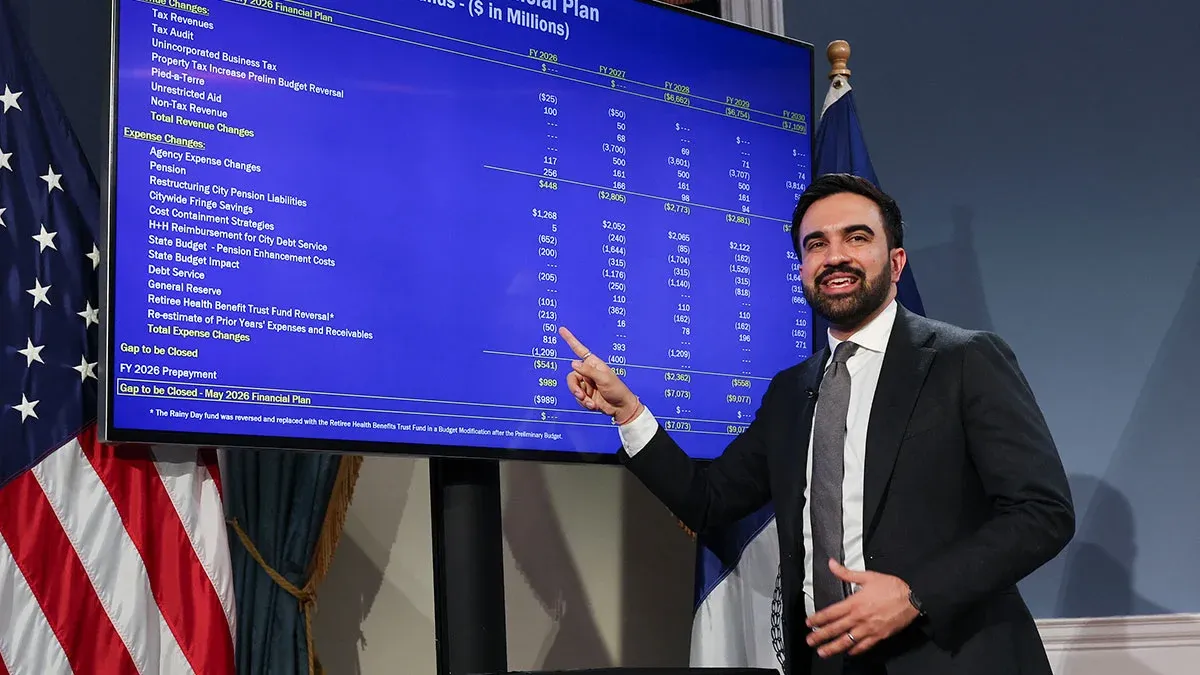
New York City Mayor Zohran Mamdani released a $124.7 billion executive budget for fiscal year 2027 that closes a $12 billion inherited deficit without raising property taxes, cutting services, or tapping reserve funds. The budget relies on a combination of nearly $8 billion in state aid from Governor Kathy Hochul, $1.77 billion in agency savings, a new pied-à-terre tax on luxury second homes expected to raise $500 million, and $1.64 billion in savings from extending the amortization period on unfunded pension liabilities. However, City Comptroller Mark Levine and fiscal watchdogs have warned that the plan depends heavily on $2.8 billion in one-time measures, and out-year budget gaps remain enormous — $7.1 billion in fiscal year 2028, rising to $9.8 billion by 2030. With recession risks elevated and economic uncertainty driven by the Iran conflict and federal policy volatility, critics argue the mayor’s reliance on short-term fixes rather than structural savings leaves the city dangerously exposed to future fiscal shocks.
Markets move fast; don’t get left behind. We’ve paired the Serrari Group Market Index with a curated Marketplace and a comprehensive Wealth Builder Platform to ensure you have the data—and the skills—to act on it.
Key Overview
- Budget Size: $124.7 billion for fiscal year 2027
- Inherited Deficit: Approximately $12 billion across FY2026 and FY2027
- State Aid: Nearly $8 billion over two years from Governor Hochul
- Pied-à-Terre Tax: $500 million annually from a surcharge on non-resident second homes worth over $5 million
- Pension Restructuring: $1.64 billion in FY2027 savings by extending amortization of unfunded liabilities
- Agency Savings: $1.77 billion from Chief Savings Officers across city agencies
- One-Time Measures: $2.8 billion, per Comptroller Levine’s estimate
- Future Budget Gaps: $7.1 billion (FY2028), $9.1 billion (FY2029), $9.8 billion (FY2030)
- Property Tax Hike: Dropped from the plan after being proposed at 9.5% in February
- Recession Risk: Goldman Sachs estimates 25%; Moody’s Analytics places odds at 40%
New York City Mayor Zohran Mamdani took a victory lap with the release of his $124.7 billion executive budget for fiscal year 2027, which begins on July 1. He has closed a $12 billion funding gap he inherited on taking office, he claims, without resorting to the austerity measures demanded by fiscal hawks who, in his framing, want to harm working people and benefit the wealthy. “It is evidence of a new era of government in our city, one that can balance both ambition and fiscal responsibility,” Mamdani said at City Hall.
Balancing the budget is, of course, the mayor’s job — by law. Mamdani deserves credit for submitting a credible financial plan. Despite his inexperience, he has mastered the budget process and successfully worked with the governor and state legislature to secure the relief he needed. But his plan is designed to hold for just one year. If he had listened more closely to the budget critics, less trouble would be in store for the future. Depending on unfolding events — many beyond his control — working New Yorkers may yet find their benefits under serious strain.
Closing the Gap in Two Phases
The mayor closed the funding gap in two stages. In his preliminary budget last February, he included $6.6 billion in additional tax revenue over fiscal years 2026 and 2027, along with $1.5 billion in state aid promised by Governor Kathy Hochul. That closed most of the gap, but Mamdani also included $1.77 billion in projected agency savings generated through a new requirement that every city agency appoint a Chief Savings Officer, drew down reserves, and proposed a $3.7 billion property tax increase — a 9.5% rate hike.
The property tax proposal was in lieu of the mayor’s preferred increase in personal and business income taxes, which required state legislation that the governor opposed. City Council Speaker Julie Menin immediately declared it off the table, and commentators criticised the plan to draw down already inadequate reserves. Mamdani subsequently dropped both proposals.
For the May executive budget, the major new revenue measures include a pied-à-terre tax — a levy on high-value non-resident second homes worth more than $5 million — intended to raise $500 million annually. The tax attracted national attention when Mamdani stood outside billionaire financier Ken Griffin’s $238 million penthouse to announce it, prompting Griffin to call the video “creepy and weird” and say that Citadel would expand in Miami over New York in response. The tax is expected to be passed by the legislature with the governor’s support as part of current state budget negotiations, though the precise design has not been finalised.
Mamdani also proposes raising $68 million through changes to the unincorporated business tax (UBT) by reducing the credit self-employed taxpayers receive on their city income tax, a change the city council can enact alone. That would affect taxpayers with taxable incomes as low as $142,000. The UBT, unique to New York City, already creates an incentive for self-employed high earners to live outside the city, and this would strengthen that incentive further.
Pension Restructuring and Spending Deferrals
On the spending side, the mayor’s largest single move is extending the amortization period for unfunded pension liabilities, a tactic that enjoys support from both the governor and the state legislature. The restructuring would save $1.64 billion in fiscal year 2027 by creating more predictable annual payments, with further savings in subsequent years. First Deputy Mayor Dean Fuleihan said the proposal would establish level annual payments through 2037 to move the city’s five pension systems toward full funding; the systems are currently approximately 86% funded.
However, those savings extend pension amortization payments well into the 2030s, fuelling budget gaps a future mayor will need to close. William Glasgall of the Volcker Alliance warned in The City that extending pension amortization “creates a debt that’s more expensive than muni bonds,” meaning taxpayers will be paying for today’s savings for years to come. Andrew Perry of the Fiscal Policy Institute offered a more sympathetic assessment, calling the restructuring a “pretty sensible” smoothing of a contribution schedule originally designed by state lawmakers about 15 years ago.
The budget also claims $508 million in savings by delaying implementation of state class-size mandates, which will now take effect later than originally planned. Mamdani promises further Department of Education savings by bringing the costs of due process special education cases under control — something the city has not yet been able to do. Additionally, the mayor projects $519 million in savings by better controlling the growth of CityFHEPS, the city’s rental housing assistance programme, whose costs have more than tripled over the past three fiscal years.
Context is everything. While you follow today’s updates, use the Serrari Group Market Index and Marketplace to spot emerging shifts. Need to sharpen your edge? Our Wealth Builder Platform turns these insights into a professional-grade strategy.
The One-Shot Problem
Mamdani’s proposed savings are heavily concentrated in fiscal year 2027 and in many cases do not recur. Comptroller Mark Levine, while calling the executive budget “significantly improved” over the February plan, warned that it relies on $2.8 billion in one-time measures and $2.3 billion in short-term pension savings “without solving for the fact that City government continues to spend more than we take in, even in a year of record revenues.”
The consequences are visible in the out-years. Budget gaps remain enormous: $7.1 billion in fiscal year 2028, $9.1 billion in fiscal year 2029, and $9.8 billion in fiscal year 2030. Levine urged the city to reduce its reliance on one-time actions and build up reserves before the budget is finalised.
As veteran budget reporter Greg David wrote in The City, the budget’s reliance on short-term fixes “sets up yet another push for the mayor’s campaign promises to tax the rich next year, after the mid-term elections.” That is a deliberate strategic choice. Mamdani is a man of the Left, and his objective is that taxing and spending will rise in real terms throughout his mayoralty. Governor Hochul faces re-election in November, and the local impact of President Trump’s signature tax bill will start hitting home in 2027, creating political conditions that may favour new revenue measures.
Much of the state aid that underpins the budget is also time-limited. Hochul has promised $1.6 billion for the first two years of Pre-K expansion for three-year-olds, but there is no funding committed for future years when the programme is expected to grow rapidly. Emily Eisner of the Fiscal Policy Institute acknowledged that the city will need future recurring revenues to sustain its commitments, particularly around childcare.
Alternatives the Mayor Could Have Pursued
The mayor could have made different choices — saving more and spending less in fiscal year 2027 and beyond, with impacts falling far short of the rhetorical “austerity budget.” The budget forecasts the city-funded civilian workforce rising from 110,890 on June 30, 2026 to 111,797 a year later, remaining roughly constant thereafter. Building in a gentle decline — for example, by allowing agencies to fill only a portion of vacant positions — could save hundreds of millions annually.
The size of the teacher workforce is also projected to remain roughly constant at just under 100,000. Manhattan Institute researcher Danyela Souza Egorov has pointed out that Department of Education policies in the face of declining enrolments — including keeping open schools with fewer than 150 pupils and holding staffing levels harmless in schools where enrolment drops — cost the city additional hundreds of millions a year, requiring the hiring of more teachers than educational need would dictate.
Comptroller Levine himself noted the restraint was notable compared to past practice. “His additional spending here was pretty modest. Pretty remarkable. It’s been a while since we’ve seen a mayor be this conservative on spending,” he told City & State NY. But the structural gap between recurring revenues and recurring expenses remains unaddressed.
Recession Risks and Economic Uncertainty
The reliance on one-time rather than ongoing savings leaves the city highly vulnerable to a future recession, in which tax revenues plunge and genuine austerity becomes unavoidable. No one can confidently predict the effects on the U.S. economy of the global disruption caused by the Iran war and the closure of the Strait of Hormuz, on top of the consequences of skyrocketing federal debt and erratic trade and immigration policies.
Economic forecasters hold diverging views. Goldman Sachs chief economist Jan Hatzius recently lowered the firm’s 12-month recession probability from 30% to 25%, citing resilient economic activity and eased financial conditions. Mark Zandi of Moody’s Analytics, however, sees recession odds as “highly elevated” at 40%. JPMorgan entered 2026 with a 35% recession probability baked into its outlook. Goldman’s own growth projections show U.S. GDP cooling to just 1.25–1.75% in the second half of 2026, a level the firm describes as near “stall speed.”
The city’s own economic data reflects the uncertainty. The executive budget document notes that full-year 2026 Wall Street profits are projected to decline to a still historically high $45 billion, down from a record $65 billion in 2025, with further normalisation expected beyond 2027. Private-sector employment in New York City was down 57,300 jobs year-over-year in March, a decline of 1.3%.
A Budget That Bets on the Future
Enough uncertainty exists for New Yorkers to be concerned about Mamdani’s confidence that he can keep spending more than the city takes in, balancing the budget with one-shots, borrowing, and tax hikes. One has to go back a long time — to Mayor Michael Bloomberg, in the wake of the Great Recession in spring 2009 — to find a genuine proposed austerity budget. Bloomberg’s plan actually cut spending, from $61.2 billion in FY2009 to $59.4 billion in FY2010. It hurt in the short term, but the result was to bequeath new mayor Bill de Blasio roaring economic growth and bountiful revenues when he took office in January 2014.
For now, Mamdani has delivered a budget that avoids immediate pain and preserves services for working New Yorkers. The political achievement is real. But the fiscal foundation is built largely on temporary measures, deferred costs, and the assumption that future revenues — whether from higher taxes on the wealthy or from continued economic growth — will materialise when needed. If they do not, the city’s next budget cycle could prove far more painful than this one. Mamdani may yet need to study the Bloomberg playbook and learn its lessons.
Sources: NYC Mayor’s Office / ABC7 New York / NBC New York / CBS New York / amNewYork / THE CITY / City & State New York / CNN Business / Jacobin / NYC Comptroller’s Office / City Journal / Manhattan Institute / 710 WOR / AOL News / Fortune / TheStreet / Newsweek / Prism News / Fiscal Policy Institute / Volcker Alliance
Your financial future isn’t something you wait for—it’s something you build.
The real question is: when do you begin?
Move beyond simply staying informed.
Navigate the markets with clarity—track trends through the Serrari Group Market Index, uncover opportunities in the Serrari Marketplace, and build practical knowledge with our Curated Wealth Builder Platform.
Stay connected to what truly matters.
Get daily insights on macro trends and financial movements across Kenya, Africa, and global markets—delivered through the Serrari Newsletter.
Growth opens doors.
Advance your career through professional programs including ACCA, HESI A2, ATI TEAS 7 , HESI EXIT , NCLEX – RN and NCLEX – PN, Financial Literacy!🌟—designed to move you forward with confidence.
See where money is flowing—clearly and in real time.
Track Money Market Funds, Treasury Bills, Treasury Bonds, Green Bonds, and Fixed Deposits, alongside global and African indexes, key economic indicators, and the evolving Crypto and stablecoin landscape—all within Serrari’s Market Index.