Morocco is rapidly becoming a strategic base in the global electric vehicle supply chain as Chinese manufacturers invest heavily in batteries, cathodes, anodes and auto parts production. The shift strengthens Morocco’s industrial ambitions, but it is also drawing scrutiny from European policymakers worried that Chinese companies could use Moroccan production as a route into the European market.
Key Overview
- Chinese EV and battery firms are expanding production in Morocco.
- Gotion High-Tech is building a major battery plant in Kenitra.
- BTR New Material Group is developing a cathode facility near Tangier.
- Morocco’s EU trade access is central to its appeal as a manufacturing base.
- European regulators are watching for possible tariff circumvention.
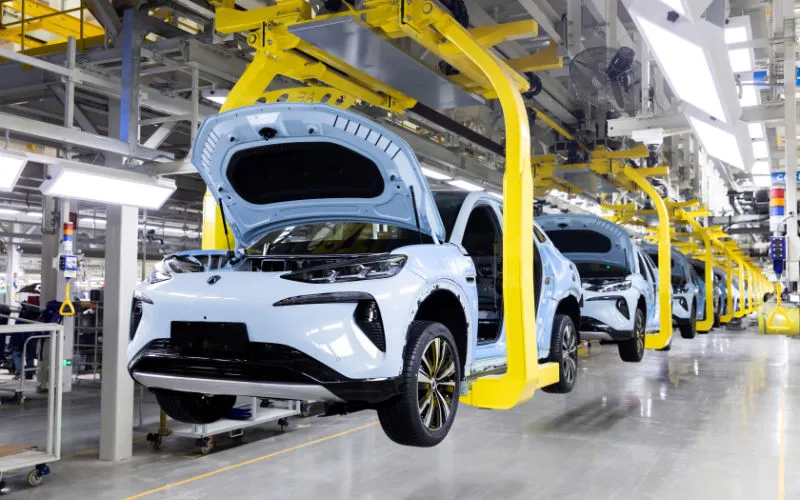
Morocco’s automotive industry is entering a new phase as Chinese investment pushes the country deeper into the electric vehicle supply chain. What began as a manufacturing success story built around Renault, Stellantis and export-focused vehicle assembly is now becoming a larger contest involving batteries, components, trade rules and industrial policy.
The Mineral Advantage: Phosphate, Cobalt, and LFP Chemistry
Chinese investment linked to Morocco’s EV ecosystem has grown sharply, with the Financial Times reporting that Chinese companies have committed about $6 billion over three years as manufacturers look for production bases close to Europe. The logic is straightforward: Morocco offers established automotive infrastructure, access to Atlantic and Mediterranean shipping routes, competitive labour costs and preferential trade links with the European Union.
One of the biggest projects is Gotion High-Tech’s planned battery plant in Kenitra. The company signed an agreement for a $1.3 billion battery facility, with initial capacity expected at 20 GWh and longer-term expansion potential. The project is positioned as a major step toward building an integrated battery supply chain in North Africa.
Other Chinese suppliers are also moving into the country. BTR New Material Group received approval to build a $300 million cathode plant near Tangier, with planned annual capacity of 50,000 tonnes. Reuters has also reported that companies including Hailiang and Shinzoom are setting up battery-related operations, reinforcing Morocco’s effort to move beyond traditional vehicle assembly into higher-value EV components.
For Morocco, the opportunity is significant. The country already hosts major vehicle production operations for Renault and Stellantis and has built a strong network of suppliers. Stellantis has also moved to expand its Moroccan footprint, including plans to more than double capacity at its Kenitra plant as part of a wider push into affordable vehicles and electrified production.
Context is everything. Stay ahead of shifting trends with today’s market updates, and uncover emerging opportunities using the Serrari Group Market Index and Marketplace. Then, take control of your own financial future by exploring our Money & Life Reset Transformation Blueprint ™ to build stronger habits, create better systems, and design a path toward lasting wealth.
The Rules of Origin Battleground
Europe, however, is increasingly cautious. The EU has imposed additional duties on battery electric vehicles made in China after concluding that Chinese producers benefited from unfair subsidies. The European Commission said the measures apply to Chinese EV imports, with duties varying by producer under its definitive countervailing duties framework.
That has made Morocco’s trade position more sensitive. The EU and Morocco have a long-standing trade relationship, with a free trade area established under the EU-Morocco Association Agreement. This gives Morocco an advantage as a manufacturing platform, but it also raises questions over how much local processing is required before products qualify for preferential access.
European concern is not theoretical. In 2025, the European Commission imposed countervailing duties on aluminium road wheels from Morocco after finding unfair subsidies, including support linked to China’s Belt and Road Initiative. That case has become a warning sign for how regulators may treat future auto-sector exports if they believe Chinese subsidies are being routed through third countries.
Moroccan officials have pushed back against the idea that the country is simply a backdoor for Chinese exports. Their argument is that Morocco is building genuine industrial depth, supported by local employment, supplier development, renewable energy potential and rules of origin that require meaningful transformation before products qualify for trade preferences.
The challenge for Europe is that Morocco is also important to European automakers. Aggressive trade action against Moroccan exports could hurt supply chains used by European manufacturers already operating in the country. That makes the situation more complicated than a simple EU-China tariff dispute.
Morocco now sits at the intersection of three powerful forces: China’s push to globalise its EV supply chain, Europe’s attempt to protect its industrial base, and Africa’s ambition to capture more value from green manufacturing. The outcome will depend on whether Morocco can prove that its EV boom is based on real local production rather than light processing — and whether Europe accepts that distinction.
Your financial future isn’t something you wait for—it’s something you build.
The real question is: when do you begin?
Move beyond simply staying informed.
Navigate the markets with clarity—track trends through the Serrari Group Market Index, uncover opportunities in the Serrari Marketplace, and build practical knowledge with our Curated Wealth Builder Platform.
Stay connected to what truly matters.
Get daily insights on macro trends and financial movements across Kenya, Africa, and global markets—delivered through the Serrari Newsletter.
Growth opens doors.
Advance your career through professional programs including ACCA, HESI A2, ATI TEAS 7 , HESI EXIT , NCLEX – RN and NCLEX – PN, Financial Literacy!🌟—designed to move you forward with confidence.
See where money is flowing—clearly and in real time.
Track Money Market Funds, Treasury Bills, Treasury Bonds, Green Bonds, and Fixed Deposits, alongside global and African indexes, key economic indicators, and the evolving Crypto and stablecoin landscape—all within Serrari’s Market Index.