


















Stanbic Bank Kenya has introduced direct Renminbi payment processing through China’s Cross-Border Interbank Payment System, giving businesses a more efficient channel for settling trade transactions with Chinese partners. The service is designed to shorten payment routes, improve transaction visibility and reduce reliance on multiple correspondent banks.
Key Overview
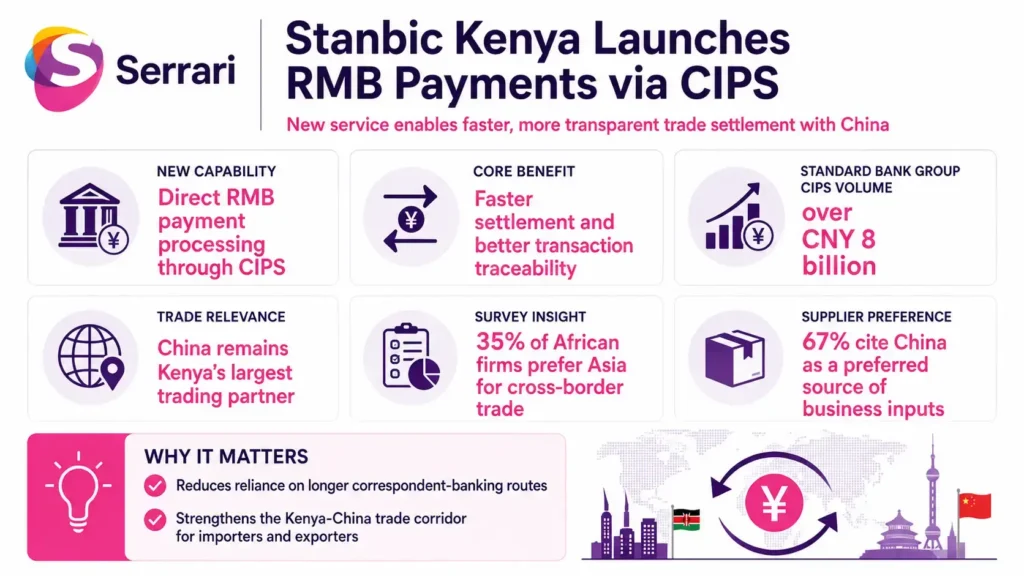
- Stanbic Bank Kenya can now process direct RMB payments through CIPS.
- The service offers faster settlement and greater payment traceability.
- Standard Bank Group has processed more than CNY8 billion through the system.
- The group and ICBC can jointly clear RMB transactions across 19 African markets.
- Asia is now the preferred trading region for 35% of surveyed African businesses.
- China is the preferred source of business inputs for 67% of survey respondents.
Stanbic Opens a Direct RMB Payment Route
Stanbic Bank Kenya officially launched the new payment capability during its 2026 China Day, an event that brought together investors, diplomats, business leaders and trade partners involved in Kenya–China commerce.
The new CIPS capability enables the bank to process payments directly in Renminbi, the official Chinese currency. Businesses importing goods or services from China can therefore settle eligible transactions without routing every payment through longer conventional correspondent-banking chains.
Stanbic said the system should provide faster payment processing, better transaction tracking and greater certainty over when funds reach their destination. The launch also gives Kenyan companies another settlement option when negotiating contracts with Chinese suppliers.
Jonathan Muga, Head of Corporate and Investment Banking at Stanbic Bank Kenya, described the launch as an important milestone for the Kenya–China trade corridor. He said businesses increasingly require payment systems that offer greater speed, transparency and operational efficiency.
Direct RMB settlement may also reduce the number of currency conversions required in some transactions. A Kenyan importer whose Chinese supplier invoices in RMB can settle the obligation in the requested currency rather than relying entirely on an intermediary currency, although the final cost will still depend on exchange rates, bank charges and the structure of the transaction.
How CIPS Changes Cross-Border Settlement
CIPS is a wholesale payment and clearing network authorised by the People’s Bank of China. It supports cross-border and offshore RMB transactions between participating financial institutions.
Standard Bank became the first African banking group authorised to offer transactions through the system. Its participation gives subsidiaries such as Stanbic Bank Kenya access to infrastructure intended to connect African businesses more directly with China’s financial system.
The network does not eliminate all compliance checks or foreign-exchange considerations. Banks must still complete anti-money-laundering screening, sanctions checks, payment validation and other regulatory processes. However, a more direct payment route can reduce operational complexity and provide better visibility than transactions passing through several institutions.
Standard Bank Group has already processed more than CNY8 billion, equivalent to approximately $1.2 billion, through CIPS. The transaction volume indicates growing demand among businesses for RMB-denominated settlement between Africa and China.
Standard Bank and ICBC Expand RMB Clearing
The Kenyan launch builds on Standard Bank Group’s strategic relationship with the Industrial and Commercial Bank of China. The two institutions were jointly authorised by the People’s Bank of China to operate as the Renminbi Clearing Bank of Africa.
Under the RMB clearing arrangement, the two banks can support clearing capacity across 19 African countries. Standard Bank is the first African-based bank to receive this authorisation.
The arrangement provides access to China’s domestic financial infrastructure, including liquidity, payment services and selected capital-market capabilities. For African companies, this could support a broader range of RMB services beyond basic payments as adoption grows.
The partnership combines ICBC’s position in China’s banking system with Standard Bank Group’s African network. This gives the institutions a platform for connecting Chinese companies operating in Africa with African businesses purchasing goods, equipment and services from China.
Context is everything. Stay ahead of shifting trends with today’s market updates, and uncover emerging opportunities using the Serrari Group Market Index and Marketplace. Then, take control of your own financial future by exploring our Money & Life Reset Transformation Blueprint ™ to build stronger habits, create better systems, and design a path toward lasting wealth.
China’s Role in Kenya’s Trade Corridor
China remains Kenya’s largest source of imported goods and one of its most important commercial partners. Kenyan companies source machinery, electronics, vehicles, construction materials, textiles and other manufactured products from Chinese suppliers.
The relationship remains uneven, with Kenya importing substantially more from China than it exports. Kenya has consequently pursued measures intended to improve access for its agricultural and manufactured products. In March 2026, the government announced that it had finalised trade negotiations with China following discussions over expanded duty-free access for Kenyan exports.
The CIPS launch does not directly correct the trade imbalance. However, it can improve the financial infrastructure supporting companies operating along the corridor. More efficient payments may help businesses manage suppliers, working capital and settlement timelines more effectively.
Stanbic already operates China-focused banking services that assist clients with trade finance, foreign exchange, payments and introductions to potential commercial partners. The RMB capability adds a dedicated settlement rail to that broader offering.
African Businesses Shift Toward Asian Markets
The launch also reflects changing trade preferences across Africa. The latest Africa Trade Barometer findings show that Asian countries are now the preferred trading partners for an average of 35% of businesses surveyed across 10 African markets, up from 24% in 2024.
China remains the leading source of business inputs, selected by 67% of respondents. Businesses highlighted competitive pricing, broad product variety and supply-chain reliability as key reasons for sourcing from the country.
As more African companies trade with Asian suppliers and customers, demand for payment infrastructure capable of settling transactions efficiently in regional currencies is likely to increase. Stanbic Bank Kenya’s CIPS launch places the lender within that shift while strengthening the financial links supporting Kenya–China commerce.
Sources: Xinhua / Standard Bank / Reuters / Africa Business Communities
Your financial future isn’t something you wait for—it’s something you build.
The real question is: when do you begin?
Move beyond simply staying informed.
Navigate the markets with clarity—track trends through the Serrari Group Market Index, uncover opportunities in the Serrari Marketplace, and build practical knowledge with our Curated Wealth Builder Platform.
Stay connected to what truly matters.
Get daily insights on macro trends and financial movements across Kenya, Africa, and global markets—delivered through the Serrari Newsletter.
Growth opens doors.
Advance your career through professional programs including ACCA, HESI A2, ATI TEAS 7 , HESI EXIT , NCLEX – RN and NCLEX – PN, Financial Literacy!🌟—designed to move you forward with confidence.
See where money is flowing—clearly and in real time.
Track Money Market Funds, Treasury Bills, Treasury Bonds, Green Bonds, and Fixed Deposits, alongside global and African indexes, key economic indicators, and the evolving Crypto and stablecoin landscape—all within Serrari’s Market Index.