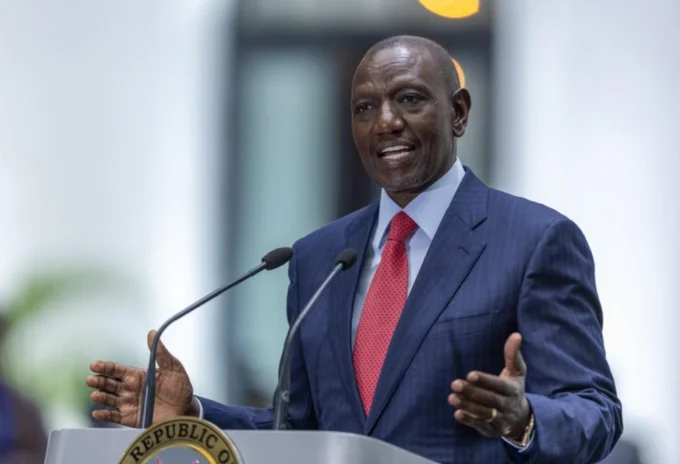
Kenyan households, businesses and industries will continue paying current electricity tariffs after the Ministry of Energy and Petroleum withdrew a retail tariff review application submitted by Kenya Power. Energy Cabinet Secretary Opiyo Wandayi said the decision followed consultations within government and engagement with energy-sector stakeholders. The move offers short-term relief to consumers and firms that were bracing for possible higher power costs from July 2026.
Key Overview
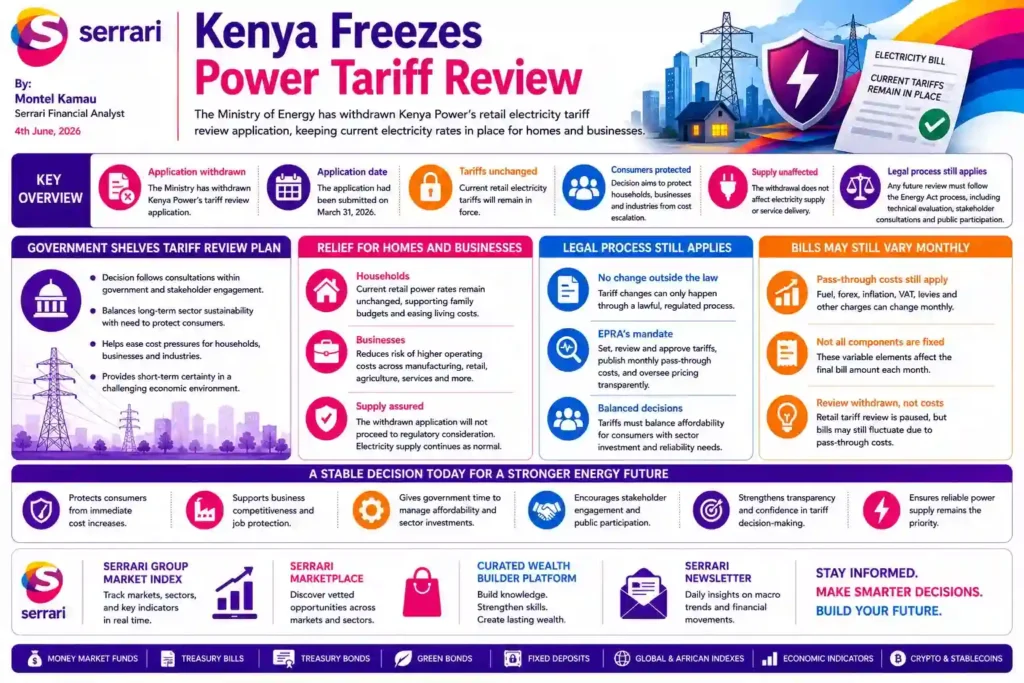
- The Ministry of Energy has withdrawn Kenya Power’s retail electricity tariff review application.
- The application had been submitted on March 31, 2026.
- Current retail electricity tariffs will remain in force.
- Wandayi said the decision is meant to protect households, businesses and industries from cost escalation.
- The withdrawal does not affect continued electricity supply or service delivery.
- Any future tariff review must follow the Energy Act, including technical evaluation, stakeholder consultations and public participation.
- Monthly power bills can still be affected by pass-through costs such as fuel, forex and statutory levies.
Government Shelves Tariff Review Plan
Kenya’s Ministry of Energy and Petroleum has withdrawn the proposed retail electricity tariff review, meaning consumers will continue using the current tariff structure unless a fresh review is lawfully initiated.
The application had been submitted by Kenya Power on March 31, 2026, on behalf of the electricity sector. It was expected to guide power pricing for the next tariff control period, covering the 2026/27 to 2028/29 financial years.
Wandayi said the withdrawal followed consultations within government and engagement with key energy-sector stakeholders. He said the decision was intended to balance the long-term sustainability of the power sector with the need to shield households, businesses and industries from possible electricity cost escalation.
The announcement comes as energy costs remain a major concern for consumers and businesses. Any increase in power tariffs would have added pressure to household budgets and raised operating costs for manufacturers, retailers, service firms and small enterprises.
Context is everything. Stay ahead of shifting trends with today’s market updates, and uncover emerging opportunities using the Serrari Group Market Index and Marketplace. Then, take control of your own financial future by exploring our Money & Life Reset Transformation Blueprint ™ to build stronger habits, create better systems, and design a path toward lasting wealth.
Relief for Homes and Businesses
For households, the decision means current retail power rates remain unchanged for now. This provides temporary certainty at a time when many consumers are already dealing with higher living costs, fuel-related pressures and other monthly expenses.
For businesses, the freeze reduces the risk of fresh cost-push pressure. Electricity is a key input in manufacturing, cold storage, agriculture, hospitality, retail and digital services. A tariff hike would likely have increased production costs, with some firms passing the burden to consumers through higher prices.
According to a separate report, the withdrawn tariff application would not proceed to the next stages of regulatory consideration after the government’s decision. The Ministry also assured consumers that electricity supply and service delivery would not be affected.
The decision therefore gives households and firms short-term budget stability, even as the wider sector continues to face investment needs in transmission, distribution and service reliability.
Legal Process Still Applies
The Ministry stressed that electricity tariffs cannot be changed outside the law. Under Kenya’s regulatory framework, tariff adjustments require an application, technical review, stakeholder consultation and public participation before approval.
The Energy and Petroleum Regulatory Authority is mandated to set, review and approve retail electricity tariffs, publish monthly pass-through costs and oversee electricity-sector pricing in a transparent and predictable manner.
This process matters because tariff decisions must balance several competing interests. Consumers need affordable power, while utilities and energy agencies require enough revenue to maintain infrastructure, pay suppliers, improve reliability and support future investment.
Bills May Still Vary Monthly
Although the retail tariff review has been withdrawn, electricity bills may still change from month to month because not all bill components are fixed. Kenya’s power bills include the base consumption charge, but they also include pass-through costs such as the fuel cost charge, foreign exchange adjustment, inflation adjustment, VAT, regulatory levies and rural electrification-related charges.
These variable elements mean the final amount paid by consumers can still move even when the core retail tariff structure remains unchanged. Earlier reporting on the tariff cycle noted that pass-through costs are among the main variables that determine final monthly electricity bills.
The withdrawal therefore does not mean all electricity bills will stay exactly the same every month. It means the proposed formal review of retail tariffs has been shelved, preserving the current tariff framework unless a future application is filed and approved through the required legal process.
For now, the decision offers immediate relief to consumers while giving the government more time to manage the delicate balance between affordability, energy-sector investment and reliable power supply.
Sources used: Ministry of Energy and Petroleum / Capital Business / Energy and Petroleum Regulatory Authority / Business Daily
Your financial future isn’t something you wait for—it’s something you build.
The real question is: when do you begin?
Move beyond simply staying informed.
Navigate the markets with clarity—track trends through the Serrari Group Market Index, uncover opportunities in the Serrari Marketplace, and build practical knowledge with our Curated Wealth Builder Platform.
Stay connected to what truly matters.
Get daily insights on macro trends and financial movements across Kenya, Africa, and global markets—delivered through the Serrari Newsletter.
Growth opens doors.
Advance your career through professional programs including ACCA, HESI A2, ATI TEAS 7 , HESI EXIT , NCLEX – RN and NCLEX – PN, Financial Literacy!🌟—designed to move you forward with confidence.
See where money is flowing—clearly and in real time.
Track Money Market Funds, Treasury Bills, Treasury Bonds, Green Bonds, and Fixed Deposits, alongside global and African indexes, key economic indicators, and the evolving Crypto and stablecoin landscape—all within Serrari’s Market Index.