Data centres powering artificial intelligence are expected to consume twice as much electricity and water by 2030, according to United Nations University researchers. The warning highlights how AI is no longer just a software story but a physical infrastructure challenge involving power grids, cooling systems, land, water, chips and critical minerals. As governments and companies race to expand AI capacity, the report urges stronger planning to prevent local resource stress, higher emissions and rising electronic waste.
Key Overview
- Data centres consumed 448 terawatt-hours of electricity globally in 2025.
- AI accounted for about one-fifth of that electricity use.
- Data-centre water consumption reached 4.5 trillion litres in 2025.
- Electricity demand is projected to rise to 945 TWh by 2030.
- Water consumption could increase to 9.3 trillion litres by 2030.
- CO2 emissions could rise from 189 million tonnes to 399 million tonnes.
- Data-centre land footprint may expand from 6,900 square kilometres to more than 14,500 square kilometres.
AI Growth Is Becoming an Infrastructure Test
Artificial intelligence is driving a sharp expansion in data centres, but new research warns that the environmental cost is being underestimated. The United Nations University Institute for Water, Environment and Health said the world must treat AI as physical infrastructure, not just software, because every model depends on electricity generation, cooling systems, transmission networks, land, water and hardware supply chains.
According to the report, global data centres consumed 448 TWh of electricity in 2025, more than Saudi Arabia’s annual electricity use. By 2030, that figure is expected to rise to 945 TWh, close to Japan’s current electricity consumption, with AI accounting for about 40% of total data-centre power demand.
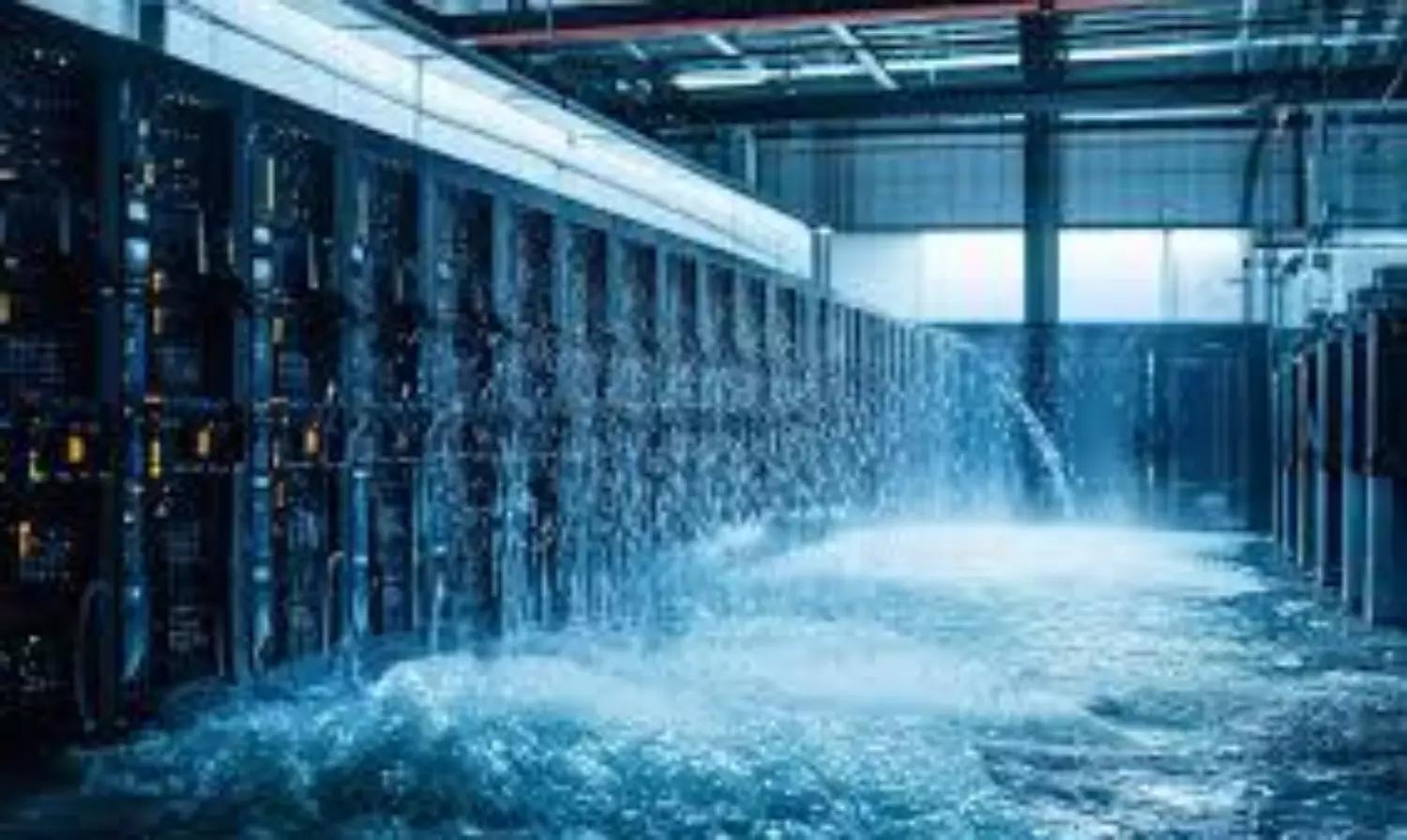
The water footprint is rising just as quickly. Data centres consumed 4.5 trillion litres of water in 2025, while the projected 2030 figure of 9.3 trillion litres would equal the basic annual domestic water needs of about 1.3 billion people in Sub-Saharan Africa.
Context is everything. Stay ahead of shifting trends with today’s market updates, and uncover emerging opportunities using the Serrari Group Market Index and Marketplace. Then, take control of your own financial future by exploring our Money & Life Reset Transformation Blueprint ™ to build stronger habits, create better systems, and design a path toward lasting wealth.
Carbon Is Only Part of the AI Footprint
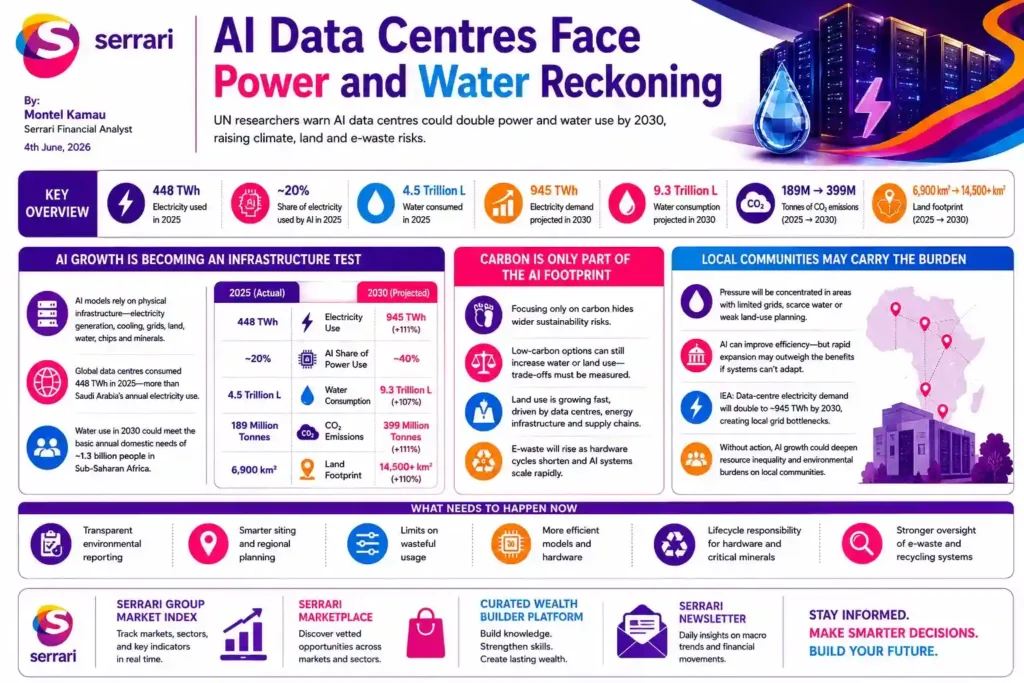
The report warns that measuring AI only through carbon emissions hides wider sustainability risks. Data centres generated 189 million tonnes of carbon dioxide in 2025, with emissions expected to rise to 399 million tonnes by 2030 if capacity expands without stronger safeguards.
But the bigger issue is that low-carbon options can still create trade-offs. The researchers said some energy choices may reduce carbon while increasing water or land demand, making it important for policymakers to assess AI projects through combined carbon, water and land metrics.
The land footprint is also growing. Data-centre-related land use is expected to increase from 6,900 square kilometres in 2025 to more than 14,500 square kilometres by 2030. That includes the land needed for energy infrastructure, supply chains and supporting systems.
Local Communities May Carry the Burden
The environmental pressure will not be evenly spread. Reuters reported that data centres are expected to consume twice as much power and water by 2030, but the strain will be most visible in specific locations where data-centre growth collides with limited grid capacity, scarce water or weak land-use planning.
This creates a policy challenge for governments. AI may help optimise power grids, improve efficiency and reduce waste, but those benefits could be outweighed if countries and corporations build capacity faster than energy and water systems can adapt.
The International Energy Agency has also warned that data-centre electricity demand is projected to double to around 945 TWh by 2030, while noting that data centres are geographically concentrated and can create local grid bottlenecks even if their global electricity share remains relatively small.
The UN researchers argue that responsible AI planning now should include transparent environmental reporting, better siting decisions, limits on wasteful usage, more efficient models, lifecycle responsibility for hardware and stronger oversight of electronic waste. Without that, the AI boom could deepen resource inequality by placing the environmental costs in communities that may not receive the economic benefits.
Sources used: United Nations University / Reuters / International Energy Agency
Your financial future isn’t something you wait for—it’s something you build.
The real question is: when do you begin?
Move beyond simply staying informed.
Navigate the markets with clarity—track trends through the Serrari Group Market Index, uncover opportunities in the Serrari Marketplace, and build practical knowledge with our Curated Wealth Builder Platform.
Stay connected to what truly matters.
Get daily insights on macro trends and financial movements across Kenya, Africa, and global markets—delivered through the Serrari Newsletter.
Growth opens doors.
Advance your career through professional programs including ACCA, HESI A2, ATI TEAS 7 , HESI EXIT , NCLEX – RN and NCLEX – PN, Financial Literacy!🌟—designed to move you forward with confidence.
See where money is flowing—clearly and in real time.
Track Money Market Funds, Treasury Bills, Treasury Bonds, Green Bonds, and Fixed Deposits, alongside global and African indexes, key economic indicators, and the evolving Crypto and stablecoin landscape—all within Serrari’s Market Index.