South Africa is intensifying its fight against foot-and-mouth disease as it works to protect livestock exports, farm incomes and food security. Agriculture Minister John Steenhuisen said the country has procured 13.5 million vaccine doses since February 2026 and vaccinated nearly 4.4 million animals by May 28. The response combines mass vaccination, import approvals for more doses, export-market negotiations and regional cooperation to prevent the outbreak from weakening the wider agricultural value chain.
Key Overview
- South Africa has procured 13.5 million FMD vaccine doses since February 2026.
- Nearly 4.4 million animals had been vaccinated by May 28.
- Government has spent R494 million on vaccine procurement and rollout.
- A further 3.5 million Biogénesis Bagó doses arrived recently.
- Approval has been granted for 14 million Dollvet doses from Turkey.
- Jordan, the UAE, Hong Kong and Kuwait remain open under agreed trade conditions.
- Agriculture generated a trade surplus of about US$7.3 billion in 2025.
Record Vaccine Rollout Targets Livestock Risk
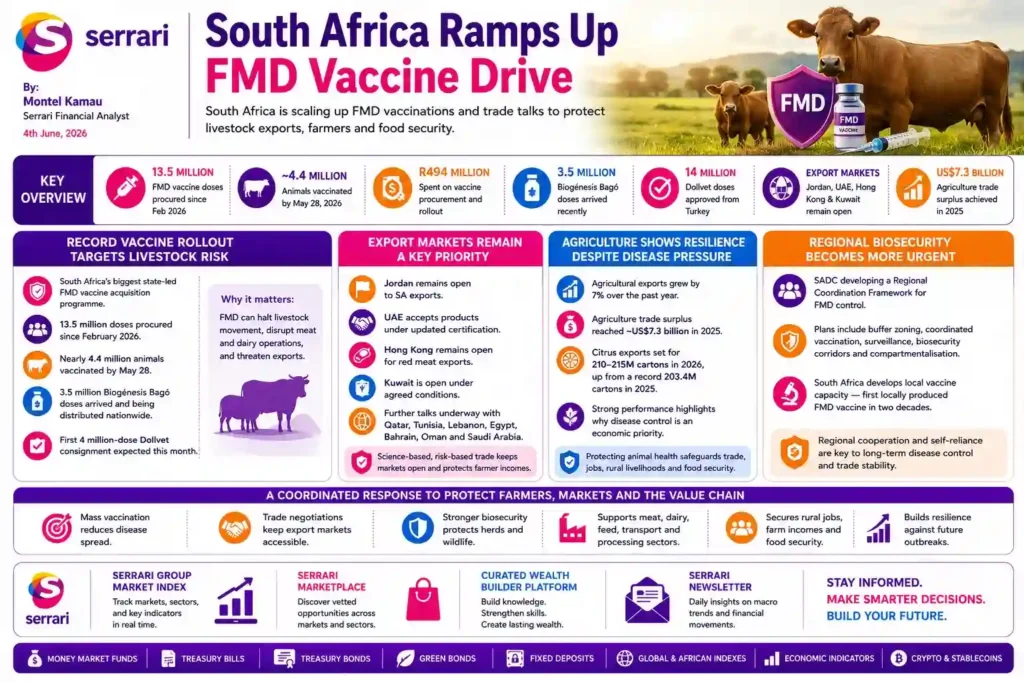
South Africa has moved into a larger and more coordinated phase of its foot-and-mouth disease response, with government describing the current rollout as the country’s biggest state-led vaccine acquisition programme.
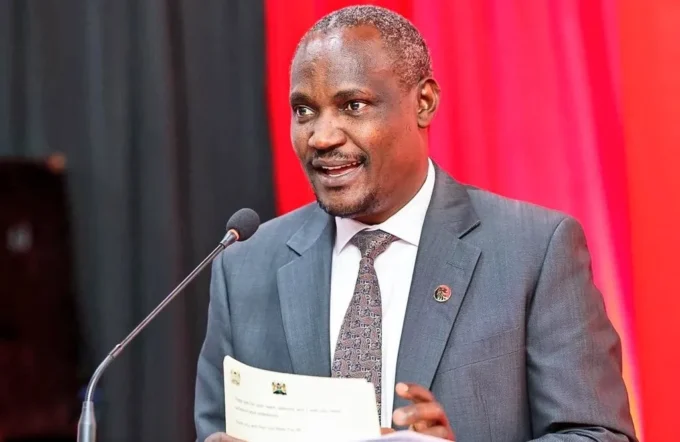
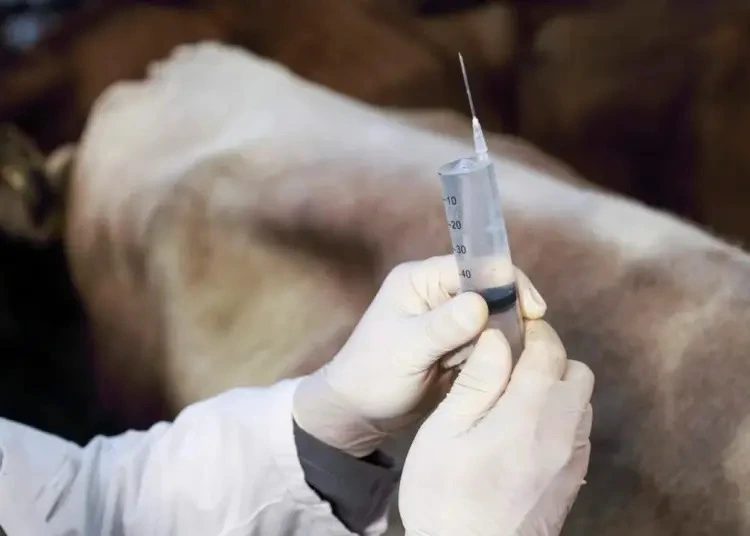
In an official briefing, Steenhuisen said 13.5 million vaccine doses had been procured since February, while just under 4.4 million animals had been vaccinated across the country by May 28. A further 3.5 million Biogénesis Bagó doses recently arrived and will be distributed to feedlots, producer groups, provinces and border vaccination programmes.
The South African Health Products Regulatory Authority has also approved Dunevax to import 14 million doses of the Dollvet vaccine, with the first four million-dose consignment expected this month. Government has already spent R494 million on vaccine procurement and deployment.
The scale of the campaign reflects the economic sensitivity of FMD. The disease is highly contagious among cloven-hoofed animals and can disrupt livestock movement, meat processing, dairy operations and export certification. Farmers have also faced movement restrictions, higher feed costs and uncertainty over market access.
Context is everything. Stay ahead of shifting trends with today’s market updates, and uncover emerging opportunities using the Serrari Group Market Index and Marketplace. Then, take control of your own financial future by exploring our Money & Life Reset Transformation Blueprint ™ to build stronger habits, create better systems, and design a path toward lasting wealth.
Export Markets Remain a Key Priority
The vaccination campaign is not only a disease-control measure. It is also part of a wider trade-protection strategy aimed at keeping South African livestock products moving into international markets.
According to a government update, Jordan remains open to South African exports, while the United Arab Emirates continues to accept products under updated certification arrangements. Hong Kong remains open for red meat exports, and Kuwait is also open under agreed conditions.
South Africa is also pursuing further discussions with Qatar, Tunisia, Lebanon, Egypt, Bahrain, Oman and Saudi Arabia. These engagements are meant to keep trade flowing through science-based and risk-based controls instead of blanket restrictions.
The export focus matters because livestock trade supports farmers, processors, transporters, feed suppliers and rural jobs. A prolonged loss of market access would put pressure on farm incomes and could weaken confidence across the meat and dairy value chains.
Agriculture Shows Resilience Despite Disease Pressure
The FMD outbreak comes at a time when South African agriculture remains one of the country’s stronger export performers. Steenhuisen said agricultural exports grew by 7% over the past year, while the sector generated a trade surplus of about US$7.3 billion in 2025.
The citrus industry has also remained a bright spot. A recent industry outlook showed South Africa could ship 210 to 215 million cartons in 2026 after a record 2025 season, when exports reached 203.4 million cartons worth R44.9 billion.
That performance highlights why disease control is now being treated as an economic priority. Livestock exports may represent only one part of the agricultural trade basket, but animal-health failures can quickly damage confidence in broader food systems, border controls and export certification.
Regional Biosecurity Becomes More Urgent
South Africa is also pushing for stronger regional coordination through the Southern African Development Community. The government has welcomed plans for a Regional Coordination Framework for FMD control, including buffer zoning, coordinated vaccination, surveillance systems, biosecurity corridors and compartmentalisation models.
The shift is important because livestock movement, wildlife interfaces and informal cross-border trade make animal diseases difficult to contain through national action alone. A more regional system could help reduce outbreak cycles while protecting food security and trade flows.
The country is also trying to improve vaccine independence. Earlier this year, South Africa announced its first locally produced FMD vaccine in two decades, developed by the Agricultural Research Council, as part of a broader effort to rebuild domestic vaccine capacity.
If sustained, the current response could move South Africa from reactive outbreak control toward a more proactive biosecurity model. That would be critical for protecting livestock, preserving export markets and reducing future shocks to farmers and consumers.
Sources used: South African Government / SAnews / Reuters / Agbiz
Your financial future isn’t something you wait for—it’s something you build.
The real question is: when do you begin?
Move beyond simply staying informed.
Navigate the markets with clarity—track trends through the Serrari Group Market Index, uncover opportunities in the Serrari Marketplace, and build practical knowledge with our Curated Wealth Builder Platform.
Stay connected to what truly matters.
Get daily insights on macro trends and financial movements across Kenya, Africa, and global markets—delivered through the Serrari Newsletter.
Growth opens doors.
Advance your career through professional programs including ACCA, HESI A2, ATI TEAS 7 , HESI EXIT , NCLEX – RN and NCLEX – PN, Financial Literacy!🌟—designed to move you forward with confidence.
See where money is flowing—clearly and in real time.
Track Money Market Funds, Treasury Bills, Treasury Bonds, Green Bonds, and Fixed Deposits, alongside global and African indexes, key economic indicators, and the evolving Crypto and stablecoin landscape—all within Serrari’s Market Index.