China is defending an economic model built around manufacturing, technology and investment as trade tensions with the United States and European Union intensify. Recent policy statements indicate that Beijing is prepared to support consumption, but not through the rapid structural shift towards household-led growth sought by many foreign governments and economists.
The message is emerging ahead of further negotiations with Washington and an October deadline set by Brussels for tangible progress on trade imbalances, industrial subsidies, export controls and market access. China argues that its industrial competitiveness reflects development, innovation and global demand, while Western governments increasingly view its export strength as a threat to domestic manufacturing.
Key Overview
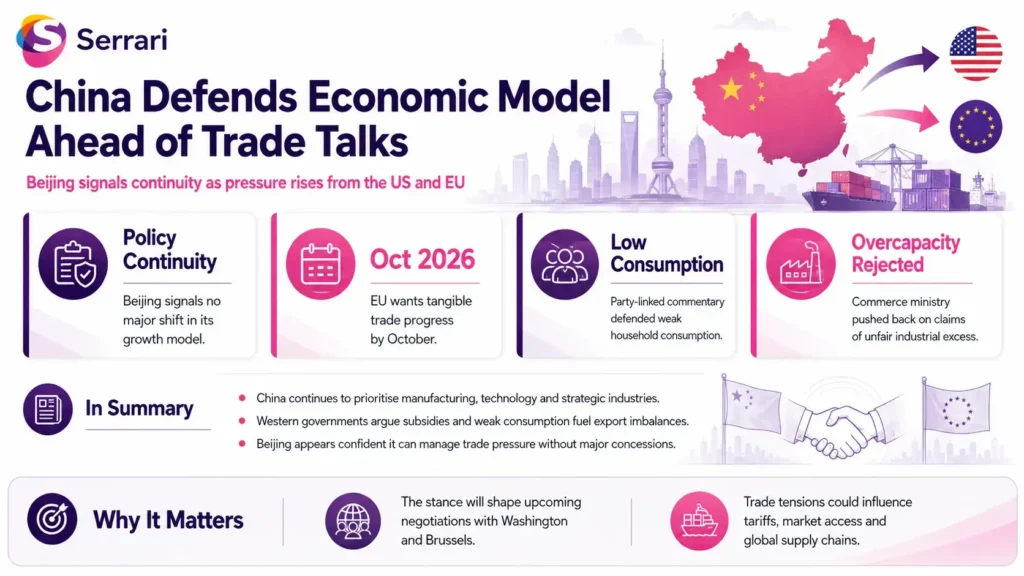
- China’s leadership is signalling policy continuity rather than a large consumer-focused stimulus programme.
- Beijing has formally rejected accusations that its industries suffer from unfair excess capacity.
- The EU wants tangible progress in trade negotiations by October 2026.
- Research links China’s export surge to subsidies, weak domestic demand and unusually high investment.
- China is promising gradual consumption growth while preserving support for strategic industries.
Beijing Formalises Its Defence of Industrial Policy
China’s top leadership used its latest economic policy meeting to emphasise faster implementation of existing fiscal measures, targeted support and stronger domestic demand. The meeting did not announce the large household transfers or structural reforms that some economists argue are needed to rebalance growth.
Days earlier, the Commerce Ministry released a formal position paper rejecting the “so-called excess capacity” argument. Beijing said foreign criticism politicises normal market competition and provides a justification for protectionist restrictions against Chinese companies.
This defence reflects China’s belief that scale, efficient supply chains and technological improvement—not merely subsidies—explain the competitiveness of its electric vehicles, batteries, solar equipment and other manufactured goods.
A separate policy discussion published in July described China’s historically low consumption share as an outcome of its investment-led development stage. However, it also acknowledged that historical justification does not make the imbalance sustainable indefinitely.
Context is everything. Stay ahead of shifting trends with today’s market updates, and uncover emerging opportunities using the Serrari Group Market Index and Marketplace. Then, take control of your own financial future by exploring our Money & Life Reset Transformation Blueprint ™ to build stronger habits, create better systems, and design a path toward lasting wealth.
Trade Negotiations Raise the Stakes
The policy messaging comes as China faces pressure on two major trade fronts. Brussels has set an October deadline for tangible results from negotiations covering trade imbalances, industrial subsidies, intellectual property and Chinese export controls.
The EU’s goods trade deficit with China reached about €360.6 billion in 2025, equivalent to nearly €1 billion a day. European officials fear that rising imports of competitively priced Chinese goods could weaken domestic manufacturers in sectors considered strategically important.
Washington is also pressing Beijing to fulfil commitments involving rare-earth supplies and agricultural products. China’s control over critical-mineral processing has provided significant leverage after the United States sharply raised tariffs during the previous phase of their trade confrontation.
Beijing’s current approach appears designed to keep negotiations active while limiting concessions that would materially alter its industrial strategy.
International Research Strengthens Western Concerns
Recent research has added evidence to arguments that China’s domestic policies affect global competition. An analysis of industrial subsidies estimated that almost 60% of the global market-share gains achieved by expanding Chinese firms between 2005 and 2023 could be explained by subsidies they received.
A study of China’s export growth concluded that about three-quarters of the country’s export expansion between 2023 and 2025 resulted from domestic factors, with weak internal demand encouraging firms to sell more production abroad. Subsidies and technological upgrading also contributed.
Meanwhile, a June global investment assessment found that China adds around three times more productive assets annually than Europe and the United States combined, while generating capital returns approximately 40% lower.
Together, the findings support concerns that China is building industrial capacity faster than its domestic economy can absorb, increasing pressure on overseas markets.
Rebalancing Is Likely to Remain Gradual
China is not rejecting stronger consumption altogether. A new five-year consumption plan targets about 60 trillion yuan in annual retail sales by 2030 and promises measures to raise household incomes, improve services and strengthen consumer confidence.
Officials have also pledged to curb destructive price competition, commonly described as “involution,” among companies sacrificing profitability to retain market share.
However, Beijing appears unwilling to abandon the manufacturing and technology policies it considers essential to national development and economic security. That creates a difficult negotiating environment: China recognises the need for gradual rebalancing, while the US and EU want faster changes to subsidies, market access and the flow of low-priced exports.
The outcome will depend on whether managed engagement produces practical compromises or merely postpones a broader escalation in tariffs, procurement restrictions and other trade-defence measures.
Sources: Reuters / Ministry of Commerce of China / State Council of China / OECD / Bank of Italy / McKinsey & Company
Your financial future isn’t something you wait for—it’s something you build.
The real question is: when do you begin?
Move beyond simply staying informed.
Navigate the markets with clarity—track trends through the Serrari Group Market Index, uncover opportunities in the Serrari Marketplace, and build practical knowledge with our Curated Wealth Builder Platform.
Stay connected to what truly matters.
Get daily insights on macro trends and financial movements across Kenya, Africa, and global markets—delivered through the Serrari Newsletter.
Growth opens doors.
Advance your career through professional programs including ACCA, HESI A2, ATI TEAS 7 , HESI EXIT , NCLEX – RN and NCLEX – PN, Financial Literacy!🌟—designed to move you forward with confidence.
See where money is flowing—clearly and in real time.
Track Money Market Funds, Treasury Bills, Treasury Bonds, Green Bonds, and Fixed Deposits, alongside global and African indexes, key economic indicators, and the evolving Crypto and stablecoin landscape—all within Serrari’s Market Index.