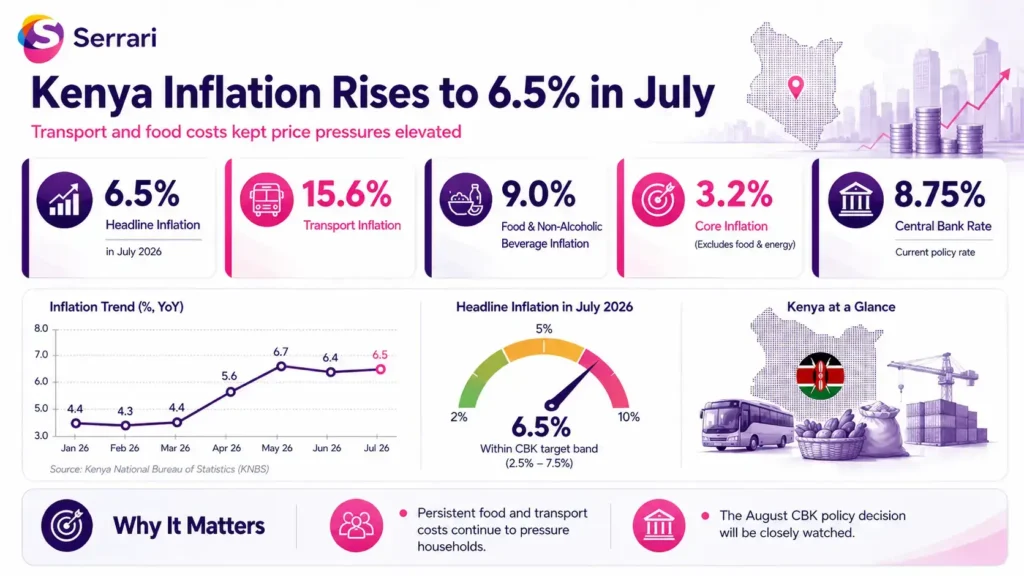
Kenya’s annual inflation increased to 6.5% in July 2026 from 6.4% in June, reversing the previous month’s moderation. The Consumer Price Index rose 0.2% between June and July, meaning prices continued increasing on a monthly basis even when the annual rate eased in June.
Transport recorded the strongest annual price growth at 15.6%, while food and non-alcoholic beverages rose 9.0%. Inflation remained inside the Central Bank of Kenya’s 2.5%–7.5% target band but stayed above its 5% midpoint for a third consecutive month.
Key Overview
- Annual inflation rose to 6.5% in July from 6.4% in June.
- Consumer prices increased 0.2% during the month.
- Transport prices climbed 15.6% year-on-year.
- Food and non-alcoholic beverage prices increased 9.0%.
- Core inflation edged up to 3.2% from 3.1%.
- The Central Bank Rate remained at 8.75% following the June policy meeting.
Transport and Food Keep Household Costs Elevated
The official July inflation report showed that transport remained the largest source of annual price pressure. Transport costs rose 15.6% compared with July 2025, only slightly below the 16.1% increase recorded in June.
The elevated transport reading reflects the continuing effects of fuel-price increases introduced earlier in the year. Kenya experienced sharp increases in petrol and diesel costs during April and May as disruption in the Middle East lifted international energy prices. Although pump prices were unchanged during the July review, those earlier increases continued to affect fares, freight and the cost of moving goods.
Food and non-alcoholic beverages rose 9.0% year-on-year, accelerating from 8.6% in June. Food prices remained vulnerable to weather conditions, transport expenses and supply-chain costs, keeping pressure on household budgets despite declines in selected products.
Context is everything. Stay ahead of shifting trends with today’s market updates, and uncover emerging opportunities using the Serrari Group Market Index and Marketplace. Then, take control of your own financial future by exploring our Money & Life Reset Transformation Blueprint ™ to build stronger habits, create better systems, and design a path toward lasting wealth.
Monthly Data Show Mixed Price Movements
Kenya’s CPI increased 0.2% between June and July. This means the June development was a decline in the annual inflation rate—not an outright fall in the overall price level. Monthly inflation had been 0.3% in June.
Some frequently purchased products became cheaper during July. According to a breakdown of the latest data, tomato prices fell 3.7%, carrots declined 3.6% and a two-kilogram packet of sifted maize flour became 1.6% cheaper.
The cost of refilling a 13-kilogram LPG cylinder also declined 1.1%. However, these decreases were offset by higher prices elsewhere. Mango prices rose 3.2%, Irish potatoes increased 2.1% and electricity charges climbed for both the 50-kilowatt-hour and 200-kilowatt-hour consumption bands.
Core Inflation Signals Broader but Moderate Pressure
Core inflation, which removes selected volatile items, rose slightly to 3.2% from 3.1% in June. The increase suggests that underlying price pressures strengthened, although core inflation remained substantially lower than headline inflation.
The gap indicates that food and energy-related categories continued to account for much of the current cost-of-living pressure. This matters for monetary policy because temporary supply shocks may not respond as quickly to higher interest rates as demand-driven inflation.
Even so, sustained transport costs can spread into other parts of the economy through distribution expenses, business operating costs and public transport fares. The longer those pressures persist, the greater the risk that inflation becomes more broad-based.
Central Bank Faces a Cautious August Decision
The Monetary Policy Committee retained the Central Bank Rate at 8.75% on June 9, marking its second consecutive hold after an earlier cycle of rate reductions.
The pause reflected the need to keep inflation expectations anchored while assessing global energy-market risks, exchange-rate conditions and domestic economic activity. July’s 6.5% reading remains within the official target range, reducing the immediate case for a sharp tightening move.
However, inflation has now remained above the 5% target midpoint since May. The August policy decision will therefore depend heavily on whether food and transport pressures persist, global oil prices stabilise and underlying inflation continues rising.
Kenya’s inflation outlook remains manageable but increasingly sensitive to supply shocks. The July data show that falling prices in a few household products are not yet strong enough to offset elevated transport, food and electricity costs across the wider economy.
Sources: Kenya National Bureau of Statistics / Central Bank of Kenya / The Star / Reuters
Your financial future isn’t something you wait for—it’s something you build.
The real question is: when do you begin?
Move beyond simply staying informed.
Navigate the markets with clarity—track trends through the Serrari Group Market Index, uncover opportunities in the Serrari Marketplace, and build practical knowledge with our Curated Wealth Builder Platform.
Stay connected to what truly matters.
Get daily insights on macro trends and financial movements across Kenya, Africa, and global markets—delivered through the Serrari Newsletter.
Growth opens doors.
Advance your career through professional programs including ACCA, HESI A2, ATI TEAS 7 , HESI EXIT , NCLEX – RN and NCLEX – PN, Financial Literacy!🌟—designed to move you forward with confidence.
See where money is flowing—clearly and in real time.
Track Money Market Funds, Treasury Bills, Treasury Bonds, Green Bonds, and Fixed Deposits, alongside global and African indexes, key economic indicators, and the evolving Crypto and stablecoin landscape—all within Serrari’s Market Index.