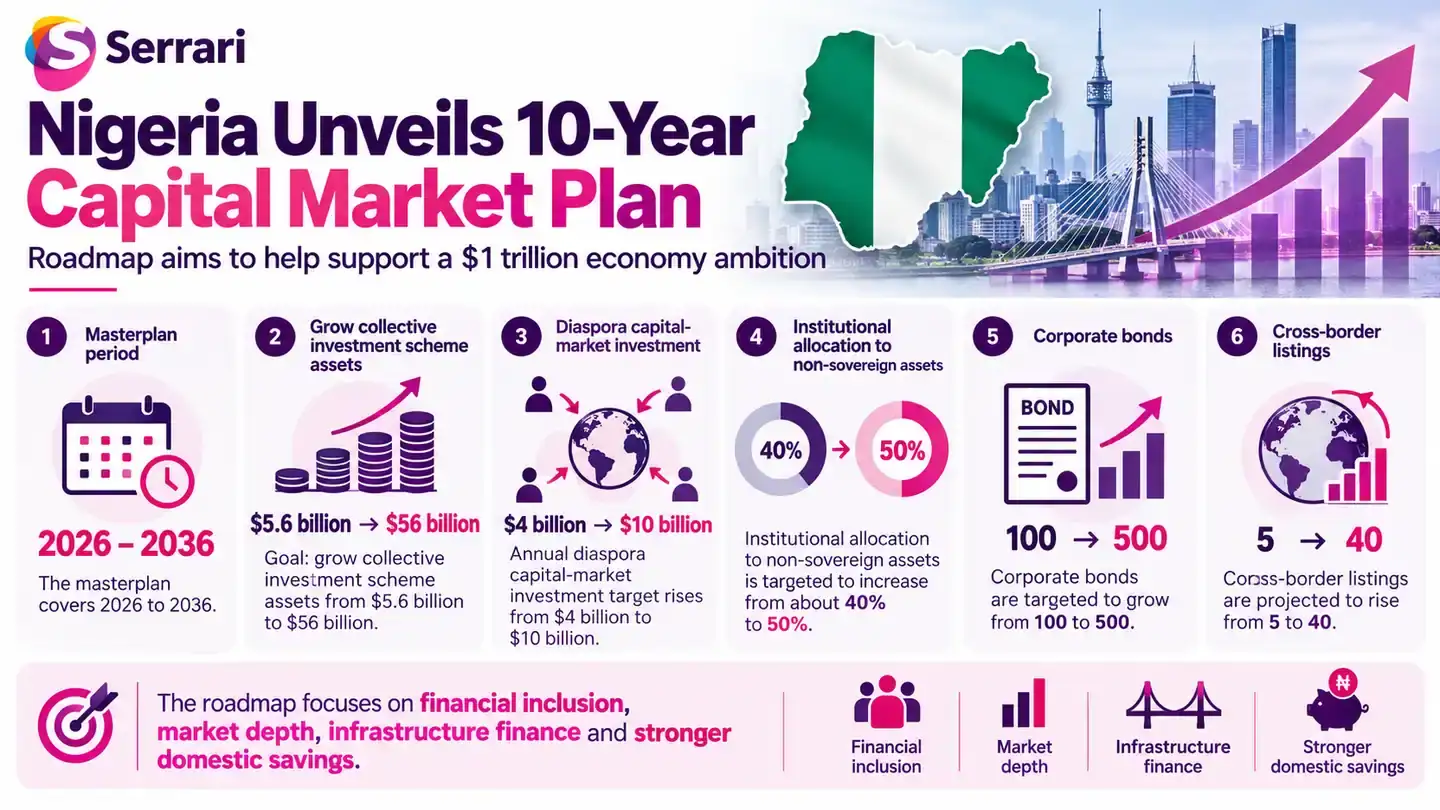
Nigeria has launched a ten-year capital market reform programme to channel more savings into businesses, infrastructure and national development. Unveiled on October 19, 2026, alongside a National Savings Scheme, the new 2026–2036 roadmap aims to help finance the government’s ambition of building a $1 trillion economy by 2030.
The masterplan is designed to expand investment products, attract local and international capital and give more Nigerians access to regulated financial markets. Its goals are ambitious, but they are targets rather than funding already secured or economic growth already achieved.
Key Overview
- Investment funds: Increase collective investment scheme assets under management from $5.6 billion to $56 billion by 2036.
- Diaspora investment: Raise annual capital-market investment from Nigerians abroad from $4 billion to $10 billion.
- Institutional capital: Increase the share of portfolios invested in non-sovereign assets from approximately 40% to 50%.
- Market expansion: Grow the targeted number of corporate bonds from 100 to 500 and cross-border listings from five to 40.
- Retail participation: Broaden access through a National Savings Scheme and initiatives to bring more individuals into investing.
- Economic ambition: Support the goal of a $1 trillion Nigerian economy by 2030, six years before the masterplan ends.
Nigeria Sets Ambitious Investment and Bond Market Targets
The most prominent target is a tenfold increase in collective investment scheme assets, from $5.6 billion to $56 billion over the decade. These assets include money managed through pooled investment products; the figure is a target for assets under management, not a promise that the government will raise $56 billion in new cash.
The published financing objectives also envisage increasing annual diaspora investment through capital markets to $10 billion and encouraging pension funds and other institutional investors to allocate more of their portfolios beyond government securities.
Expanding corporate bond issuance could give established businesses more ways to finance long-term investments. Additional cross-border listings could help Nigerian companies reach investors in other African markets, although success will depend on market liquidity, investor confidence and regulatory coordination.
National Savings Scheme Aims to Reach More Nigerians
Launching the National Savings Scheme alongside the masterplan reflects a push to connect household savings with productive investment. The scheme’s announced inclusion measures target groups such as traders, farmers and young workers, with funds to be managed by registered professionals.
Officials have also discussed potential tax incentives and easier digital access. These measures could lower participation barriers, but their effectiveness will depend on clear rules, affordable products, investor education and adequate safeguards against fraud and mis-selling.
Separately, the government has outlined an ambition to expand retail investors from roughly six million to 20 million and listed companies from 146 to 250 by 2036. The additional participation targets show that policymakers want a larger investing population, not simply higher asset prices.
Context is everything. Stay ahead of shifting trends with today’s market updates, and uncover emerging opportunities using the Serrari Group Market Index and Marketplace. Then, take control of your own financial future by exploring our Money & Life Reset Transformation Blueprint ™ to build stronger habits, create better systems, and design a path toward lasting wealth.
Five Reform Pillars Focus on Trust and Market Access
The official masterplan framework groups reforms into five areas: stronger regulation and enforcement, modern market infrastructure, more issuers and financial instruments, a broader investor base, and improved institutional expertise.
Planned improvements include clearer supervision, better digital systems, more financing options for small and medium-sized enterprises, and development of regulated digital and tokenised assets. Sustainable finance and mechanisms for state governments to raise capital are also part of the agenda.
These changes are meant to connect investment to practical needs such as electricity, transport, climate resilience and business expansion, rather than focusing exclusively on stock-market trading.
Can the Plan Help Build a $1 Trillion Economy?
The $1 trillion economy objective is a national economic ambition for 2030, not a forecast that capital-market reforms alone will produce that result. The financial-market roadmap continues through 2036, with its own longer-term milestones.
Implementation remains the main challenge. The previous masterplan achieved a reported 63% activity completion rate, leaving gaps in inclusion, regional integration and sustainable finance. Under the new programme, regulators plan to assign responsibilities, timelines and measurable performance indicators.
The proposed market-growth framework also targets an expansion in overall capital-market value from approximately ₦250 trillion to ₦750 trillion by 2036. That naira-denominated market target should not be confused with the country’s dollar-denominated GDP ambition.
For investors, the next signals to monitor are the rollout of savings products, growth in corporate fundraising, stronger investor protection and whether financing reaches productive businesses. Nigeria’s reform agenda is substantial; its impact will ultimately depend on implementation and sustained confidence.
Sources: Securities and Exchange Commission Nigeria / FSD Africa / Punch / Nairametrics / BusinessDay / TheCable
Your financial future isn’t something you wait for—it’s something you build.
The real question is: when do you begin?
Move beyond simply staying informed.
Navigate the markets with clarity—track trends through the Serrari Group Market Index, uncover opportunities in the Serrari Marketplace, and build practical knowledge with our Curated Wealth Builder Platform.
Stay connected to what truly matters.
Get daily insights on macro trends and financial movements across Kenya, Africa, and global markets—delivered through the Serrari Newsletter.
Growth opens doors.
Advance your career through professional programs including ACCA, HESI A2, ATI TEAS 7 , HESI EXIT , NCLEX – RN and NCLEX – PN, Financial Literacy!🌟—designed to move you forward with confidence.
See where money is flowing—clearly and in real time.
Track Money Market Funds, Treasury Bills, Treasury Bonds, Green Bonds, and Fixed Deposits, alongside global and African indexes, key economic indicators, and the evolving Crypto and stablecoin landscape—all within Serrari’s Market Index.