
The latest Nigeria bond market activity saw government bond yields rise sharply as investors sold sovereign debt in the secondary market. While demand for Treasury bills and Open Market Operation (OMO) bills remained strong, selling pressure in longer-dated government bonds pushed yields higher, reflecting weaker sentiment toward naira-denominated debt securities.
Key Overview
- Benchmark Nigerian government bond yields increased by 25 basis points.
- Average sovereign bond yields rose to 16.59%.
- Selling pressure was recorded across short-, medium-, and long-term maturities.
- Long-term bonds experienced the largest yield increase, rising 49 basis points.
- JUN-38 bonds recorded the highest jump in yields at 116 basis points.
- JAN-42 yields increased by 87 basis points.
- APR-29 bond yields climbed 61 basis points.
- Investor appetite remained strong for Treasury bills and OMO bills.
- The Central Bank of Nigeria raised approximately N4.5 trillion through OMO and Treasury bill auctions.
- Higher yields indicate lower bond prices and weaker demand in the secondary bond market.
Nigerian Bond Yields Rise Amid Heavy Investor Sell-Off
The latest movement in Nigerian bond yields highlights growing pressure within the country’s fixed income market as investors reduced exposure to government debt securities.
Benchmark sovereign bond yields climbed by 25 basis points in secondary market trading, pushing the average yield on Nigerian government bonds to 16.59%. The increase reflects broad-based selling across the yield curve and suggests a decline in investor appetite for certain naira-denominated assets.
Bond yields and prices move in opposite directions. When investors sell bonds, prices fall and yields rise. As a result, the latest yield increase signals weakening demand for government bonds in the secondary market.
The development comes despite continued investor interest in other fixed-income instruments, including Treasury bills and Open Market Operation bills.
Nigeria Bond Market Experiences Broad-Based Yield Increases
The latest Nigeria bond market performance showed rising yields across all major maturity segments.
According to market analysts, the short end of the yield curve recorded an increase of 22 basis points, while mid-term maturities rose by 13 basis points. The most significant movement occurred at the long end of the curve, where yields increased by 49 basis points.
The stronger increase in long-dated bonds suggests investors may be demanding greater compensation for holding longer-term debt amid uncertainty surrounding inflation, interest rates, and broader economic conditions.
Movements across all maturity categories indicate that the selloff was not isolated to a particular segment but reflected broader investor repositioning within the bond market.
The yield curve’s adjustment provides important insight into current market expectations regarding risk and future interest rate conditions.
Nigerian Government Bonds Face Selling Pressure
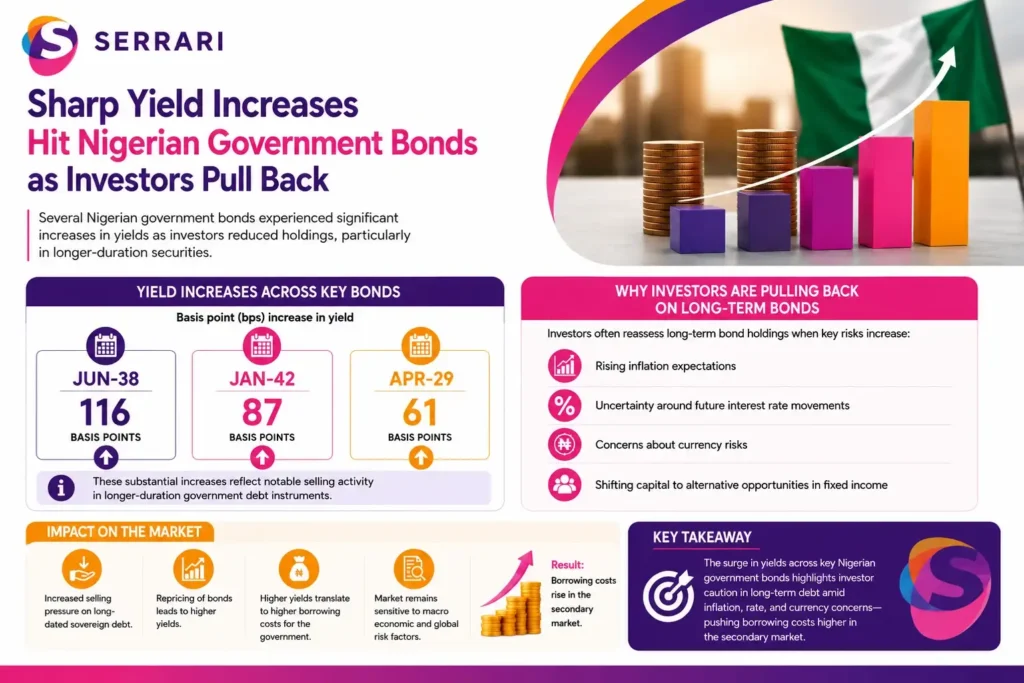
Several Nigerian government bonds experienced particularly sharp increases in yields as investors reduced holdings.
Among the most heavily affected securities was the JUN-38 bond, which recorded a yield increase of 116 basis points. The JAN-42 bond followed with an 87-basis-point rise, while the APR-29 issue saw yields climb by 61 basis points.
These substantial increases reflect notable selling activity in longer-duration government debt instruments.
Investors often reassess holdings of long-term bonds when concerns emerge regarding inflation expectations, future interest rate movements, or currency risks.
The current market environment appears to have encouraged some investors to reduce exposure to longer-dated sovereign debt while seeking opportunities elsewhere within the fixed income landscape.
The resulting repricing has pushed borrowing costs higher in the secondary market.
Context is everything. Stay ahead of shifting trends with today’s market updates, and uncover emerging opportunities using the Serrari Group Market Index and Marketplace. Then, take control of your own financial future by exploring our Money & Life Reset Transformation Blueprint ™ to build stronger habits, create better systems, and design a path toward lasting wealth.
Bond Yields Nigeria Reflect Shifting Investor Sentiment
The rise in bond yields Nigeria is widely viewed as a reflection of changing investor sentiment toward local debt assets.
Higher yields generally indicate investors are demanding greater returns to compensate for perceived risks. These risks may include inflationary pressures, currency fluctuations, fiscal concerns, or expectations regarding future monetary policy decisions.
Although the increase in yields suggests some caution toward government bonds, it does not necessarily indicate a complete withdrawal from fixed-income investments.
Instead, investors appear to be selectively reallocating capital toward shorter-term instruments that may offer attractive returns with lower duration risk.
The divergence between government bond performance and Treasury bill demand supports this interpretation.
Market participants continue to evaluate the balance between yield opportunities and potential risks within Nigeria’s evolving financial environment.
Fixed Income Market Nigeria Shows Mixed Performance
While government bonds faced pressure, the broader fixed income market Nigeria delivered a more mixed performance.
Investor demand remained strong across Treasury bills and Open Market Operation instruments, indicating that liquidity continues to flow into fixed-income assets despite weakness in certain bond segments.
The Central Bank of Nigeria recently raised approximately N4.5 trillion through Treasury bill and OMO auctions, highlighting sustained investor interest in short-term government securities.
Shorter-duration instruments often attract investors during periods of uncertainty because they provide greater flexibility and lower exposure to long-term market fluctuations.
The strong auction results demonstrate that investors remain willing to commit capital to government-backed instruments when risk-return dynamics are considered attractive.
This contrast illustrates the importance of maturity selection within the current market environment.
Debt Securities Nigeria Remain Important Investment Vehicles
Despite recent volatility, debt securities Nigeria continue to play a central role in investment portfolios.
Government bonds, Treasury bills, and OMO instruments provide investors with opportunities to generate income while maintaining exposure to relatively low-risk assets compared with equities and other higher-volatility investments.
The recent repricing in bond markets may even create opportunities for investors seeking higher yields.
As yields increase, newly issued bonds and secondary-market purchases become more attractive from an income-generation perspective.
However, investors must also consider factors such as inflation, interest rate expectations, and liquidity conditions when evaluating fixed-income investments.
The changing market landscape reinforces the importance of portfolio diversification and active risk management.
Bond Investors Monitor Future Market Direction
The recent selloff has prompted bond investors to closely monitor future developments within Nigeria’s financial markets.
Several factors are likely to influence bond market performance in the coming months, including inflation trends, central bank policy decisions, fiscal developments, and broader economic growth conditions.
Investors will also watch future government borrowing activity and auction outcomes to assess market demand and liquidity conditions.
Strong participation in Treasury bills and OMO auctions suggests that fixed-income assets remain attractive despite the recent rise in bond yields.
However, continued weakness in longer-dated bonds could signal ongoing caution regarding long-term economic and financial risks.
Market participants are therefore expected to remain highly sensitive to new economic data and policy announcements.
Conclusion
The recent increase in Nigerian bond yields reflects significant selling pressure within the government’s sovereign debt market. Average yields rose to 16.59% as investors reduced exposure to longer-dated bonds, with the most pronounced increases occurring at the long end of the yield curve.
Despite the weakness in government bonds, investor demand for Treasury bills and OMO instruments remains strong, demonstrating continued confidence in selected fixed-income assets. As Nigeria’s financial markets evolve, investors will continue balancing yield opportunities against economic risks while monitoring future policy developments and market conditions.
FAQs
1. Why did Nigerian bond yields increase?
Nigerian bond yields increased because investors sold government bonds in the secondary market. When bond prices fall due to selling activity, yields rise. The recent increase reflects weaker demand for certain sovereign debt instruments and changing investor preferences within the fixed-income market.
2. What does a rise in bond yields mean for investors?
Higher bond yields generally mean investors can earn greater returns on newly purchased bonds. However, rising yields also indicate declining bond prices, which can result in losses for investors already holding those securities. The impact depends on an investor’s strategy and investment horizon.
3. Why are investors still buying Treasury bills and OMO bills?
Treasury bills and OMO instruments typically have shorter maturities, making them less sensitive to long-term interest rate and market risks. Many investors prefer these instruments during uncertain periods because they provide attractive returns while offering greater flexibility and lower duration risk.
4. How do Nigerian government bonds affect the broader economy?
Government bonds help finance public spending and play an important role in the country’s financial system. Changes in bond yields can influence borrowing costs, investment decisions, and overall market sentiment. Rising yields may increase government financing costs while also affecting other interest rates across the economy.
Your financial future isn’t something you wait for—it’s something you build.
The real question is: when do you begin?
Move beyond simply staying informed.
Navigate the markets with clarity—track trends through the Serrari Group Market Index, uncover opportunities in the Serrari Marketplace, and build practical knowledge with our Curated Wealth Builder Platform.
Stay connected to what truly matters.
Get daily insights on macro trends and financial movements across Kenya, Africa, and global markets—delivered through the Serrari Newsletter.
Growth opens doors.
Advance your career through professional programs including ACCA, HESI A2, ATI TEAS 7 , HESI EXIT , NCLEX – RN and NCLEX – PN, Financial Literacy!🌟—designed to move you forward with confidence.
See where money is flowing—clearly and in real time.
Track Money Market Funds, Treasury Bills, Treasury Bonds, Green Bonds, and Fixed Deposits, alongside global and African indexes, key economic indicators, and the evolving Crypto and stablecoin landscape—all within Serrari’s Market Index.