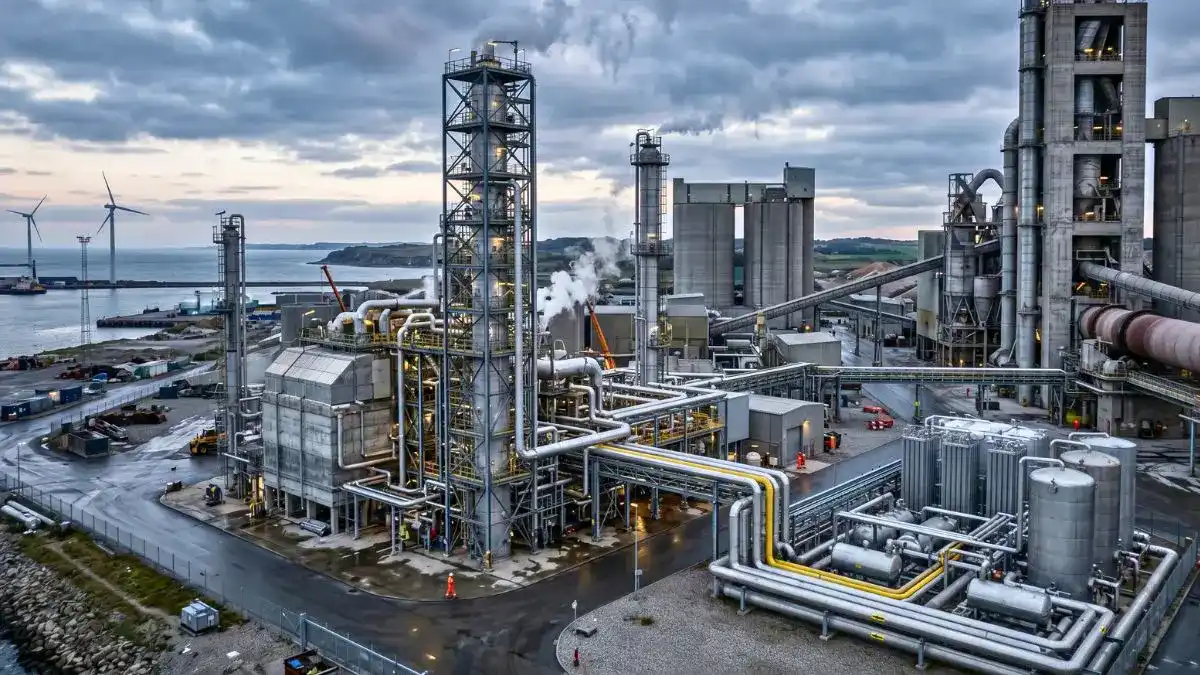
Denmark has awarded up to $2.6 billion in carbon capture and storage (CCS) subsidies to Aalborg Portland, the country’s largest carbon emitter, to support one of Europe’s largest industrial decarbonization projects. The funding will help capture, transport, and permanently store up to 1.25 million tonnes of CO2 annually from 2030. The project is expected to play a key role in helping Denmark meet its legally binding target of reducing greenhouse gas emissions by 70% from 1990 levels while advancing low-carbon cement production.
Key Overview
- Denmark awarded Aalborg Portland up to 16.5 billion Danish crowns in CCS subsidies
- Funding is equivalent to approximately $2.6 billion
- Project will capture up to 1.25 million tonnes of CO2 annually
- Subsidies will run for 15 years beginning in 2030
- Aalborg Portland is Denmark’s largest CO2 emitter
- Air Liquide will provide carbon capture technology
- Harbour Energy will provide transport and storage infrastructure
Denmark Supports Large-Scale Industrial Carbon Capture
Denmark has awarded its largest-ever carbon capture and storage subsidy contract to Aalborg Portland, providing up to 16.5 billion Danish crowns ($2.6 billion) in support for a major industrial decarbonization project.
The agreement, signed with the Danish Energy Agency, positions the cement producer at the center of Denmark’s climate strategy and marks one of the largest industrial carbon capture initiatives currently under development in Europe.
The funding will support the capture, transport, and permanent storage of carbon dioxide emissions generated by Aalborg Portland’s cement operations beginning in 2030.
Tackling One of Denmark’s Largest Sources of Emissions
Aalborg Portland is Denmark’s largest single emitter of carbon dioxide, making the project strategically important for the country’s climate ambitions.
Under the agreement, the company will receive 875 Danish crowns for every tonne of carbon dioxide captured and permanently stored.
This translates into annual support of up to 1.1 billion Danish crowns annually over a 15-year period, subject to project performance and capture volumes.
The project aims to capture as much as 1.25 million tonnes of CO2 per year, representing a substantial reduction in Denmark’s industrial emissions.
Why Cement Is Difficult to Decarbonize
Cement production is widely regarded as one of the difficult sectors to decarbonize.
Unlike many industries that can reduce emissions through electrification, cement manufacturing produces carbon emissions through both fuel combustion and chemical reactions during production.
The process of converting limestone into clinker releases significant amounts of CO2 regardless of the energy source used.
Globally, cement manufacturing accounts for around 8% of global industry CO2, making it a major focus of climate mitigation efforts.
Because these process emissions are difficult to eliminate, carbon capture and storage has emerged as one of the few viable pathways for achieving deep emissions reductions within the sector.
Context is everything. Stay ahead of shifting trends with today’s market updates, and uncover emerging opportunities using the Serrari Group Market Index and Marketplace. Then, take control of your own financial future by exploring our Money & Life Reset Transformation Blueprint ™ to build stronger habits, create better systems, and design a path toward lasting wealth.
Major Contribution to Denmark’s Climate Goals
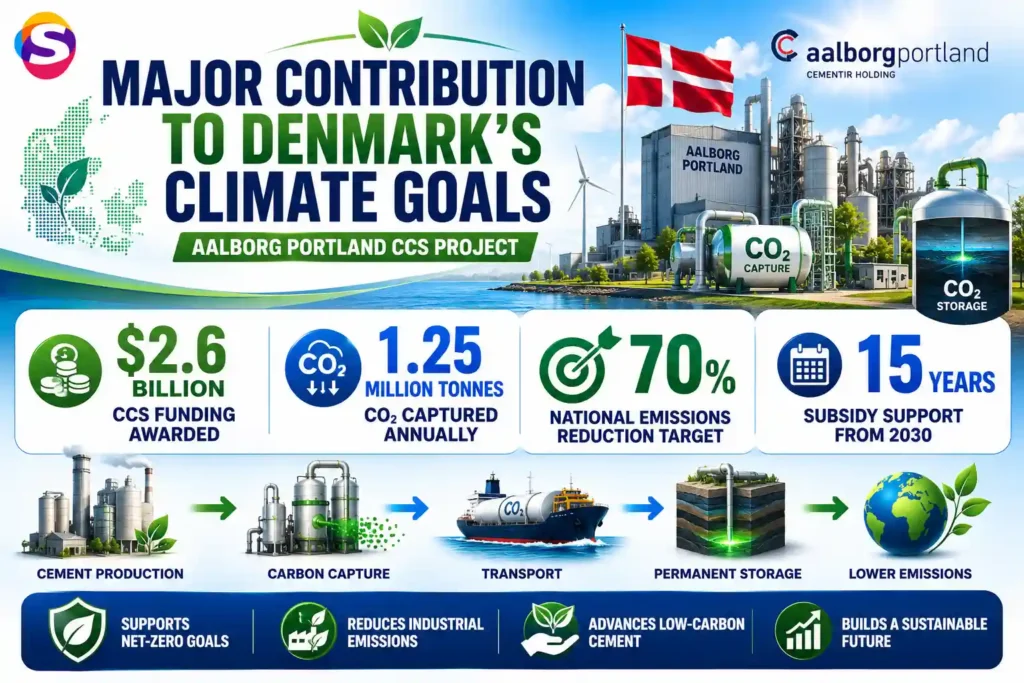
The project is expected to play a critical role in helping Denmark meet its legally binding climate targets.
Denmark aims to reduce greenhouse gas emissions by 70% from 1990 levels, one of the most ambitious climate goals in Europe.
According to Aalborg Portland, the project could account for more than half of Denmark’s national carbon capture target of 2.3 million tonnes of C02 annually from 2029 onward.
This makes the initiative one of the most significant individual climate investments currently planned in the country.
Government officials view CCS technology as an essential tool for reducing emissions in sectors where alternative decarbonization options remain limited.
Strong Industrial Partnerships Support the Project
The carbon capture project, known as ACCSION, will be developed through partnerships with major international energy companies.
French industrial gases company Air Liquide will provide the carbon capture technology required to separate CO2 emissions from cement production processes.
Meanwhile, Harbour Energy will be responsible for transportation infrastructure and long-term storage solutions to ensure captured emissions are permanently removed from the atmosphere.
Together, the partnership aims to create a complete carbon management system capable of handling large-scale industrial emissions.
Debate Around Carbon Capture Continues
Despite growing support from governments and industry, carbon capture and storage remains a topic of debate among policymakers, environmental groups, and energy experts.
The International Energy Agency (IEA) considers CCS a critical technology for achieving global climate objectives, particularly in hard-to-abate sectors such as cement, steel, and chemicals.
Supporters argue that carbon capture provides a practical pathway for reducing emissions from existing industrial facilities while maintaining economic activity.
Critics, however, question the long-term commercial viability of CCS projects due to their high costs and dependence on government subsidies.
Some environmental organizations also argue that widespread CCS deployment could prolong reliance on fossil fuel-related industries rather than accelerating the transition to alternative technologies.
Outlook
Denmark’s decision to provide up to $2.6 billion in CCS funding to Aalborg Portland underscores the growing importance of carbon capture technology in industrial decarbonization strategies. With the potential to capture 1.25 million tonnes of CO2 annually, the project is expected to become one of Europe’s largest industrial carbon capture facilities and a cornerstone of Denmark’s climate plans.
As governments across Europe pursue net-zero targets, large-scale CCS projects like ACCSION are likely to play an increasingly important role in reducing emissions from industries where conventional decarbonization methods remain challenging.
FAQs
FAQ 1: How much funding did Denmark award to Aalborg Portland for carbon capture?
Denmark awarded Aalborg Portland up to 16.5 billion Danish crowns (approximately $2.6 billion) in carbon capture and storage (CCS) subsidies over a 15-year period starting in 2030.
FAQ 2: How much CO2 will the Aalborg Portland CCS project capture?
The project is expected to capture, transport, and permanently store up to 1.25 million tonnes of CO2 annually, making it one of the largest industrial carbon capture projects in Europe.
FAQ 3: Why is carbon capture important for the cement industry?
Cement production generates significant CO2 emissions from both fuel combustion and the chemical process of converting limestone into clinker. Carbon capture technology helps reduce these emissions, making it one of the key solutions for decarbonizing the cement sector.
FAQ 4: How does the Aalborg Portland project support Denmark’s climate goals?
The project is expected to contribute more than half of Denmark’s target of capturing 2.3 million tonnes of CO2 annually from 2029 onward, helping the country achieve its goal of reducing greenhouse gas emissions by 70% compared with 1990 levels.
Sources: ESG News, Global Flow Control, domain-b.com, Global Banking & finance, AOL
Your financial future isn’t something you wait for—it’s something you build.
The real question is: when do you begin?
Move beyond simply staying informed.
Navigate the markets with clarity—track trends through the Serrari Group Market Index, uncover opportunities in the Serrari Marketplace, and build practical knowledge with our Curated Wealth Builder Platform.
Stay connected to what truly matters.
Get daily insights on macro trends and financial movements across Kenya, Africa, and global markets—delivered through the Serrari Newsletter.
Growth opens doors.
Advance your career through professional programs including ACCA, HESI A2, ATI TEAS 7 , HESI EXIT , NCLEX – RN and NCLEX – PN, Financial Literacy!🌟—designed to move you forward with confidence.
See where money is flowing—clearly and in real time.
Track Money Market Funds, Treasury Bills, Treasury Bonds, Green Bonds, and Fixed Deposits, alongside global and African indexes, key economic indicators, and the evolving Crypto and stablecoin landscape—all within Serrari’s Market Index.