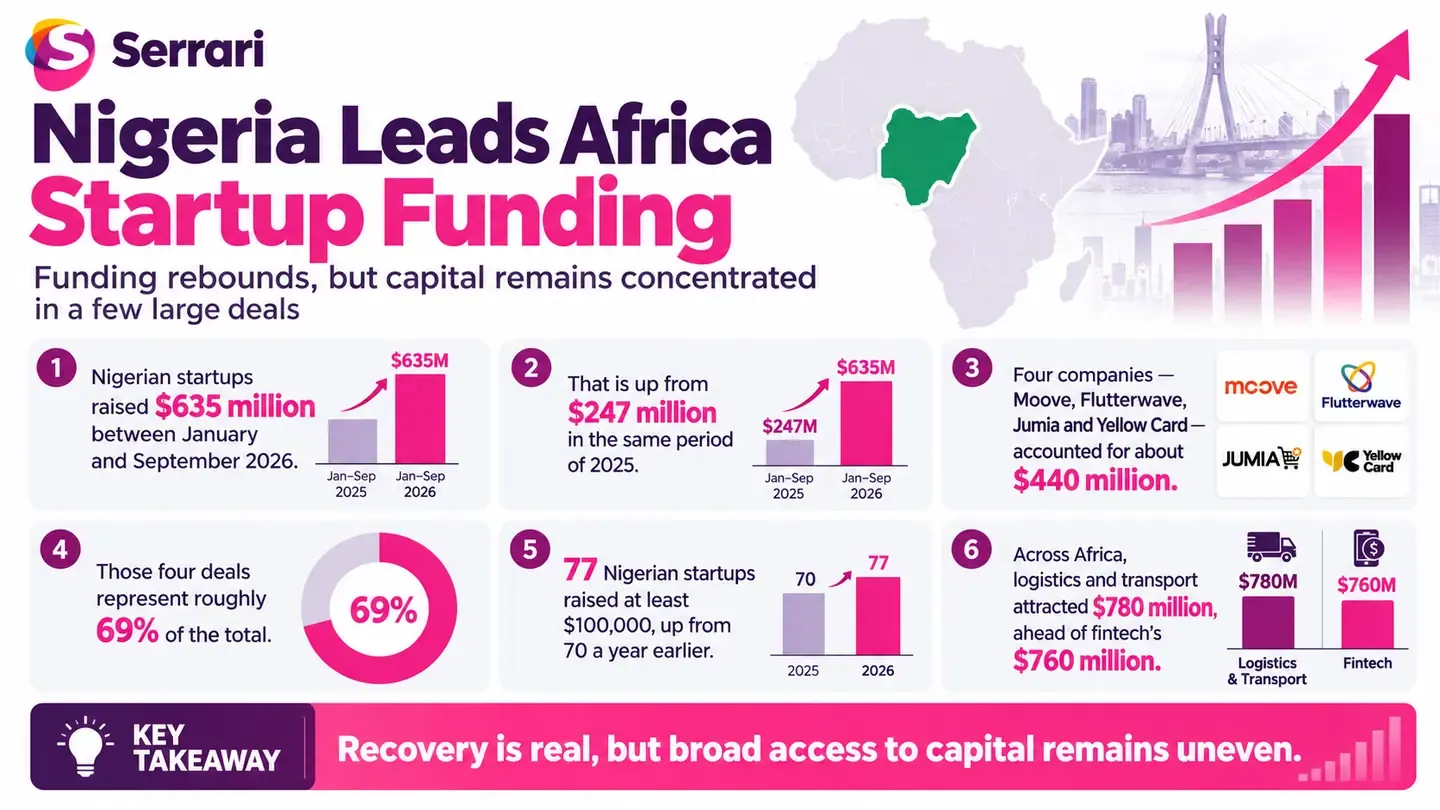
Nigeria has returned to the top of Africa’s startup funding rankings, with companies classified as Nigerian raising $635 million between January and September 2026, up from $247 million a year earlier. The latest nine-month funding breakdown shows renewed investment in mobility, payments and digital businesses, despite weaker activity in some competing markets.
The comeback comes with a warning: four companies accounted for roughly 69% of Nigeria’s funding. The increase signals investor confidence in selected businesses, but not necessarily easier access to capital for every founder.
Key Overview
- Nigeria’s total: $635 million in January–September 2026, approximately 157% higher than the same period in 2025.
- Largest deals: Moove, Flutterwave, Jumia and Yellow Card raised a combined $440 million, or about 69% of the total.
- More funded startups: 77 Nigerian ventures raised at least $100,000, compared with 70 a year earlier.
- Sector shift: African logistics and transport startups attracted $780 million, narrowly ahead of fintech’s $760 million.
- Regional comparisons: Egypt raised $445 million, Kenya $201 million and South Africa $182 million.
- Inclusion gap: Across Africa, startups with at least one woman co-founder received only 8.9% of funding.
Why Nigeria Regained the Top Position
Nigeria’s $635 million total was its strongest January-to-September result since 2022. The four standout transactions were Moove’s $250 million round, Flutterwave’s $100 million, Jumia’s $50 million and Yellow Card’s $40 million. Combined, they supplied $440 million, leaving approximately $195 million for other recorded ventures.
That concentration matters. Moove alone represented about 39% of Nigeria’s reported funding. Nevertheless, the number of Nigerian startups securing at least $100,000 rose by 10%, making Nigeria the only one of Africa’s four largest funding markets to report growth in this measure. The country-level funding comparison therefore points to some improvement beyond the headline deals.
Logistics Overtakes Fintech Across Africa
Across the continent, logistics and transport attracted $780 million, or 36% of startup funding in the first nine months of 2026. Fintech followed closely with $760 million, representing 35%. However, fintech still led by the number of companies funded, with 80 startups raising at least $100,000.
The sector funding analysis shows that Spiro’s $345 million and Moove’s $250 million accounted for roughly three-quarters of logistics investment. Without those two transactions, transport funding would have been around $185 million. The apparent sector leadership is therefore heavily influenced by a few exceptional rounds rather than uniformly stronger investment activity.
Context is everything. Stay ahead of shifting trends with today’s market updates, and uncover emerging opportunities using the Serrari Group Market Index and Marketplace. Then, take control of your own financial future by exploring our Money & Life Reset Transformation Blueprint ™ to build stronger habits, create better systems, and design a path toward lasting wealth.
Kenya, Egypt and South Africa Face Different Trends
Egypt remained a major competitor with $445 million raised, roughly 10% above the previous year. Kenya attracted $201 million, down 73%, while South Africa raised $182 million, down 58%. Together, these four countries captured 85% of funding assigned to individual national markets, excluding companies classified as pan-African.
Country rankings also depend on how funding databases classify companies. For example, some datasets exclude share sales by already-listed companies, including Jumia’s $50 million transaction, whereas the headline ranking includes it. The $635 million figure should therefore be read as a tracker-defined fundraising total, not money necessarily spent within Nigeria.
More Capital Does Not Mean Equal Access
The continent’s wider funding picture remains uneven. African startups raised approximately $2.16 billion during the nine months, 4% below the comparable 2025 period. The number of startups raising at least $100,000 fell from 381 to 311, while deals of $10 million or more accounted for 83% of total funding. The deal-size review points to rising concentration at the top.
There is also a gender gap. Startups with at least one woman co-founder accounted for 28% of funded ventures but received just 8.9% of the capital. Their median funding round was $240,000, versus $750,000 among ventures with at least one man co-founder. These are Africa-wide figures, not statistics specific to Nigeria.
What Investors Should Watch Next
Nigeria’s return to first place is encouraging, but its durability will depend on more than large fundraising announcements. Investors should watch whether smaller companies secure seed funding, whether established ventures deliver sustainable revenues, and whether capital reaches more sectors and founders.
A stronger startup economy ultimately depends on businesses that create productive jobs, improve services and survive beyond their initial funding rounds. Nigeria has regained the fundraising lead; turning it into broad-based growth is the next challenge.
Sources: Africa: The Big Deal / Nairametrics / Propel Africa
Your financial future isn’t something you wait for—it’s something you build.
The real question is: when do you begin?
Move beyond simply staying informed.
Navigate the markets with clarity—track trends through the Serrari Group Market Index, uncover opportunities in the Serrari Marketplace, and build practical knowledge with our Curated Wealth Builder Platform.
Stay connected to what truly matters.
Get daily insights on macro trends and financial movements across Kenya, Africa, and global markets—delivered through the Serrari Newsletter.
Growth opens doors.
Advance your career through professional programs including ACCA, HESI A2, ATI TEAS 7 , HESI EXIT , NCLEX – RN and NCLEX – PN, Financial Literacy!🌟—designed to move you forward with confidence.
See where money is flowing—clearly and in real time.
Track Money Market Funds, Treasury Bills, Treasury Bonds, Green Bonds, and Fixed Deposits, alongside global and African indexes, key economic indicators, and the evolving Crypto and stablecoin landscape—all within Serrari’s Market Index.