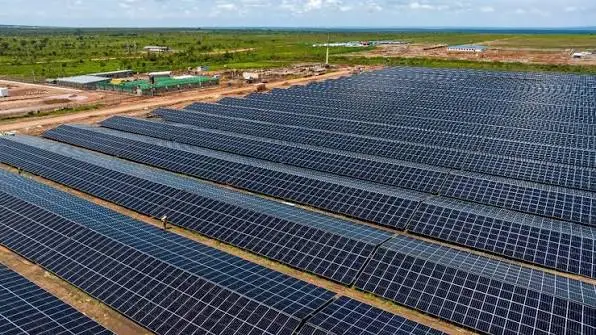
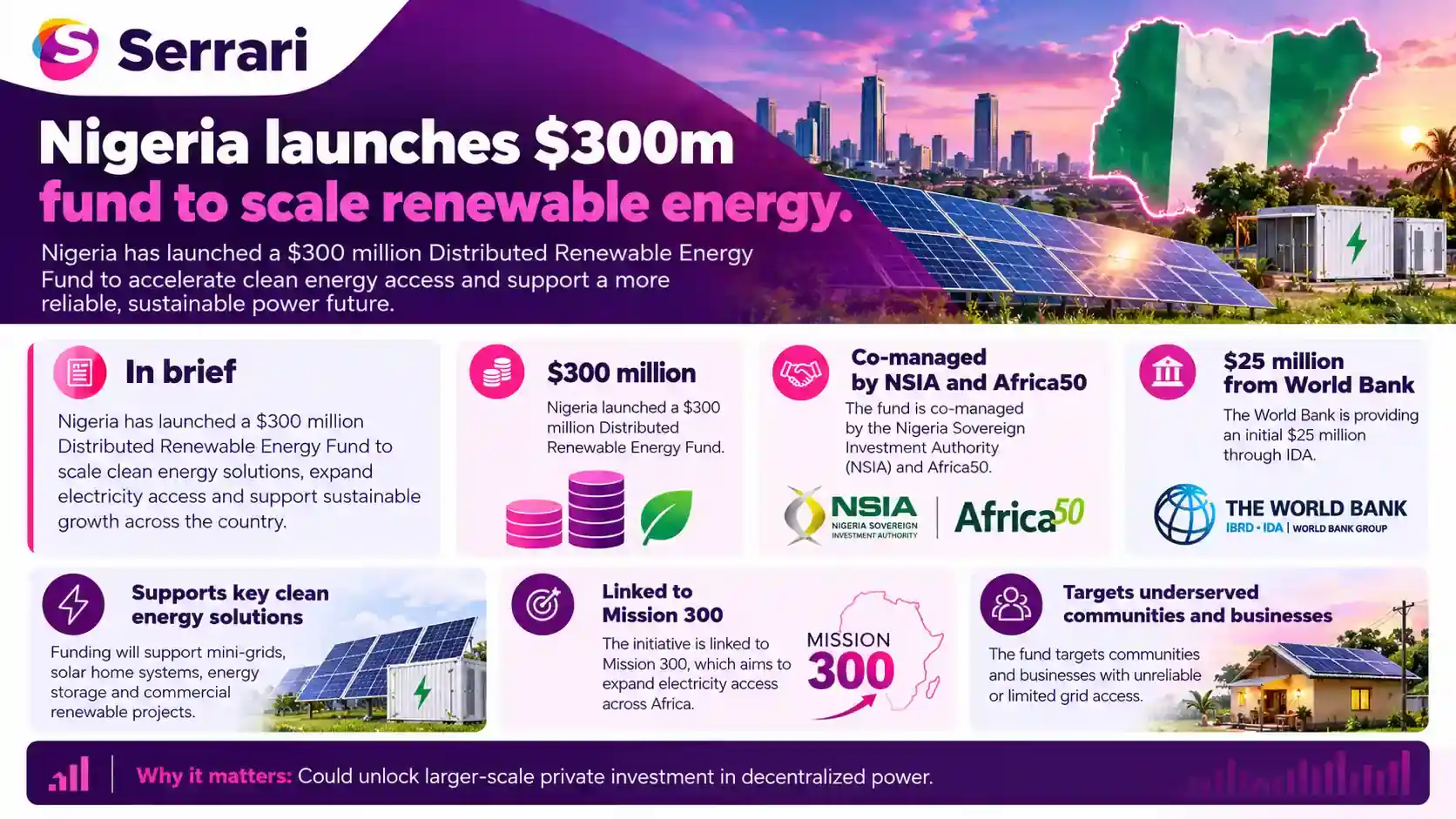
Nigeria has commercially launched a $300 million Distributed Renewable Energy Fund designed to finance mini-grids, standalone solar systems, battery storage and other decentralised electricity projects across the country.
The fund is co-managed by the Nigeria Sovereign Investment Authority and Africa50, with Sustainable Energy for All supporting energy-access strategy and the World Bank participating as a founding partner. The initiative is intended to move distributed renewable energy beyond smaller pilot projects and create a scalable investment platform capable of attracting commercial capital.
Key Overview
- Nigeria’s Distributed Renewable Energy Fund targets $300 million in investment.
- The fund reached commercial launch on September 20, 2026, in New York.
- NSIA and Africa50 will co-manage the investment vehicle.
- The World Bank has provided an initial $25 million through the International Development Association.
- Investments can include mini-grids, standalone solar, commercial and industrial power solutions and energy storage.
- The fund supports Mission 300, which aims to connect 300 million Africans to electricity by 2030.
- More than 80 million Nigerians still lack access to electricity.
- Nigeria’s previous electrification programme helped deploy 180 solar hybrid mini-grids across 23 states.
$300 Million Fund Moves Into Commercial Deployment
The fund reached its commercial launch milestone on September 20, marking a shift from structuring and fundraising toward active capital deployment.
The investment platform is designed to support distributed power projects capable of serving communities and businesses where grid electricity is unavailable, unreliable or too costly to extend.
Eligible opportunities include mini-grids, solar home systems, commercial and industrial renewable installations, embedded generation and innovative energy-storage technologies.
These technologies can allow homes and businesses to receive electricity without waiting for large transmission and distribution projects to reach every location.
World Bank Provides Initial $25 Million
The World Bank is participating as a founding partner and has committed an initial $25 million through IDA.
That contribution represents about 8.3% of the fund’s $300 million target, leaving the vehicle designed to mobilise substantially more capital from other development institutions and private investors.
The structure combines NSIA’s knowledge of the Nigerian investment environment with Africa50’s infrastructure financing and fund-management experience. Sustainable Energy for All contributes expertise in electricity access, while the International Solar Alliance is supporting the wider distributed-renewable-energy framework.
A central objective is to make Nigerian distributed-power projects more attractive to commercial investors by developing larger portfolios, providing appropriate financing structures and reducing risks that often prevent renewable-energy developers from reaching scale.
Fund Supports Africa’s Mission 300 Initiative
Nigeria’s fund also forms part of the broader effort to expand electricity access under Mission 300.
The programme, backed by major African and international development institutions, aims to connect 300 million people to electricity by 2030.
Distributed renewable energy is expected to play a major role because extending national transmission and distribution networks to every underserved community can be expensive and slow.
Mini-grids and standalone systems can instead provide power directly to households, farms, schools, health facilities and businesses while larger grid infrastructure continues to develop.
Nigeria’s size also makes the country an important test case. If the financing structure succeeds in attracting private capital at scale, similar country-focused vehicles could potentially be replicated elsewhere in Africa.
Context is everything. Stay ahead of shifting trends with today’s market updates, and uncover emerging opportunities using the Serrari Group Market Index and Marketplace. Then, take control of your own financial future by exploring our Money & Life Reset Transformation Blueprint ™ to build stronger habits, create better systems, and design a path toward lasting wealth.
Nigeria Already Has a Growing Mini-Grid Market
Nigeria is not starting from scratch.
Under the earlier Nigeria Electrification Project, 180 solar hybrid mini-grids were installed across 23 states by April 2025.
Those projects enabled 19.2 MW of new renewable-energy capacity, exceeding the programme’s original target of 15.5 MW.
The experience demonstrated that private developers can deploy decentralised power infrastructure when financing, regulation and performance incentives are aligned.
The new fund is intended to build on that foundation but at a larger commercial scale, giving developers access to capital for portfolios rather than relying predominantly on isolated projects or grant-funded programmes.
Electricity Access Gap Remains Enormous
Despite previous investment, Nigeria’s electricity deficit remains one of the largest globally.
Recent estimates indicate that more than 80 million Nigerians lack electricity access, while many households and businesses formally connected to the grid still experience unreliable supply.
That reliability problem has encouraged widespread use of petrol and diesel generators, increasing operating costs for businesses while exposing households to volatile fuel prices.
Distributed solar, battery storage and mini-grids offer an alternative by locating generation much closer to consumers.
For businesses, more dependable electricity can support manufacturing, refrigeration, telecommunications, agriculture and other productive activities that suffer when power supply is inconsistent.
Private Capital Will Determine the Fund’s Impact
The commercial launch does not automatically guarantee that $300 million will immediately reach projects.
Developers will still need bankable business models, credible electricity-demand forecasts, appropriate tariffs, reliable equipment and strong maintenance systems. Investors will also assess currency risks, project economics and the ability of customers to pay for electricity over the long term.
The significance of the fund is therefore its attempt to transform distributed renewable energy into an investable infrastructure category rather than treating off-grid power mainly as a development programme.
If the vehicle successfully attracts private capital and builds a pipeline of viable projects, it could significantly accelerate Nigeria’s move toward more decentralised and reliable electricity while providing a financing model for other African markets.
Sources: Nigeria Sovereign Investment Authority / Africa50 / Sustainable Energy for All / World Bank / International Solar Alliance
Your financial future isn’t something you wait for—it’s something you build.
The real question is: when do you begin?
Move beyond simply staying informed.
Navigate the markets with clarity—track trends through the Serrari Group Market Index, uncover opportunities in the Serrari Marketplace, and build practical knowledge with our Curated Wealth Builder Platform.
Stay connected to what truly matters.
Get daily insights on macro trends and financial movements across Kenya, Africa, and global markets—delivered through the Serrari Newsletter.
Growth opens doors.
Advance your career through professional programs including ACCA, HESI A2, ATI TEAS 7 , HESI EXIT , NCLEX – RN and NCLEX – PN, Financial Literacy!🌟—designed to move you forward with confidence.
See where money is flowing—clearly and in real time.
Track Money Market Funds, Treasury Bills, Treasury Bonds, Green Bonds, and Fixed Deposits, alongside global and African indexes, key economic indicators, and the evolving Crypto and stablecoin landscape—all within Serrari’s Market Index.