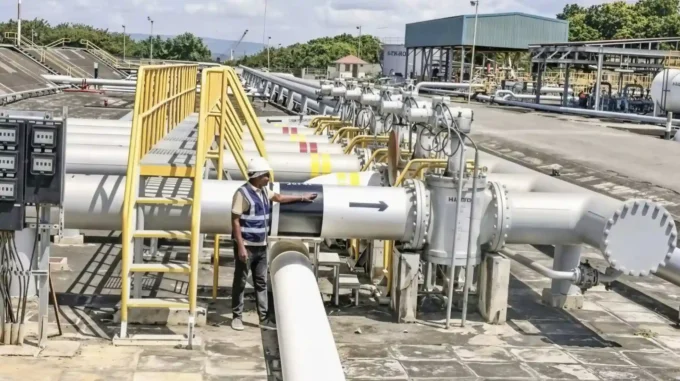
The Nigeria Customs Service and the African Export-Import Bank are deepening cooperation to reduce cross-border trade barriers, strengthen regional transit systems and accelerate implementation of the African Continental Free Trade Area.
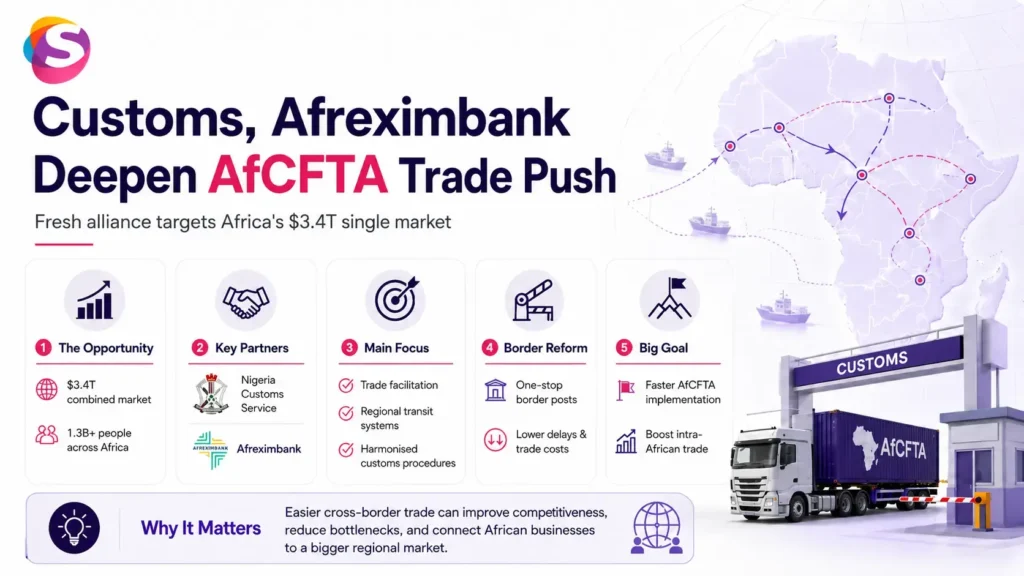
The renewed partnership was reaffirmed during a working visit by Afreximbank President and Chairman George Elombi to Comptroller-General of Customs Adewale Adeniyi in Abuja. The discussions focused on practical reforms including harmonised customs procedures, one-stop border posts and better coordination between African customs administrations.
The initiative comes as African governments seek to turn the AfCFTA from a trade agreement into a functioning continental market. The bloc connects more than 1.3 billion people across Africa and represents about $3.4 trillion in combined economic activity.
Key Overview
- Partnership: Nigeria Customs Service and Afreximbank.
- Core focus: Trade facilitation, regional transit and customs reform.
- Border strategy: Development of one-stop border posts along major trade corridors.
- Continental objective: Faster implementation of the AfCFTA.
- Market opportunity: More than 1.3 billion people and about $3.4 trillion in combined GDP.
- Main challenge: High trade costs caused by delays, fragmented procedures and weak coordination across borders.
Turning African Trade Ambition Into Practical Reform
The renewed alliance is aimed at addressing one of the AfCFTA’s most difficult challenges: moving goods across African borders efficiently.
According to reporting on the Abuja meeting, both institutions agreed to strengthen trade facilitation initiatives, support regional transit systems and improve cooperation between customs administrations.
Adeniyi said the partnership is based on the belief that Africa’s economic future will depend increasingly on trade among African countries. The immediate objective is therefore not only to increase trade volumes, but also to remove procedural obstacles that make intra-African commerce more expensive and unpredictable.
The proposed measures include harmonising customs processes and expanding one-stop border posts, where traders can complete border procedures through a more coordinated system rather than passing through multiple layers of checks.
For businesses, the potential impact is significant. Faster clearance can reduce transport costs, improve delivery times and make regional supply chains more competitive.
Regional Transit Systems Become a Priority
A major part of the collaboration will focus on regional transit arrangements.
African businesses often face repeated documentation requirements, separate customs guarantees and administrative delays when goods cross several countries. These costs can undermine the commercial benefits of lower tariffs.
Afreximbank has already been supporting a broader regional transit guarantee initiative designed to make the movement of goods across borders more efficient.
The bank has encouraged Nigeria to play a leading role in expanding such systems across West Africa. The model is intended to reduce the need for traders to obtain separate guarantees every time cargo moves through another jurisdiction.
Nigeria’s involvement is strategically important because of the scale of its economy, its borders with several neighbouring states and its position within major West African trade corridors.
Context is everything. Stay ahead of shifting trends with today’s market updates, and uncover emerging opportunities using the Serrari Group Market Index and Marketplace. Then, take control of your own financial future by exploring our Money & Life Reset Transformation Blueprint ™ to build stronger habits, create better systems, and design a path toward lasting wealth.
Customs PACT Provides a Foundation
The latest engagement also builds on earlier cooperation through the Customs Partnership for African Cooperation in Trade, known as Customs PACT.
The initiative was developed to improve customs cooperation, tackle non-tariff barriers and encourage stronger coordination between governments, trade institutions and businesses.
A 2025 Customs PACT roundtable brought together the Nigeria Customs Service, Afreximbank, the AfCFTA Secretariat and other partners to discuss regional transit guarantees and interoperable customs systems.
That earlier initiative identified a central problem: African customs systems often operate separately and do not communicate efficiently with one another.
The latest partnership seeks to move beyond discussion by supporting systems that can be implemented along actual trade corridors.
Why Border Reform Matters for the AfCFTA
The AfCFTA is often described primarily as a tariff-reduction agreement, but many of its potential gains depend on reducing delays and other non-tariff barriers.
World Bank analysis has found that effective implementation could produce major economic benefits by making it easier for companies to participate in regional supply chains. A deeper integration scenario could raise African incomes by 9% by 2035, while also encouraging investment and creating new employment opportunities.
For those gains to materialise, businesses need predictable customs procedures, reliable transport corridors and lower administrative costs.
That makes the Nigeria Customs–Afreximbank partnership important beyond Nigeria itself. Successful transit and border reforms could offer a model for connecting national customs systems with the wider continental trade framework.
Nigeria Seeks a Central Role in Continental Trade
Nigeria has a strong incentive to lead the process.
As one of Africa’s largest economies and consumer markets, it could benefit from stronger regional demand for manufactured goods, services and agricultural products. However, businesses will only capture those opportunities if border procedures become faster and more predictable.
The renewed partnership therefore links Nigeria’s domestic customs reforms with a broader continental objective: building a trade system capable of supporting the AfCFTA at scale.
The challenge now is implementation. One-stop border posts, harmonised procedures and regional transit guarantees will require cooperation across multiple governments and agencies.
But the direction is clear. The AfCFTA’s $3.4 trillion opportunity will depend not simply on signed agreements, but on whether African institutions can make trade across the continent genuinely easier.
Sources: Punch / Afreximbank / World Bank
Your financial future isn’t something you wait for—it’s something you build.
The real question is: when do you begin?
Move beyond simply staying informed.
Navigate the markets with clarity—track trends through the Serrari Group Market Index, uncover opportunities in the Serrari Marketplace, and build practical knowledge with our Curated Wealth Builder Platform.
Stay connected to what truly matters.
Get daily insights on macro trends and financial movements across Kenya, Africa, and global markets—delivered through the Serrari Newsletter.
Growth opens doors.
Advance your career through professional programs including ACCA, HESI A2, ATI TEAS 7 , HESI EXIT , NCLEX – RN and NCLEX – PN, Financial Literacy!🌟—designed to move you forward with confidence.
See where money is flowing—clearly and in real time.
Track Money Market Funds, Treasury Bills, Treasury Bonds, Green Bonds, and Fixed Deposits, alongside global and African indexes, key economic indicators, and the evolving Crypto and stablecoin landscape—all within Serrari’s Market Index.