Nigeria crypto tax reforms introduce stamp duty and withholding tax requirements on certain cryptocurrency transactions, with industry leaders warning the measures could discourage regulated trading and push activity toward offshore platforms. While the government aims to strengthen tax collection and financial regulation, critics argue the framework may increase transaction costs, weaken crypto adoption, and reduce the competitiveness of Nigeria’s licensed exchanges.
Key Overview
Nigeria has introduced new tax measures targeting cryptocurrency transactions as part of broader financial regulation. Although the reforms seek to improve tax compliance in the rapidly expanding digital assets sector, industry participants argue the current structure could discourage regulated trading, increase costs for crypto investors, and encourage migration to offshore exchanges.
Nigeria Introduces New Crypto Tax Framework
The Nigeria crypto tax regime introduces stamp duty on selected cryptocurrency transactions alongside withholding tax obligations for digital asset activities.
A notable feature of the new framework allows eligible crypto businesses to remit taxes using digital assets instead of the Nigerian naira, marking a significant development in the country’s evolving approach to cryptocurrency regulation.
The reforms come as Nigerian authorities seek to expand oversight of one of Africa’s largest and most active virtual assets markets while improving tax collection from the growing fintech ecosystem.
Industry Warns Higher Costs Could Hurt Cryptocurrency Adoption
Industry stakeholders have expressed concern that the new tax measures could discourage crypto adoption rather than strengthen regulatory compliance.
Obinna Iwuno, representing the Digital Assets Coalition, argued that taxation should focus on investment gains rather than the movement of funds.
According to the coalition, imposing transaction-based taxes risks increasing trading costs substantially and could discourage users from utilizing licensed Nigerian exchanges.
The organization also warned that regulated exchanges could increasingly function as tax collection agents, creating additional compliance burdens for both platforms and customers.
Regulated Exchanges Face Competitive Pressure
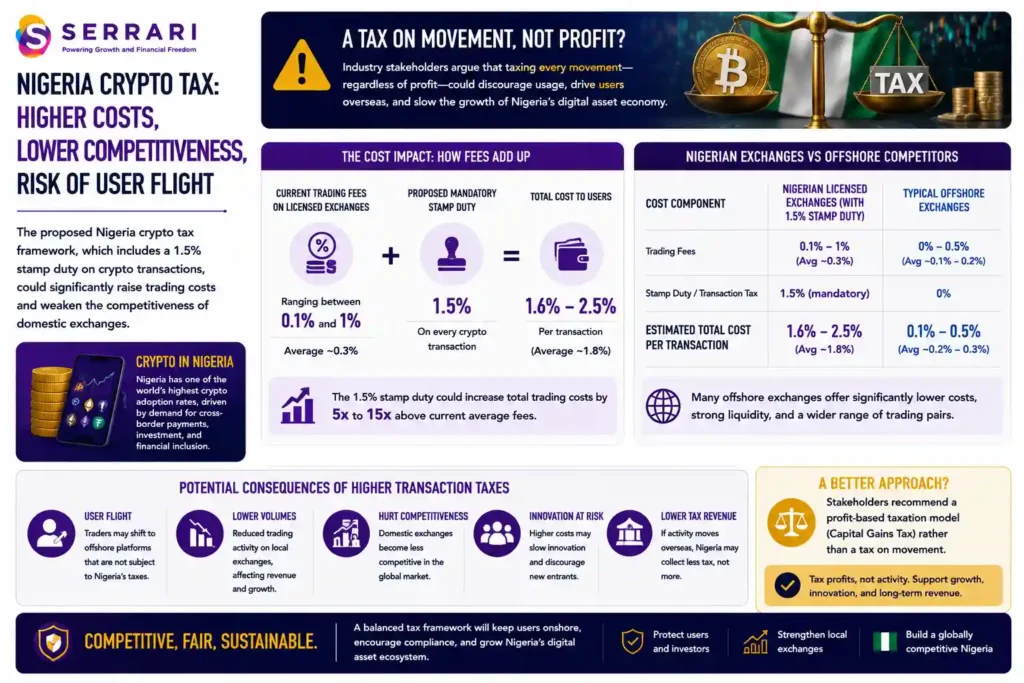
One of the biggest concerns surrounding the Nigeria crypto tax framework is its potential impact on the competitiveness of domestic exchanges.
Industry estimates indicate that licensed exchanges currently charge trading fees ranging between 0.1% and 1%, with average transaction costs around 0.3%.
Adding a mandatory 1.5% stamp duty would significantly increase the overall cost of trading, making regulated Nigerian platforms considerably more expensive than many offshore competitors.
Critics argue that higher transaction costs could encourage users to move trading activity to foreign exchanges that are not subject to Nigeria’s tax framework.
Context is everything. Stay ahead of shifting trends with today’s market updates, and uncover emerging opportunities using the Serrari Group Market Index and Marketplace. Then, take control of your own financial future by exploring our Money & Life Reset Transformation Blueprint ™ to build stronger habits, create better systems, and design a path toward lasting wealth.
Lessons from International Crypto Regulation
Industry participants have pointed to experiences in other countries when evaluating the likely impact of the new rules.
India introduced a 1% tax deducted at source (TDS) on cryptocurrency transactions, after which regulated exchanges experienced a sharp decline in trading volumes. Research cited by industry representatives indicates that a significant portion of trading activity migrated to offshore platforms following the policy’s implementation.
Similarly, Kenya repealed its transaction-based crypto tax in 2025, while Turkey also withdrew a comparable proposal in 2026 after concerns about market competitiveness.
These international examples have fueled calls for Nigeria to adopt a taxation model focused on investment profits rather than transaction values.
Nigeria Remains One of Africa’s Largest Crypto Markets
Despite years of regulatory uncertainty, Nigeria has emerged as one of Africa’s leading cryptocurrency markets.
Digital assets are widely used across the country for savings, payments, remittances, and cross-border transactions, supported by a young population, strong mobile technology adoption, and increasing demand for alternative financial services.
The country’s vibrant Nigeria fintech ecosystem has also contributed to growing interest in blockchain technology and digital financial innovation.
Balancing Financial Regulation and Innovation
The government’s objective is to strengthen financial regulation while ensuring that cryptocurrency activity contributes to tax revenues and operates within a formal legal framework.
However, industry groups argue that excessive taxation could undermine those objectives by driving activity away from regulated platforms and reducing transparency.
Supporters of a revised framework believe a profit-based tax system would allow authorities to collect revenue while maintaining incentives for users to remain within regulated exchanges.
Such an approach, they argue, would support long-term market development while encouraging compliance from both businesses and crypto investors.
Outlook for Nigeria’s Crypto Market
The future of the Nigeria crypto tax framework will depend on whether policymakers adjust the rules in response to industry feedback.
Nigeria remains one of the continent’s most important markets for blockchain, digital assets, and financial innovation, making regulatory decisions particularly significant for Africa’s broader cryptocurrency ecosystem.
Finding the right balance between taxation, innovation, and investor protection will likely determine whether Nigeria strengthens its position as a leading crypto hub or sees increasing trading activity migrate to offshore markets.
FAQs
What is the new Nigeria crypto tax?
The Nigeria crypto tax introduces stamp duty and withholding tax requirements on certain cryptocurrency transactions as part of the country’s evolving financial regulation framework.
Why are industry groups concerned?
Industry representatives believe the transaction-based taxes could significantly increase trading costs, discourage crypto adoption, and push users toward offshore exchanges.
Can crypto taxes be paid using digital assets?
Yes. Under the new framework, eligible cryptocurrency businesses may remit certain tax obligations using digital assets instead of the Nigerian naira.
How could the tax affect Nigeria’s cryptocurrency market?
Higher transaction costs may reduce activity on regulated exchanges, although the government aims to improve tax compliance and strengthen oversight of the growing cryptocurrency sector.
Sources: Reuters, CNBC, Business Day, Outlook Money
Your financial future isn’t something you wait for—it’s something you build.
The real question is: when do you begin?
Move beyond simply staying informed.
Navigate the markets with clarity—track trends through the Serrari Group Market Index, uncover opportunities in the Serrari Marketplace, and build practical knowledge with our Curated Wealth Builder Platform.
Stay connected to what truly matters.
Get daily insights on macro trends and financial movements across Kenya, Africa, and global markets—delivered through the Serrari Newsletter.
Growth opens doors.
Advance your career through professional programs including ACCA, HESI A2, ATI TEAS 7 , HESI EXIT , NCLEX – RN and NCLEX – PN, Financial Literacy!🌟—designed to move you forward with confidence.
See where money is flowing—clearly and in real time.
Track Money Market Funds, Treasury Bills, Treasury Bonds, Green Bonds, and Fixed Deposits, alongside global and African indexes, key economic indicators, and the evolving Crypto and stablecoin landscape—all within Serrari’s Market Index.