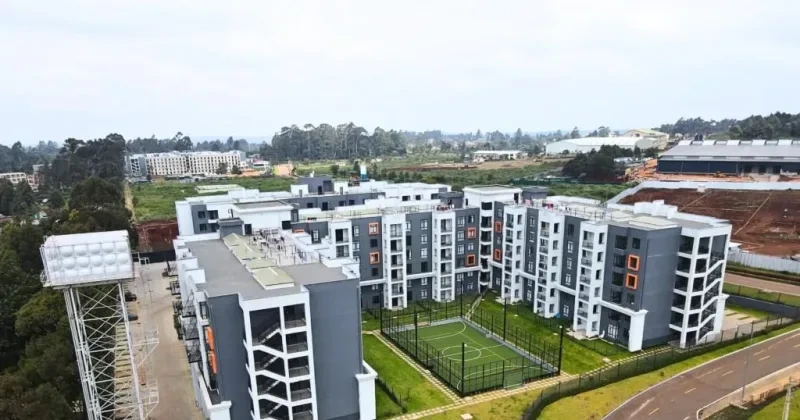
IHS Kenya has launched a Sh1 billion residential project in Tilisi, adding 240 new homes to Kenya’s growing housing sector. The development targets middle-income buyers and investors while supporting sustainable residential real estate through energy-efficient design and professionally managed communities.
Key Overview
The new Kenya housing development, known as Muzi Salama, will deliver two- and three-bedroom apartments designed for middle-class homebuyers. The project reflects continued confidence in the Kenya property market, where demand for quality residential housing continues to outpace supply despite ongoing private sector investment.
IHS Kenya Launches Sh1 Billion Housing Development
International Housing Solutions (IHS) Kenya has unveiled a Sh1 billion residential project in Tilisi, reinforcing private sector investment in Kenya’s growing housing sector.
Named Muzi Salama, the development will deliver 240 residential units, helping address the country’s persistent housing shortage while expanding the supply of professionally managed homes for middle-income buyers.
The project demonstrates continued confidence in the long-term prospects of Kenya housing development, despite broader economic challenges affecting construction and mortgage financing.
Targeting Middle-Class Homebuyers
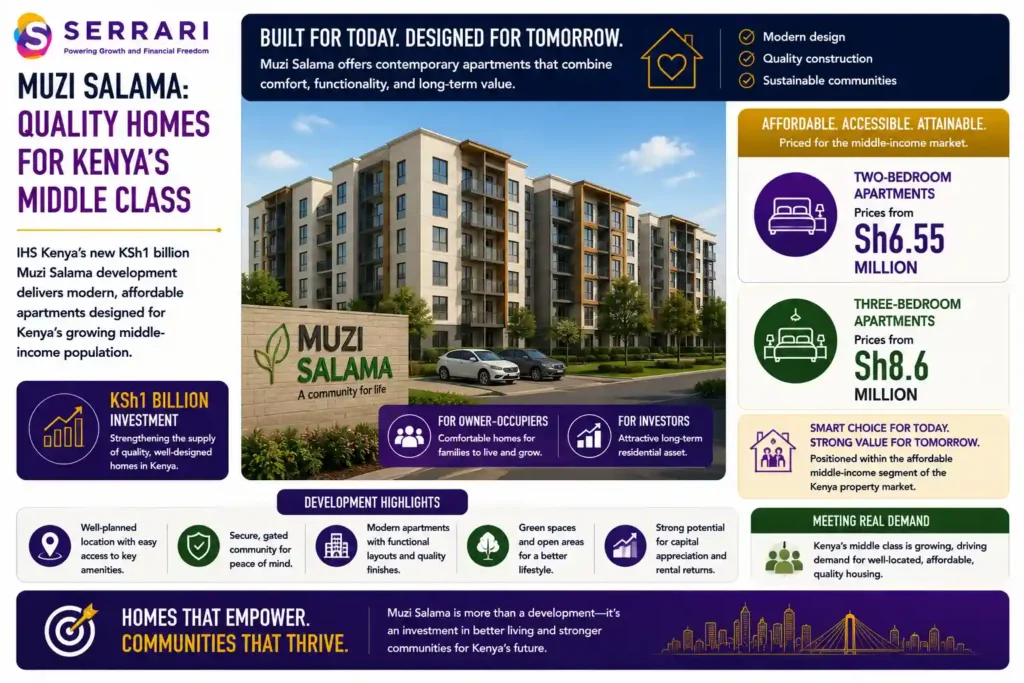
The Muzi Salama development has been specifically designed to serve Kenya’s expanding middle-income population.
The project comprises a mix of two-bedroom and three-bedroom apartments, providing housing options for both owner-occupiers and property investors seeking long-term residential assets.
Pricing begins at Sh6.55 million for two-bedroom apartments, while three-bedroom units start from Sh8.6 million, positioning the development within the affordable middle-income segment of the Kenya property market.
Sustainable Residential Real Estate
Sustainability forms a key component of the development.
The project has been designed to pursue EDGE (Excellence in Design for Greater Efficiencies) certification through the incorporation of energy-efficient and water-saving technologies.
These features are intended to lower utility costs for homeowners while promoting environmentally sustainable urban development.
As sustainability becomes increasingly important in residential real estate, developers are incorporating green building standards to improve operational efficiency and long-term property value.
Context is everything. Stay ahead of shifting trends with today’s market updates, and uncover emerging opportunities using the Serrari Group Market Index and Marketplace. Then, take control of your own financial future by exploring our Money & Life Reset Transformation Blueprint ™ to build stronger habits, create better systems, and design a path toward lasting wealth.
Building on Previous Success
The launch follows the success of IHS Kenya’s earlier Muzi Stawi development at Garden City.
According to the company, the previous project is approaching full occupancy, highlighting continued demand for professionally managed residential communities within Nairobi and its surrounding metropolitan areas.
The strong performance of earlier developments provides additional confidence that demand for quality middle-income housing remains resilient despite broader affordability challenges facing the market.
Long-Term Housing Expansion Strategy
The latest project forms part of IHS Kenya’s broader expansion strategy.
The company aims to deliver approximately 3,000 housing units by 2030, although management acknowledges that achieving this target will depend on several factors, including financing availability, market conditions, and sustained buyer demand.
The long-term pipeline reflects continued optimism regarding Kenya’s expanding urban population and the need for additional quality residential property.
Housing as an Economic Growth Driver
IHS Kenya views housing development as more than simply constructing residential buildings.
Managing Director Kioi Wambaa said the company sees housing as a catalyst for both economic growth and social transformation, with each development intended to create lasting value for homeowners and surrounding communities.
According to Wambaa, Muzi Salama reflects the company’s long-term confidence in Kenya while emphasizing professionally managed communities, quality construction, and homes designed to retain value over generations.
The approach highlights the growing importance of integrated community development within the country’s evolving real estate investment landscape.
Addressing Kenya’s Housing Demand
Kenya continues to experience a substantial housing deficit driven by rapid urbanization, population growth, and increasing demand from middle-income households.
Private developers have played an increasingly important role in expanding supply as demand for quality housing continues to exceed available inventory across major urban centres.
Developments such as Muzi Salama contribute toward narrowing this housing gap while providing investment opportunities within the country’s expanding residential real estate market.
Although supply continues to improve, affordability, mortgage accessibility, and infrastructure remain important considerations influencing future market growth.
Outlook for Kenya’s Property Market
The launch of Muzi Salama reflects continued confidence in the long-term outlook for the Kenya property market.
Growing urbanization, rising middle-class incomes, and increasing demand for professionally managed housing communities continue to support investment in residential development.
Projects incorporating sustainability features, modern community planning, and professional property management are likely to remain attractive to both homeowners and investors as Kenya’s housing market continues to mature.
FAQs
What is Muzi Salama?
Muzi Salama is a Sh1 billion Kenya housing development launched by IHS Kenya in Tilisi that will add 240 residential apartments targeting middle-income homebuyers and investors.
What types of homes are available?
The development consists of two-bedroom and three-bedroom apartments, with prices starting from Sh6.55 million and Sh8.6 million, respectively.
What is EDGE certification?
EDGE (Excellence in Design for Greater Efficiencies) is a green building certification that promotes energy and water efficiency, helping homeowners reduce utility costs while supporting sustainable construction.
Why is Kenya’s housing market attracting investment?
Strong urbanization, continued housing demand, a growing middle class, and a persistent housing shortage continue to make real estate investment in Kenya’s residential sector attractive for private developers and institutional investors.
Your financial future isn’t something you wait for—it’s something you build.
The real question is: when do you begin?
Move beyond simply staying informed.
Navigate the markets with clarity—track trends through the Serrari Group Market Index, uncover opportunities in the Serrari Marketplace, and build practical knowledge with our Curated Wealth Builder Platform.
Stay connected to what truly matters.
Get daily insights on macro trends and financial movements across Kenya, Africa, and global markets—delivered through the Serrari Newsletter.
Growth opens doors.
Advance your career through professional programs including ACCA, HESI A2, ATI TEAS 7 , HESI EXIT , NCLEX – RN and NCLEX – PN, Financial Literacy!🌟—designed to move you forward with confidence.
See where money is flowing—clearly and in real time.
Track Money Market Funds, Treasury Bills, Treasury Bonds, Green Bonds, and Fixed Deposits, alongside global and African indexes, key economic indicators, and the evolving Crypto and stablecoin landscape—all within Serrari’s Market Index.