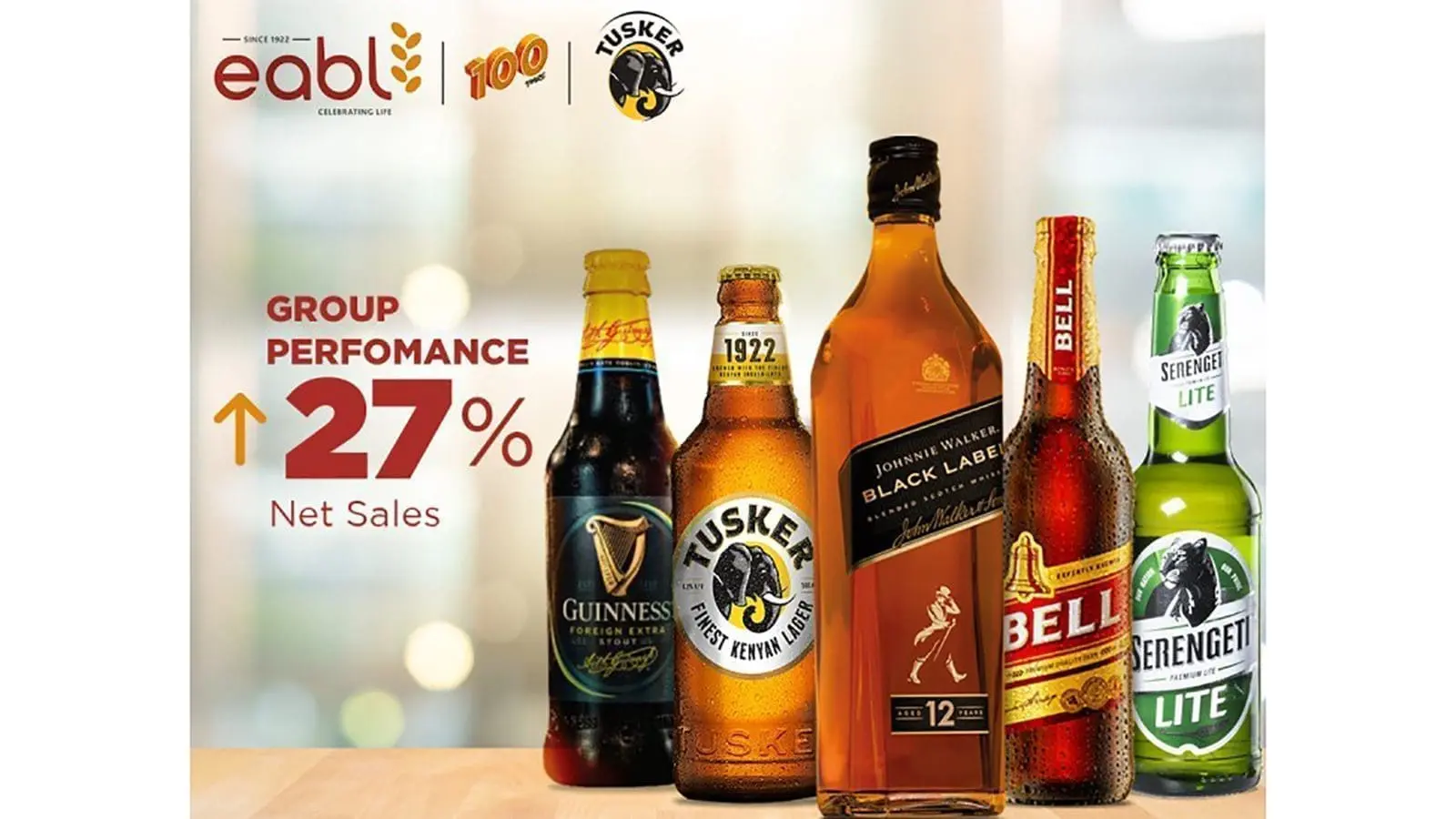
EABL full-year results show that profit after tax increased by 49% to KSh18.23 billion during the year ended 30 June 2026.
LIVENSE market summarySee NSE data →Net sales rose by 13% to approximately KSh146 billion, supported by higher volumes, product innovation and strong growth in Uganda and Tanzania. Lower debt and financing costs also allowed profit to grow faster than revenue.
The board proposed a final dividend of KSh8.70 per share, bringing the total annual dividend to KSh12.70 per share, 59% higher than the previous year.
The results show improved operating performance, cash generation and balance-sheet strength. However, investors must also consider slower growth in Kenya, a KSh1.22 billion foreign-exchange loss, consumer affordability pressures and the pending change in EABL’s controlling shareholder.
Key Overview
- EABL’s net sales increased by 13% to KSh145.96 billion.
- Profit after tax rose by 49% to KSh18.23 billion.
- Earnings per share increased by 59% to KSh18.99.
- The total annual dividend increased by 59% to KSh12.70 per share.
- Cash generated from operations rose by 18% to KSh41.98 billion.
- Year-end cash increased by 41% to approximately KSh17.99 billion.
- Lower debt reduced EABL’s net finance costs by approximately 25%.
- Tanzania recorded 44% revenue growth.
- Uganda’s revenue increased by 16%.
- Kenya, EABL’s largest market, grew by 5%.
- Mainstream spirits volumes increased by 30%.
- The company recorded a KSh1.22 billion foreign-exchange loss.
- The Diageo–Asahi ownership transaction remains subject to final regulatory completion.
EABL Full Year Results Lift Profit 49% and Dividend 59%
East African Breweries PLC reported a 49% increase in profit after tax for the financial year ended 30 June 2026 as higher sales, stronger cash generation and lower borrowing costs improved its financial performance.
The official EABL full-year results release reported profit after tax of KSh18.23 billion, compared with approximately KSh12.20 billion in the previous year. Net sales increased by 13% to KSh145.96 billion.
The brewer’s earnings before interest and tax increased by 27% to KSh32.07 billion, while earnings per share rose by approximately 59% to KSh18.99.
The results show that EABL generated growth across sales, operating profit, cash flow and shareholder distributions despite continued pressure on household spending and input costs.
Higher Sales Supported Profit Growth
EABL’s revenue growth was supported by increased product volumes, a stronger product mix and expansion across its three main East African markets.
Beer volumes increased by 9%, while mainstream spirits recorded growth of approximately 30%. Premium beer and spirits volumes rose by a further 9%.
The official EABL full-year investor presentation shows that the company benefited from innovation, improved distribution and consumer demand across both value and premium products.
Mainstream spirits were the fastest-growing category.
This part of EABL’s portfolio includes products positioned below the most expensive international spirits but above informal or unregulated alcohol. Growth in this segment suggests that consumers continued spending on recognised brands while remaining sensitive to price.
Premium products also continued growing, indicating that EABL was able to serve both cost-conscious consumers and higher-income customers.
Regional Markets Grew at Different Speeds
EABL’s regional diversification played an important role in the results.
Revenue in Tanzania increased by 44%, while Uganda recorded growth of 16%. Kenya grew by a more modest 5%.
The The Star’s independent results coverage reported that Kenya continued contributing approximately 60% of EABL’s business, but the faster performance in Tanzania and Uganda reduced the company’s dependence on its largest market.
Tanzania’s performance was supported by continued market recovery and growth in Serengeti Breweries’ portfolio.
Uganda also benefited from stronger beer and spirits demand.
The regional difference matters because a company can report strong group growth even where its largest individual market is expanding more slowly.
For investors, faster regional growth provides diversification but also introduces additional exposure to different currencies, regulations, tax systems and consumer conditions.
Kenya Remains the Largest Market
Kenya remains central to EABL’s earnings because it is the company’s largest market and home to several of its strongest brands.
Revenue growth of 5% was positive but materially below the rates recorded in Uganda and Tanzania.
The Kenyan consumer continued facing pressure from food, transport, housing and other household costs. This can encourage customers to buy less frequently, choose smaller packages or move toward cheaper products.
EABL must therefore balance price increases with affordability.
Raising prices can help protect profit margins when excise duties, energy or input costs rise. However, excessive price increases may push customers toward lower-priced alternatives or illicit alcohol.
The company’s ability to offer products at different price points remains important to protecting market share.
Lower Debt Strengthened the Bottom Line
EABL’s profit increased much faster than its revenue.
Net sales grew by 13%, but profit after tax increased by 49%.
One reason was the reduction in financing costs.
According to Khusoko’s detailed EABL earnings analysis, net finance costs declined by approximately 25% to around KSh4.4 billion after EABL reduced its debt during the year.
The official results materials refer to debt reduction of approximately KSh5.8 billion, although some reports use slightly different rounded figures.
The important point is that lower borrowing reduced the amount of operating profit absorbed by interest expenses.
This helped profit after tax grow faster than sales and operating earnings.
Deleveraging also gives EABL greater flexibility to invest in production, brands and distribution without depending as heavily on new borrowing.
Cash Generation Improved
Cash generated from operations increased by approximately 18% to KSh41.98 billion.
Year-end cash and cash equivalents rose by 41% to approximately KSh17.99 billion.
The audited FY2026 financial results advertisement provides the audited income-statement, balance-sheet and cash-flow figures supporting the company’s profit and dividend announcement.
Strong operating cash generation is important because accounting profit does not automatically provide the money needed to pay dividends or reduce debt.
A company can report profit while experiencing weak cash collection, growing inventories or high capital expenditure.
EABL’s improved cash position indicates that a significant part of its operating performance translated into actual liquidity.
That cash supported debt repayment, investment and the proposed shareholder distribution.
Dividend Increases to KSh12.70
EABL’s board recommended a final dividend of KSh8.70 per share.
Together with the KSh4 interim dividend, the total annual dividend reaches KSh12.70 per share.
This represents an increase of approximately 59% from the previous financial year.
The TechTrends Kenya’s current earnings report confirms that the final dividend remains subject to shareholder approval and applicable withholding tax.
The proposed final dividend is expected to be paid on 31 October 2026 after shareholder approval.
The larger dividend suggests that EABL’s board has greater confidence in the company’s current cash position and ability to fund its operations.
However, the dividend is not guaranteed to increase at the same rate every year.
Future distributions will depend on earnings, cash flow, investment requirements, debt levels and the company’s wider operating environment.
Dividend Yield Requires Context
EABL’s share price stood at approximately KSh269 on 30 June 2026.
Comparing the KSh12.70 annual dividend with that share price produces a simple historical gross dividend yield of approximately 4.7%. This is a derived calculation before withholding tax and is not management guidance.
The total dividend also represented approximately 67% of the company’s KSh18.99 earnings per share.
This simple payout comparison suggests that EABL distributed around two-thirds of annual earnings through dividends while retaining the remainder within the business.
Investors should not evaluate the dividend yield alone.
The share price can rise or fall, changing the yield available to a new investor. Taxes also reduce the amount ultimately received.
Dividend sustainability is more important than a single historical yield.
Context is everything. Stay ahead of shifting trends with today’s market updates, and uncover emerging opportunities using the Serrari Group Market Index and Marketplace. Then, take control of your own financial future by exploring our Money & Life Reset Transformation Blueprint ™ to build stronger habits, create better systems, and design a path toward lasting wealth.
Foreign-Exchange Losses Increased
Not every part of EABL’s financial performance improved.
The company recorded a foreign-exchange loss of approximately KSh1.22 billion, compared with a KSh313 million gain during the previous financial year.
The Khusoko’s detailed EABL earnings analysis explains that currency movements remained one of the main negative items affecting an otherwise strong financial year.
EABL operates across several countries and imports some inputs, equipment and products priced in foreign currencies.
A weaker local currency can increase the cost of paying suppliers or settling foreign-currency obligations.
Regional diversification can support revenue growth, but it also means that EABL’s financial statements are exposed to currency translation and transaction effects.
The company’s core operating performance was strong enough to absorb the loss during FY2026. Future currency movements may be more or less favourable.
LIVENSE market summarySee NSE data →Operating Growth Was Stronger Before Currency Effects
EABL reported operating profit before foreign-exchange effects of approximately KSh33.3 billion, representing growth of nearly 34%.
After accounting for the foreign-exchange loss, reported earnings before interest and tax were lower at approximately KSh32.07 billion.
This distinction helps investors understand the quality of the underlying performance.
Sales volumes, product mix, productivity and cost controls improved the operating business.
Currency movements then reduced part of that benefit.
Investors should monitor both figures rather than focusing only on reported profit after tax.
A strong underlying business can still experience volatile reported earnings when exchange rates move sharply.
EABL’s full-year 2026 results show net sales increasing by 13% to approximately KSh146 billion and profit after tax rising by 49% to KSh18.23 billion. Cash generated from operations reached almost KSh42 billion, while year-end cash increased to approximately KSh18 billion. Lower debt reduced net financing costs by around 25%, helping the company increase its total dividend by 59% to KSh12.70 per share. The infographic compares regional revenue growth of 5% in Kenya, 16% in Uganda and 44% in Tanzania. It also highlights beer-volume growth of 9%, mainstream-spirits growth of 30% and a KSh1.22 billion foreign-exchange loss. The graphic explains that EABL’s stronger profit was driven by both operating growth and balance-sheet improvement rather than revenue growth alone.
Profit Quality Appears Stronger
The 49% profit increase was supported by several separate factors:
- Higher sales volumes;
- Revenue growth across all three main markets;
- Better product mix;
- Productivity improvements;
- Lower debt;
- Reduced interest expenses; and
- Improved working-capital management.
This combination is more encouraging than profit growth produced mainly by a one-time asset sale or accounting adjustment.
Operating earnings grew, cash generation improved and debt declined during the same period.
However, financing-cost reductions will not provide the same growth benefit indefinitely.
Once debt reaches a lower and more stable level, future profit growth will depend more heavily on sales, margins and operating efficiency.
Share Price Increased Before Results
EABL’s share price was reported at KSh269 at the end of June 2026, approximately 43% higher than a year earlier.
The TechTrends Kenya’s current earnings report links the stronger share performance with improving earnings, cash generation and expectations for shareholder returns.
A rising share price benefits existing shareholders, but it can make the stock more expensive for new investors.
Part of EABL’s improved outlook may already be reflected in its valuation.
Investors should therefore compare the market price with earnings, dividends, cash flow, debt and expected future growth rather than assuming that strong financial results automatically make the shares inexpensive.
Consumer Affordability Remains a Risk
Alcohol is a discretionary consumer product.
Customers can reduce consumption, choose cheaper brands or purchase smaller quantities when household budgets become strained.
EABL reported that consumers were trading down in some areas while demand for flavoured beverages and selected premium products continued growing.
This creates both risk and opportunity.
The company needs affordable products to retain price-sensitive customers while continuing to expand higher-margin premium brands.
Illicit alcohol remains another major challenge.
Unregulated products can sell at lower prices because their producers may avoid taxes, quality standards and regulatory costs.
This affects formal manufacturers, government tax collections and consumer safety.
Excise Taxes Can Affect Demand
Alcoholic beverages are subject to substantial excise taxes across East Africa.
Changes in tax rates can affect retail prices, demand and the profitability of different product categories.
Predictable tax policy allows producers to plan investments and pricing more effectively.
Sharp or frequent increases can widen the price gap between regulated and illicit products.
Investors should therefore monitor the fiscal policies of Kenya, Uganda and Tanzania alongside EABL’s own financial performance.
Regional growth does not guarantee that future tax and regulatory conditions will remain favourable.
Ownership Change Remains Pending
EABL’s results were released while the proposed sale of Diageo’s controlling interest to Asahi Group Holdings remains in progress.
The Diageo’s official EABL sale announcement states that Diageo agreed to sell the company holding its 65% EABL stake to Asahi as part of a wider transaction valued at approximately US$2.3 billion.
The transaction is between EABL’s shareholders rather than a sale of EABL’s operating assets.
EABL remains listed on the Nairobi Securities Exchange and continues operating normally.
The change would nevertheless replace the company’s controlling shareholder and could influence long-term capital allocation, brand licensing and regional strategy.
The transaction should not be described as completed.
Regulatory Approval Is Still Important
The proposed ownership change has faced court challenges and remains subject to applicable regulatory processes.
The EABL’s official transaction status update states that business operations remain unaffected while the parties continue with the regulatory and legal process.
Investors will monitor whether the transaction receives all remaining approvals and closes within the expected timeline.
They will also watch for information on Asahi’s plans for EABL’s local brands, manufacturing operations and regional expansion.
The ownership change could create new opportunities, but the financial benefits and strategic direction cannot be assumed before completion.
What Investors Should Monitor
The first issue is whether EABL can maintain sales and volume growth across its three largest markets.
Tanzania’s 44% growth was exceptional and may be difficult to repeat every year.
Kenya’s slower 5% growth also deserves attention because it remains EABL’s largest market.
Investors should monitor:
- Beer and spirits volumes;
- Consumer affordability;
- Product pricing;
- Excise-tax changes;
- Operating profit margins;
- Cash generation;
- Debt levels;
- Finance costs;
- Foreign-exchange movements;
- Capital expenditure;
- Dividend coverage;
- Illicit alcohol competition; and
- Completion of the Diageo–Asahi transaction.
The official EABL investor financial-results archive provides the company’s audited statements, presentations and press releases for comparison with future reporting.
Conclusion
EABL delivered a strong financial year, with net sales increasing by 13% to approximately KSh146 billion and profit after tax rising by 49% to KSh18.23 billion.
The performance was supported by higher volumes, regional growth, lower financing costs and stronger cash generation.
Uganda and Tanzania grew significantly faster than Kenya, showing the increasing importance of EABL’s regional diversification.
The company also reduced debt and increased its annual dividend by 59% to KSh12.70 per share.
However, investors should not focus only on the headline profit and dividend increases.
The KSh1.22 billion foreign-exchange loss, slower growth in Kenya, consumer affordability pressures, excise-tax risks and the pending ownership transition remain important.
The results suggest that EABL’s earnings quality improved because operating growth, cash generation and balance-sheet strengthening occurred together.
The next test is whether the company can sustain that momentum after the benefits from lower financing costs become less significant.
FAQs
1. Why did EABL’s profit grow faster than revenue?
EABL’s net sales increased by 13%, while profit after tax rose by 49%. The faster profit growth was supported by higher volumes, a better product mix, productivity improvements and lower financing costs. EABL reduced its debt during the year, which lowered the amount of operating profit absorbed by interest expenses. The comparison therefore reflects both stronger operations and balance-sheet improvement.
2. How much dividend did EABL declare?
EABL’s board recommended a final dividend of KSh8.70 per share. Together with the KSh4 interim dividend, this brings the total annual dividend to KSh12.70 per share. The total is approximately 59% higher than the previous year. The final dividend remains subject to shareholder approval and applicable withholding tax.
3. Is EABL’s KSh12.70 dividend sustainable?
The dividend is supported by stronger profit, operating cash generation and a larger year-end cash balance. It represents approximately 67% of EABL’s KSh18.99 earnings per share. However, future dividends will depend on sales, cash flow, debt, capital investment, foreign-exchange movements and operating conditions. The current increase should not be treated as a guarantee of equivalent future growth.
4. What does the Diageo–Asahi transaction mean for EABL?
Diageo agreed to sell the company holding its 65% stake in EABL to Japan’s Asahi Group Holdings. EABL remains listed and its daily operations continue normally. The transaction would change EABL’s controlling shareholder if it receives all remaining approvals and is completed. Investors will monitor Asahi’s strategy, capital-allocation plans and approach to EABL’s local and licensed brands.
Sources: EABL official financial-results archive, official EABL full-year results release, official EABL full-year investor presentation, audited FY2026 financial results advertisement, The Star independent results coverage, Khusoko detailed EABL earnings analysis and TechTrends Kenya current earnings report.
Your financial future isn’t something you wait for—it’s something you build.
The real question is: when do you begin?
Move beyond simply staying informed.
Navigate the markets with clarity—track trends through the Serrari Group Market Index, uncover opportunities in the Serrari Marketplace, and build practical knowledge with our Curated Wealth Builder Platform.
Stay connected to what truly matters.
Get daily insights on macro trends and financial movements across Kenya, Africa, and global markets—delivered through the Serrari Newsletter.
Growth opens doors.
Advance your career through professional programs including ACCA, HESI A2, ATI TEAS 7 , HESI EXIT , NCLEX – RN and NCLEX – PN, Financial Literacy!🌟—designed to move you forward with confidence.
See where money is flowing—clearly and in real time.
Track Money Market Funds, Treasury Bills, Treasury Bonds, Green Bonds, and Fixed Deposits, alongside global and African indexes, key economic indicators, and the evolving Crypto and stablecoin landscape—all within Serrari’s Market Index.