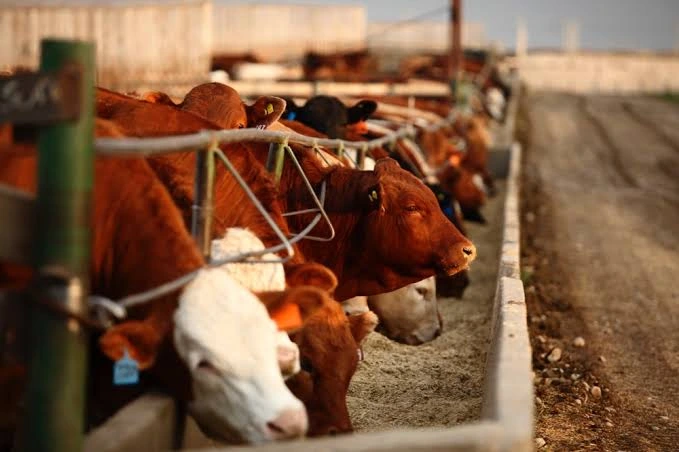
Chicago livestock futures declined on the Chicago Mercantile Exchange (CME) as weaker U.S. stock market performance and cautious investor sentiment weighed on cattle and lean hog contracts. While cash cattle prices remained higher than the previous week, softer wholesale beef prices and broader market uncertainty pressured livestock futures. Traders also monitored grain markets, weather forecasts, and strong Chinese demand for U.S. soybeans.
Key Overview
The decline in Chicago livestock futures reflected a combination of weaker equity markets, mixed wholesale meat prices, and cautious trading activity. Live cattle, feeder cattle, and lean hog futures all closed lower, while investors continued to monitor developments in agricultural commodities, global demand, and geopolitical risks that could influence commodity markets.
Chicago Livestock Futures Decline Alongside U.S. Stock Market
Chicago livestock futures ended lower on Thursday as weakness across the U.S. stock market dampened investor appetite for risk assets. Traders reacted cautiously to the latest corporate earnings releases while also awaiting signs of progress in diplomatic efforts between the United States and Iran.
The softer tone across financial markets spilled over into the commodities market, contributing to declines across both cattle and hog futures traded on the Chicago Mercantile Exchange (CME).
Cattle Futures Retreat Despite Higher Cash Prices
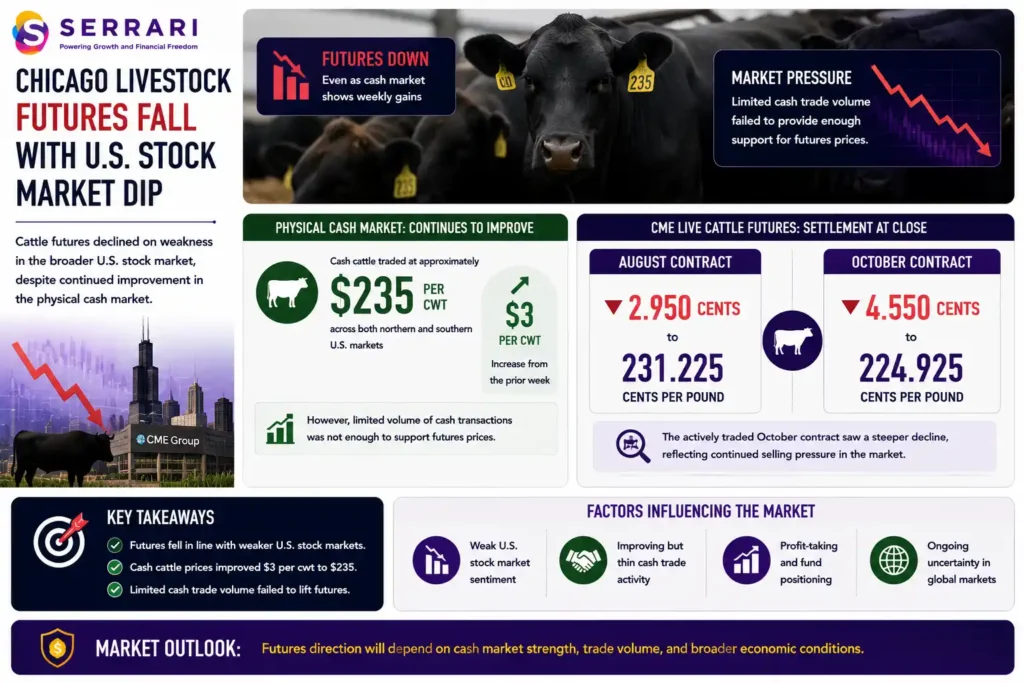
Cattle futures came under pressure even though the physical cash market continued to improve compared with the previous week.
Analysts noted that cash cattle traded at approximately $235 per hundredweight (cwt) across both northern and southern U.S. markets, representing an increase of $3 per cwt from the prior week. However, the limited volume of cash transactions failed to provide sufficient support for futures prices.
At the close of trading, CME August live cattle futures fell 2.950 cents to 231.225 cents per pound, while the actively traded October contract declined 4.550 cents to 224.925 cents per pound.
Feeder Cattle Also Move Lower
Selling pressure extended into feeder cattle contracts.
CME August feeder cattle futures dropped 5.275 cents to 348.050 cents per pound, while deferred contracts also finished the session in negative territory.
The declines reflected cautious market positioning as traders assessed beef demand, wholesale pricing, and broader macroeconomic uncertainty.
Wholesale Beef Prices Deliver Mixed Signals
The wholesale beef market presented a mixed picture during the trading session.
According to the U.S. Department of Agriculture (USDA), Choice beef cuts fell sharply by $5.10 to $362.87 per cwt, while Select beef cuts rose 97 cents to $349.03 per cwt.
The divergence suggests that demand remains uneven across different beef categories, limiting bullish momentum in livestock prices despite stronger cash cattle values.
Context is everything. Stay ahead of shifting trends with today’s market updates, and uncover emerging opportunities using the Serrari Group Market Index and Marketplace. Then, take control of your own financial future by exploring our Money & Life Reset Transformation Blueprint ™ to build stronger habits, create better systems, and design a path toward lasting wealth.
Lean Hog Futures Extend Losses
The weakness also spread to the hog market.
The USDA reported that the pork carcass cutout declined $1.79 from the previous day to $99.26 per cwt, reflecting softer wholesale pork values.
Against this backdrop, CME August lean hog futures settled 1.100 cents lower at 95.500 cents per pound, while the October contract fell 1.300 cents to 81.725 cents per pound.
Lower wholesale pork prices added pressure to lean hog futures, reinforcing cautious sentiment among traders.
Agricultural Commodities Mixed as Traders Watch Weather
Outside the livestock complex, major agricultural commodities traded lower during the session.
The most actively traded soybean contract on the Chicago Board of Trade (CBOT) slipped 0.11% to $11.76½ per bushel.
Wheat futures declined 0.27% to $6.36¾ per bushel, while corn futures lost 0.48% to $4.63¼ per bushel.
Weather forecasts calling for hotter and drier conditions during August remained a key focus, with traders evaluating the potential impact on crop yields across major U.S. growing regions.
China Demand Supports Soybean Market
Despite broader weakness across commodity markets, soybean demand from China continued to provide underlying support.
The USDA confirmed private export sales of 132,000 metric tons of U.S. soybeans to China for delivery during the 2026/27 marketing year, which begins on September 1, 2026.
The transaction followed an earlier purchase of approximately one million metric tons of U.S. soybeans by Chinese buyers, highlighting continued demand from the world’s largest soybean importer despite ongoing market uncertainty.
Strong export demand remains an important factor supporting agricultural commodity prices even as weather risks and global economic concerns continue to influence futures trading.
Energy Markets Continue to Influence Commodity Markets
Energy prices remain an important driver of agricultural commodities because farm products are increasingly used in biofuel production.
Movements in crude oil can influence demand for crops such as soybeans and corn, affecting pricing across both crop and livestock markets.
At the same time, investors continue to balance geopolitical developments, inflation expectations, and weather forecasts when evaluating opportunities across the broader commodity markets.
Outlook for Chicago Livestock Futures
The outlook for Chicago livestock futures will depend on several key factors, including cash cattle demand, wholesale meat prices, feed costs, export activity, and broader financial market sentiment.
Weather conditions during August will remain critical for grain production, while developments in global trade, Chinese agricultural imports, and geopolitical events could continue influencing both livestock prices and the wider commodities market.
FAQs
Why did Chicago livestock futures decline?
Chicago livestock futures fell as weaker U.S. stock market performance, mixed wholesale meat prices, and cautious investor sentiment weighed on cattle and lean hog contracts despite higher cash cattle prices.
How did cattle futures perform?
CME August live cattle futures declined to 231.225 cents per pound, while October live cattle futures fell to 224.925 cents per pound. Feeder cattle contracts also ended the session lower.
What happened to lean hog futures?
Lean hog futures declined after the USDA reported lower wholesale pork prices, with August futures settling at 95.500 cents per pound.
Why are weather forecasts important for commodity markets?
Hot, dry weather can reduce crop yields for corn and soybeans, increasing feed costs and influencing livestock prices, agricultural commodities, and overall commodity markets.
Your financial future isn’t something you wait for—it’s something you build.
The real question is: when do you begin?
Move beyond simply staying informed.
Navigate the markets with clarity—track trends through the Serrari Group Market Index, uncover opportunities in the Serrari Marketplace, and build practical knowledge with our Curated Wealth Builder Platform.
Stay connected to what truly matters.
Get daily insights on macro trends and financial movements across Kenya, Africa, and global markets—delivered through the Serrari Newsletter.
Growth opens doors.
Advance your career through professional programs including ACCA, HESI A2, ATI TEAS 7 , HESI EXIT , NCLEX – RN and NCLEX – PN, Financial Literacy!🌟—designed to move you forward with confidence.
See where money is flowing—clearly and in real time.
Track Money Market Funds, Treasury Bills, Treasury Bonds, Green Bonds, and Fixed Deposits, alongside global and African indexes, key economic indicators, and the evolving Crypto and stablecoin landscape—all within Serrari’s Market Index.