


















New Zealand’s Climate Change Commission has warned the country is at risk of missing all of its climate targets unless stronger policies are introduced within the next one to two years. The commission says emissions reductions stalled in 2024, while weakened climate policies and slower adoption of low-emissions technologies threaten the country’s pathway to net-zero emissions by 2050.
Key Overview
- New Zealand risks missing all of its legislated climate targets.
- Emissions reductions stalled in 2024 after years of gradual progress.
- The Climate Change Commission says emissions cuts must more than double.
- Current policies are considered insufficient to meet future emissions budgets.
- Faster adoption of low-emissions technologies could lower household energy costs.
Climate Commission Warns New Zealand Is Falling Behind
New Zealand is in danger of missing all of its climate targets unless the government introduces stronger emissions reduction measures within the next one to two years, according to the country’s Climate Change Commission.
In its latest annual emissions monitoring report, the independent advisory body said national greenhouse gas emissions have gradually declined over recent years but progress stalled during 2024.
The commission warned that the pace of emissions reductions must now more than double if New Zealand hopes to remain on track to achieve its legally binding climate commitments.
“The time available to correct course is now short,” the report states, warning that delays today will make future emissions cuts more difficult and expensive.
Climate Targets Under Growing Pressure
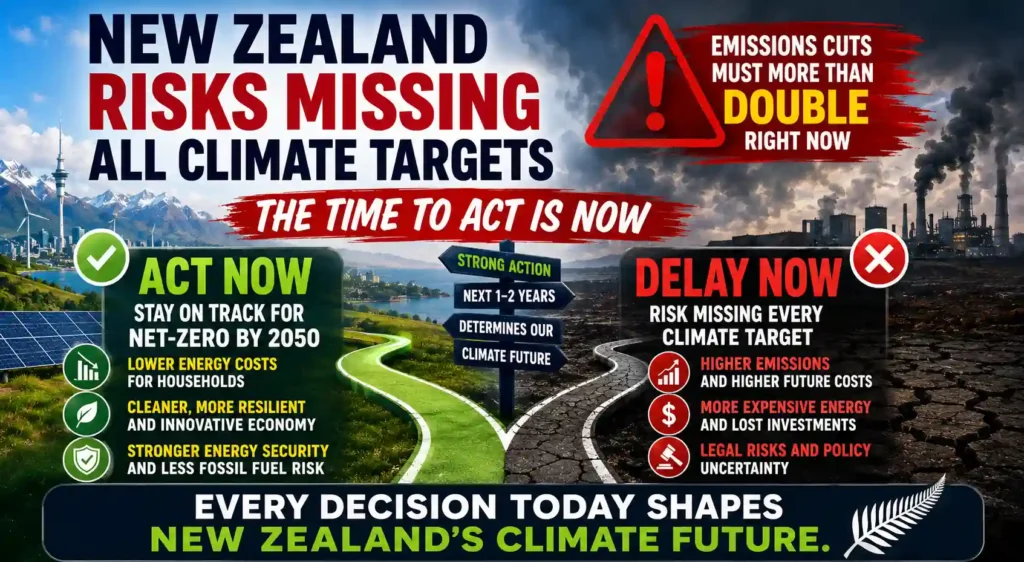
New Zealand has legislated a series of emissions budgets designed to support its goal of achieving net-zero for 2050.
These budgets set limits on total greenhouse gas emissions over specific periods and are intended to guide government policy, business investment and the deployment of low-carbon technologies.
However, the commission concluded that both the country’s second and third emissions budgets are now at high risk of being missed.
It also warned that New Zealand is unlikely to achieve its 2030 target for biogenic methane, highlighting one of the country’s most difficult climate challenges.
Agriculture Remains a Major Challenge
Agriculture continues to be the largest obstacle to reducing New Zealand’s emissions.
The commission criticised the government’s decision to remove agricultural emissions pricing and said current industry incentive programmes are insufficient to achieve meaningful reductions in methane emissions.
Biogenic methane, produced mainly by livestock and agricultural activities, remains politically sensitive because farming is one of New Zealand’s largest export industries and a major contributor to the national economy.
The report also noted that the government weakened its long-term methane reduction targets by amending the Climate Change Response Act in 2025.
The commission had recommended stronger methane reduction goals and net-negative emissions for other greenhouse gases, but those recommendations were not adopted.
Policy Changes Increase Emissions Risk
According to the report, several recent government policy decisions could increase national emissions.
These include:
- Excluding agriculture from emissions pricing
- Changes to clean vehicle policies
- Reduced climate reporting requirements for businesses
- Plans to develop a liquefied natural gas import facility
Although New Zealand has introduced some policies expected to reduce emissions over the past year, the commission believes these gains are likely to be outweighed by measures that increase greenhouse gas emissions elsewhere in the economy.
The report also identified the government’s decision to close the dedicated Ministry for the Environment and merge it into a broader government department as another potential governance risk.
Context is everything. Stay ahead of shifting trends with today’s market updates, and uncover emerging opportunities using the Serrari Group Market Index and Marketplace. Then, take control of your own financial future by exploring our Money & Life Reset Transformation Blueprint ™ to build stronger habits, create better systems, and design a path toward lasting wealth.
Businesses Need Greater Policy Certainty
The commission warned that continued policy uncertainty could discourage investment in low-carbon technologies.
It described confidence in New Zealand’s Emissions Trading Scheme (ETS) as “fragile” and noted that many industrial emissions reductions achieved so far resulted from projects funded under the previous government’s GIDI scheme, which has since been discontinued.
Without clearer long-term policy signals, businesses may delay investments in renewable energy, electric transport, industrial electrification and other technologies necessary for reducing emissions.
The report said uncertainty could also affect future carbon prices, capital investment and planning across the energy, transport, manufacturing and agricultural sectors.
Low-Emissions Technologies Already Available
The commission emphasised that New Zealand does not need to wait for emerging technologies before accelerating emissions reductions.
Commercially available solutions—including electric vehicles, rooftop solar systems, battery storage and industrial heat pumps—can already reduce emissions while lowering energy costs over their operational lifetimes.
However, high upfront costs remain one of the biggest barriers to wider adoption.
The commission suggested government-backed finance, targeted incentives and improved access to affordable financing could help households and businesses invest in clean technologies more quickly.
According to the report, faster deployment would not only reduce emissions but also lower exposure to volatile international fossil fuel prices and deliver long-term savings on energy bills.
Legal Pressure Continues to Build
The government’s climate policies are also facing legal scrutiny.
Earlier this year, Lawyers for Climate Action and the Environmental Law Initiative filed legal proceedings arguing that New Zealand’s climate policies are insufficient to meet the country’s legislated emissions targets.
A court decision is expected in the coming months and could have significant implications for future climate policy.
Meanwhile, the Climate Change Commission says decisions taken over the next 12 to 24 months will determine whether New Zealand can still meet its climate commitments or faces substantially more costly emissions reductions in the future.
Outlook
The Climate Change Commission’s latest assessment sends a clear signal that New Zealand’s climate transition is losing momentum. With emissions reductions slowing and several key policies weakened, the country faces increasing risks of missing its emissions budgets and 2050 climate goals. Stronger government action, clearer policy direction and greater investment in commercially available low-carbon technologies will be essential to restoring confidence, reducing long-term costs and keeping New Zealand on track toward a resilient, low-emissions economy.
FAQs
1. Why is New Zealand at risk of missing its climate targets?
The Climate Change Commission says emissions reductions stalled in 2024 and current government policies are not reducing emissions quickly enough.
2. What are New Zealand’s climate goals?
The country aims to achieve net-zero long-lived greenhouse gas emissions by 2050 through legally binding emissions budgets.
3. Why is agriculture central to the climate challenge?
Agriculture is New Zealand’s largest source of biogenic methane emissions, largely due to livestock production, making it one of the country’s hardest sectors to decarbonise.
4. What solutions does the commission recommend?
The commission recommends stronger climate policies, faster adoption of electric vehicles, solar energy, battery storage and industrial heat pumps, alongside better financing and clearer investment signals for businesses.
Sources: RNZ News, ESG News, RFI, The Manila Times
Your financial future isn’t something you wait for—it’s something you build.
The real question is: when do you begin?
Move beyond simply staying informed.
Navigate the markets with clarity—track trends through the Serrari Group Market Index, uncover opportunities in the Serrari Marketplace, and build practical knowledge with our Curated Wealth Builder Platform.
Stay connected to what truly matters.
Get daily insights on macro trends and financial movements across Kenya, Africa, and global markets—delivered through the Serrari Newsletter.
Growth opens doors.
Advance your career through professional programs including ACCA, HESI A2, ATI TEAS 7 , HESI EXIT , NCLEX – RN and NCLEX – PN, Financial Literacy!🌟—designed to move you forward with confidence.
See where money is flowing—clearly and in real time.
Track Money Market Funds, Treasury Bills, Treasury Bonds, Green Bonds, and Fixed Deposits, alongside global and African indexes, key economic indicators, and the evolving Crypto and stablecoin landscape—all within Serrari’s Market Index.