Türkiye USD bonds issued domestically give institutional investors exposure to US-dollar-denominated sovereign debt while keeping the credit risk tied to the Republic of Türkiye. The latest two-year transaction was almost entirely conventional government bonds, with a small lease-certificate component for investors seeking a Sharia-compliant structure. Dollar denomination reduces lira exposure for investors, but it does not remove sovereign credit, liquidity, transfer or policy risk. For the government, the transaction diversifies funding instruments but also increases foreign-currency-linked liabilities.
Key Overview
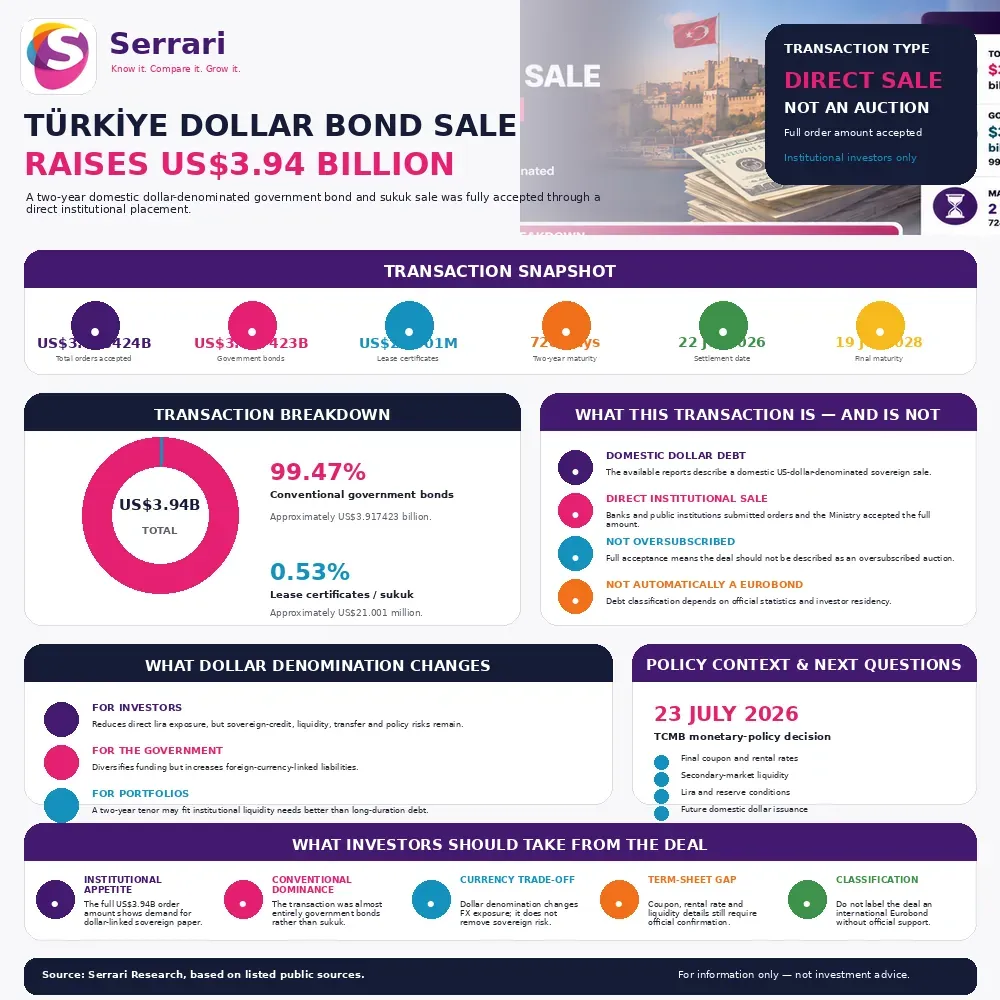
- Total orders reached US$3.938424 billion.
- Government bonds issued totalled about US$3.917423 billion.
- Lease certificates issued totalled about US$21.001 million.
- The government-bond share was approximately 99.47%.
- The sukuk share was approximately 0.53%.
- The securities have a two-year / 728-day maturity.
- Settlement is 22 July 2026.
- Final maturity is 19 July 2028.
- The sale was conducted by direct sale to banks and public institutions, not as an oversubscribed auction. (Dünya Gazetesi)
Turkey Dollar Bond Sale Raises $3.94 Billion for Two-Year Debt
Treasury Accepted the Full Order Amount
The Ministry accepted the entire order book, meaning the sale should not be called oversubscribed. Dünya, citing Anadolu Agency and the Treasury announcement, reported that investors submitted US$3.938424 billion for dollar-denominated government bonds and lease certificates with a 22 July 2026 value date and 19 July 2028 redemption date. The ministry met the full demand. (Dünya Gazetesi)
That structure makes the transaction different from a competitive auction where demand may exceed supply and only part of the order book is allocated. Here, the key market signal is not oversubscription. It is the size of institutional demand accepted in a direct sale.
Conventional Bonds Dominated the Transaction
The conventional bond portion was the main instrument. About US$3.917423 billion was issued as dollar-denominated fixed-coupon government debt, equal to roughly 99.47% of the total transaction. The lease-certificate portion was about US$21.001 million, or roughly 0.53%. (Dünya Gazetesi)
That split matters for investors. The sukuk component provides a Sharia-compliant route, but the transaction’s scale came overwhelmingly through conventional dollar-denominated government bonds. The result shows demand for dollar-linked sovereign exposure from domestic institutions, rather than a broad retail investment product.
This Is Not a Conventional Eurobond
The instrument should not be confused with an international Eurobond. The available reports describe a domestic dollar-denominated government security and lease-certificate sale to institutional investors, with the amounts communicated to eligible banks through the Central Bank’s payment-systems auction infrastructure. (Dünya Gazetesi)
That distinction matters because a domestic dollar-denominated security can still be part of domestic borrowing strategy. It creates foreign-currency exposure for the government, but it should not automatically be classified as external borrowing without checking the official debt-statistics treatment and investor residency breakdown.
Why Raise Dollar Debt Now?
The timing comes as Türkiye is trying to balance disinflation, domestic funding needs and debt-market diversification. The IMF said Türkiye’s disinflation programme had shown progress, with inflation falling from 49.4% year-on-year in September 2024 to 30.9% in December 2025, supported by fiscal consolidation, prudent income policies and tight monetary policy. (IMF)
Against that backdrop, issuing dollar-denominated domestic debt can help diversify the investor base and offer institutions an alternative to lira-denominated government securities. But the trade-off is clear: foreign-currency liabilities may become more burdensome if the lira weakens or if dollar liquidity tightens.
The Policy Decision Adds Context
The Central Bank of the Republic of Türkiye’s calendar lists the next Monetary Policy Committee decision for 23 July 2026. That makes the dollar-debt transaction especially timely because institutional investors will soon reassess lira rates, inflation expectations and the direction of local funding markets. (Central Bank of the Republic of Turkey)
The policy decision does not directly determine the value of the dollar bond, but it can influence domestic liquidity, currency expectations, institutional portfolio choices and appetite for lira versus dollar-linked government instruments.
Context is everything. Stay ahead of shifting trends with today’s market updates, and uncover emerging opportunities using the Serrari Group Market Index and Marketplace. Then, take control of your own financial future by exploring our Money & Life Reset Transformation Blueprint ™ to build stronger habits, create better systems, and design a path toward lasting wealth.
Investor Demand Has Two Interpretations
The first interpretation is positive. A US$3.94 billion accepted order amount shows that domestic institutional investors still want Turkish sovereign instruments when the currency denomination and tenor match their needs. The two-year maturity also avoids very long duration, which may appeal to banks managing balance-sheet liquidity.
The second interpretation is more cautious. Heavy use of dollar-denominated borrowing increases the government’s sensitivity to foreign-currency liabilities. Even if buyers are domestic, the debt is still linked to the US dollar. That means currency management remains central to the sovereign-risk story.
Sukuk Adds a Smaller Funding Channel
The lease-certificate component was small, but strategically relevant. Islamic Finance News separately reported that Türkiye issued US$21 million of US-dollar-denominated fixed-rent-rate lease certificates as part of the 21 July dual issuance, with settlement on 22 July and maturity on 19 July 2028. (islamicfinancenews.com)
This gives institutional investors a Sharia-compliant alternative within the same funding window. However, the small size means the sukuk element should be framed as a complementary channel, not the core driver of the transaction.
What Investors Should Watch Next
Investors should watch the final term sheet for the coupon, rental rate, pricing basis, liquidity terms and any secondary-market details. Current accessible reports confirm the size, maturity, settlement date and instrument split, but they do not clearly provide the coupon and lease rates. (Dünya Gazetesi)
They should also watch the 23 July central-bank decision, lira movement, Turkey’s reserve position, institutional demand for future domestic dollar securities and how the Ministry classifies these instruments in public debt statistics.
Conclusion
Turkey Dollar Bond Sale activity has delivered a large US$3.94 billion two-year funding transaction just before a key monetary-policy decision. The sale was almost entirely made up of dollar-denominated fixed-coupon government bonds, with a small lease-certificate component for Sharia-compliant investors.
For investors, the transaction offers a useful signal of institutional appetite for dollar-linked Turkish sovereign paper. But it should be read carefully. This was not an oversubscribed international Eurobond. It was a domestic direct sale to banks and public institutions, giving investors dollar denomination while leaving sovereign, liquidity, transfer and policy risks firmly in place.
FAQs
1. What was the Turkey Dollar Bond Sale?
The Turkey Dollar Bond Sale was a two-year US-dollar-denominated government security and lease-certificate transaction conducted by Türkiye’s Ministry of Treasury and Finance for institutional investors. Total orders reached US$3.938424 billion, and the ministry accepted the full amount. (Dünya Gazetesi)
2. How much was issued as bonds and sukuk?
Approximately US$3.917423 billion was issued as fixed-coupon government bonds, while about US$21.001 million was issued as lease certificates, or sukuk. That means conventional government bonds accounted for roughly 99.47% of the transaction, while sukuk accounted for about 0.53%. (Dünya Gazetesi)
3. Was the transaction oversubscribed?
No. The full order amount was accepted, so the transaction should not be described as oversubscribed. The better wording is that institutional investors submitted about US$3.94 billion in orders and the Ministry accepted essentially the entire amount.
4. Is this the same as an international Eurobond?
No. The available reports describe a domestic US-dollar-denominated government bond and lease-certificate sale to institutional investors. It should not automatically be classified as external borrowing or compared directly with an international Eurobond without checking the official debt-statistics treatment.
5. What are the main risks for investors?
The main risks include Turkish sovereign-credit risk, liquidity risk, transfer risk, policy risk, and uncertainty over the final coupon or lease terms unless confirmed from the official term sheet. Dollar denomination reduces lira exposure for investors, but it does not remove exposure to Türkiye’s sovereign-risk profile.
Sources: Türkiye Ministry of Treasury and Finance, Dünya / Anadolu Agency, Son Dakika / Anadolu Agency, TCMB, IMF, Islamic Finance News
Your financial future isn’t something you wait for—it’s something you build.
The real question is: when do you begin?
Move beyond simply staying informed.
Navigate the markets with clarity—track trends through the Serrari Group Market Index, uncover opportunities in the Serrari Marketplace, and build practical knowledge with our Curated Wealth Builder Platform.
Stay connected to what truly matters.
Get daily insights on macro trends and financial movements across Kenya, Africa, and global markets—delivered through the Serrari Newsletter.
Growth opens doors.
Advance your career through professional programs including ACCA, HESI A2, ATI TEAS 7 , HESI EXIT , NCLEX – RN and NCLEX – PN, Financial Literacy!🌟—designed to move you forward with confidence.
See where money is flowing—clearly and in real time.
Track Money Market Funds, Treasury Bills, Treasury Bonds, Green Bonds, and Fixed Deposits, alongside global and African indexes, key economic indicators, and the evolving Crypto and stablecoin landscape—all within Serrari’s Market Index.