Treasury bond capital gains Kenya have risen because older high-coupon bonds became more valuable as new-issue yields declined. A bond with an 18.5% coupon can trade above its KSh100 face value because investors want the higher coupon stream. But a buyer paying KSh122.60 per KSh100 face value does not earn 18.5% on the money invested. Coupons are calculated on face value, while yield to maturity adjusts for the premium paid and the eventual redemption value. That is why premium-bond buyers must separate coupon rate, current yield and yield to maturity.
LIVEKenya bond yields: Average yield 11.93% across 58 bonds · 16 OctSee yields →Key Overview
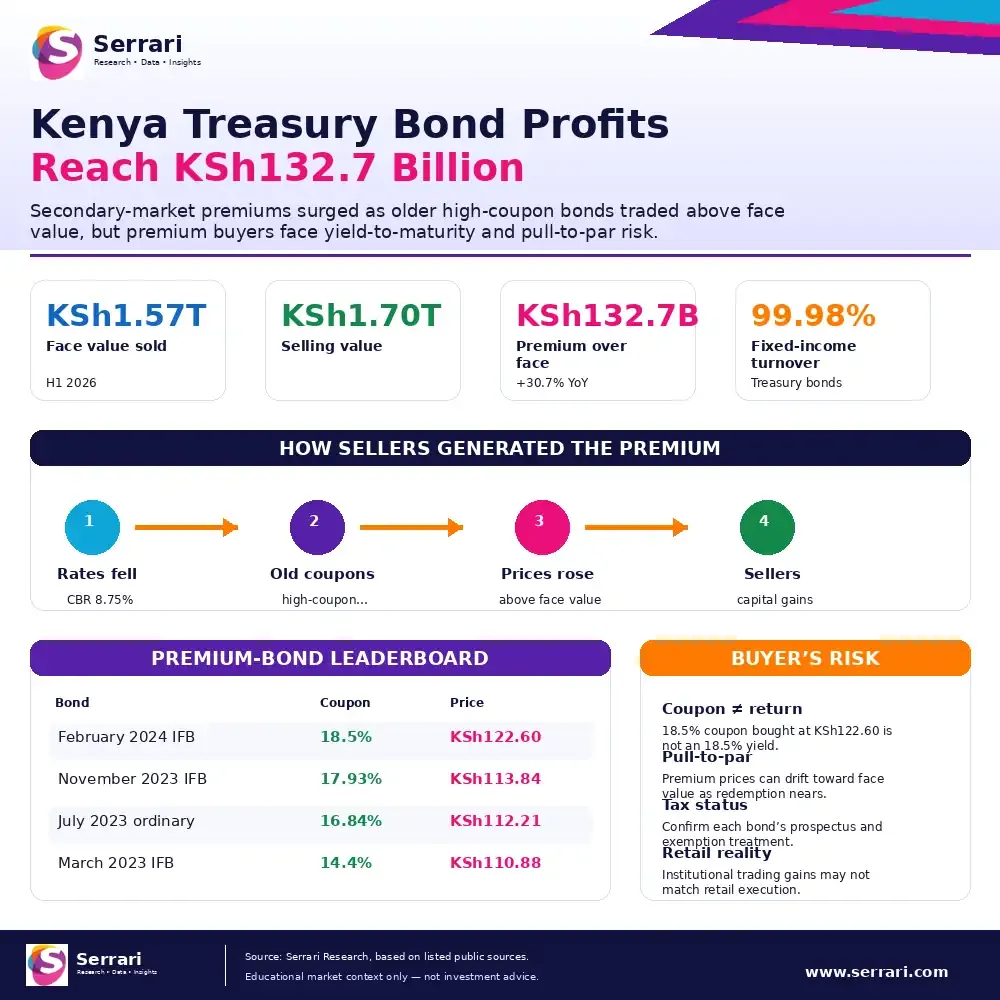
- H1 2026 Treasury bond selling value: KSh1.70 trillion.
- Face value of bonds sold: KSh1.57 trillion.
- Premium over face value: KSh132.7 billion.
- H1 2025 comparable premium: KSh101.58 billion.
- Year-on-year increase: 30.7%.
- Highest reported premium: up to 23%.
- February 2024 IFB coupon: about 18.5%.
- February 2024 IFB secondary price: KSh122.60 per KSh100.
- H1 turnover in that IFB: KSh63 billion.
- Current Central Bank Rate: 8.75%.
- Household domestic-debt holdings: KSh466.2 billion.
Kenya Treasury Bond Profits Reach KSh132.7 Billion
Why Existing Bondholders Made Gains
Bond prices rise when market yields fall. Business Daily reported that older, higher-return Treasury bonds attracted strong secondary-market demand because newer government securities were offering lower annual interest rates of about 12%–14.2%. The CBK base rate had fallen from 13% in August 2024 to 8.75%, supporting the decline in market rates.
That created capital gains for investors who already held high-coupon bonds. They could sell above face value because buyers wanted the coupon income.
Premium Bonds Need Careful Interpretation
The headline KSh132.7 billion figure is not necessarily the same as net investment profit. Business Daily explains that it is derived from the difference between aggregate secondary-market selling value and face value. It may not account for the seller’s actual acquisition price, accrued interest, brokerage costs or tax effects.
This matters because some sellers may have bought bonds in the secondary market at a premium. Their realised gain may be much smaller than the face-value premium suggests.
Context is everything. Stay ahead of shifting trends with today’s market updates, and uncover emerging opportunities using the Serrari Group Market Index and Marketplace. Then, take control of your own financial future by exploring our Money & Life Reset Transformation Blueprint ™ to build stronger habits, create better systems, and design a path toward lasting wealth.
The February 2024 IFB Is the Key Example
The most prominent paper is the February 2024 infrastructure bond with an 18.5% coupon. Business Daily reported that buyers were paying KSh122.60 for each KSh100 of face value and that the bond recorded KSh63 billion in H1 turnover.
That sounds attractive, but the new buyer’s return is not 18.5%. The buyer pays KSh122.60, receives coupons based on KSh100 face value, and ultimately receives principal according to the bond’s terms. The premium must therefore be amortised in the investor’s yield calculation.
Infrastructure Bonds Add Tax Appeal
Business Daily noted that infrastructure bonds remain among the most lucrative secondary-market papers, partly because of their tax-free status, while ordinary bonds generally carry withholding tax on interest depending on tenor.
KRA lists withholding-tax rates for different interest categories, including 15% for certain government bearer bonds and 10% for bearer bonds with maturities of ten years or more.
However, tax treatment must be checked issue by issue from the prospectus. Investors should not assume all government or infrastructure-labelled bonds have identical tax treatment.
The Market Is Institutionally Dominated
Business Daily quoted Churchill Ogutu of Capital A Investment Bank saying activity is mainly from institutional investors such as banks and fund managers executing strategies around bonds held for trading and profit-taking. It also reported that commercial banks held about KSh2.62 trillion of domestic debt, followed by pension funds at KSh1.07 trillion and insurers at KSh1.04 trillion.
Retail investors are participating more, with household holdings reported at KSh466.2 billion, but institutional activity still drives much of the market.
CMA Confirms Bond-Market Dominance
CMA’s Q4 FY2025/26 Capital Markets Soundness Report shows Treasury bonds continue to dominate Kenya’s fixed-income turnover. The report also confirms recent bond issuance activity, with KSh428.36 billion in bids against KSh355 billion offered during the quarter and KSh328.06 billion accepted.
That dominance matters because Treasury bond pricing affects pension portfolios, bank liquidity, insurance assets, unit trusts and retail fixed-income investors.
LIVEKenya bond yields: Average yield 11.93% across 58 bonds · 16 OctSee yields →What Investors Should Watch
Investors should watch inflation, CBK policy, new-bond coupons, secondary-market liquidity and the remaining maturity of premium bonds. They should also ask for yield-to-maturity calculations before buying a bond above face value.
The key danger is pull-to-par risk. A premium bond may provide attractive coupons, but as redemption approaches, the investor may not retain the market premium indefinitely.
Conclusion
Kenya Treasury Bond Profits reached KSh132.7 billion because falling yields lifted the market value of older high-coupon government securities. Existing holders benefited by selling above face value.
For new buyers, the lesson is different. A high coupon is not the same as a high return. Buying at KSh122.60 for every KSh100 of face value requires a clear understanding of current yield, yield to maturity, tax treatment, amortisation and redemption risk.
FAQs
1. How much did Kenyan Treasury bond sellers generate in premiums?
Business Daily reported that investors sold Treasury bonds worth KSh1.70 trillion against face value of KSh1.57 trillion in H1 2026, creating a KSh132.7 billion premium over face value.
2. Is KSh132.7 billion the same as net profit?
Not necessarily. It is calculated as selling value minus face value. It may not reflect acquisition price, accrued interest, brokerage fees, tax or whether the seller bought the bond at a premium.
3. Why are older bonds trading above face value?
Older bonds with high coupons became more attractive as newer bonds offered lower yields. Buyers therefore paid premiums to access higher coupon streams.
4. Does an 18.5% coupon mean an 18.5% return?
No. A buyer paying above face value receives coupons based on the KSh100 face value, not the higher purchase price. The actual return is better measured by yield to maturity.
5. What is the main risk for premium-bond buyers?
The main risk is paying too much for coupon income. If yields rise or redemption approaches, the bond price can fall toward face value or the bond’s scheduled redemption terms.
Sources: Business Daily Africa, CMA, CBK, KRA, Public Debt Management Office
Your financial future isn’t something you wait for—it’s something you build.
The real question is: when do you begin?
Move beyond simply staying informed.
Navigate the markets with clarity—track trends through the Serrari Group Market Index, uncover opportunities in the Serrari Marketplace, and build practical knowledge with our Curated Wealth Builder Platform.
Stay connected to what truly matters.
Get daily insights on macro trends and financial movements across Kenya, Africa, and global markets—delivered through the Serrari Newsletter.
Growth opens doors.
Advance your career through professional programs including ACCA, HESI A2, ATI TEAS 7 , HESI EXIT , NCLEX – RN and NCLEX – PN, Financial Literacy!🌟—designed to move you forward with confidence.
See where money is flowing—clearly and in real time.
Track Money Market Funds, Treasury Bills, Treasury Bonds, Green Bonds, and Fixed Deposits, alongside global and African indexes, key economic indicators, and the evolving Crypto and stablecoin landscape—all within Serrari’s Market Index.