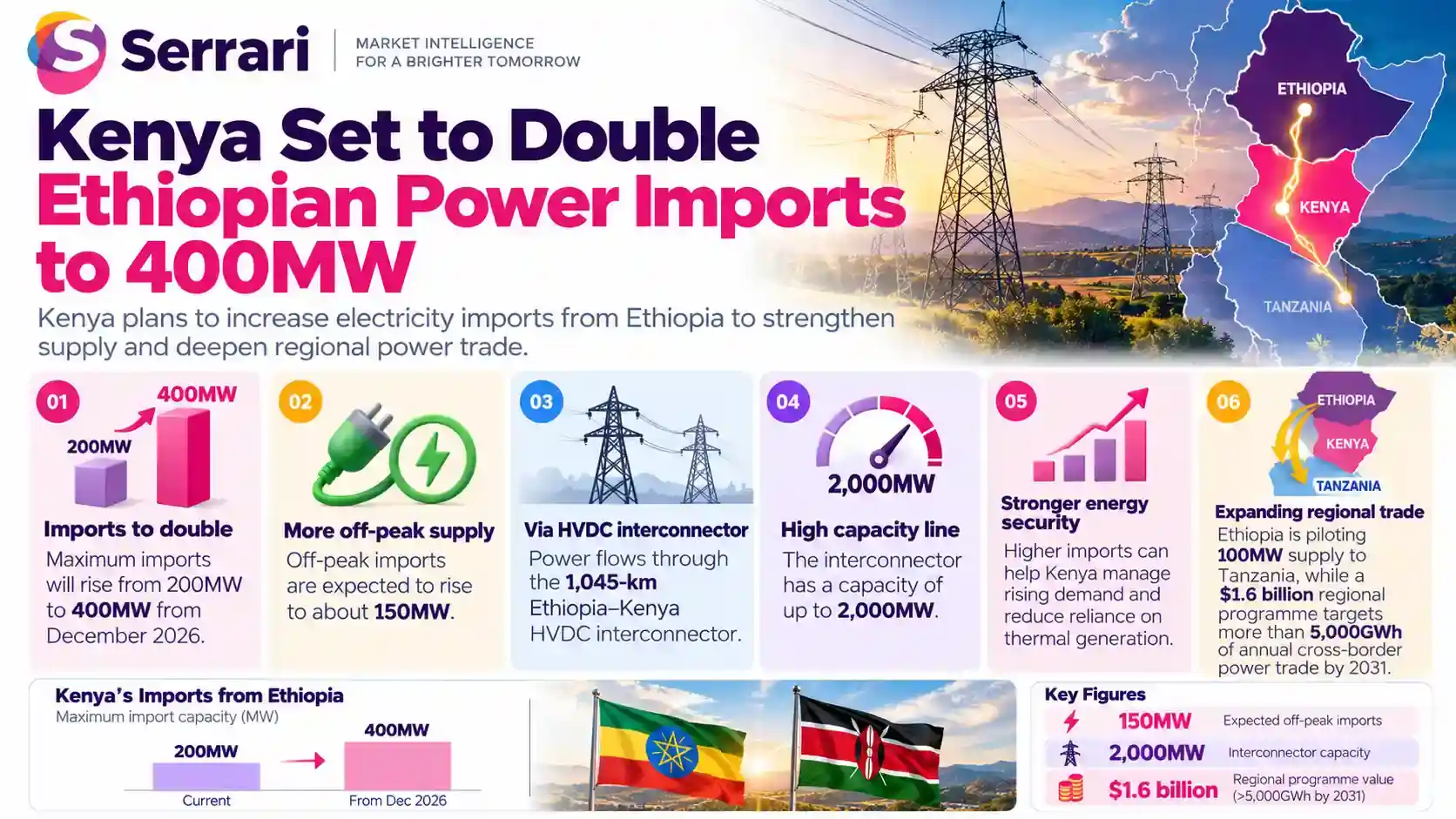
Kenya is preparing to double the maximum electricity it imports from Ethiopia to 400 megawatts from December 2026, strengthening its supply buffer as domestic power demand continues to rise.
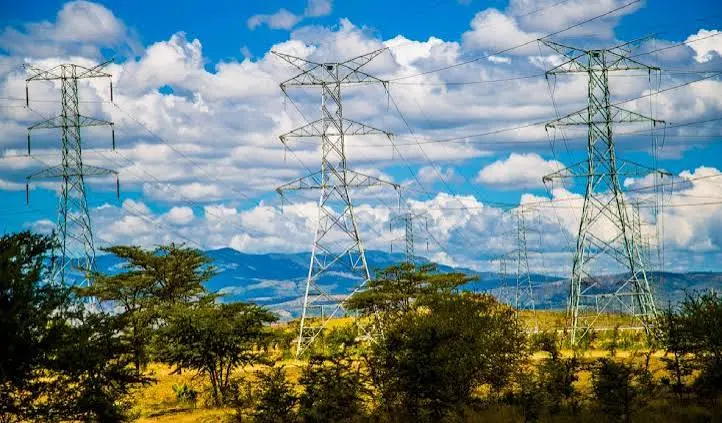
The additional capacity will flow through the Ethiopia-Kenya High Voltage Direct Current interconnector, one of East Africa’s most important cross-border electricity links. Technical teams are completing system tests before the higher transfer levels are introduced.
Under the expanded arrangement, Kenya will be able to draw up to 400MW during periods of high demand while reducing imports to about 150MW during off-peak periods.
Key Overview
- Kenya plans to increase maximum electricity imports from Ethiopia from 200MW to 400MW from December 2026.
- Off-peak imports are expected to rise from about 65MW to 150MW.
- The increase is being implemented under the countries’ existing long-term power purchase arrangement.
- Electricity travels through the 1,045-kilometre Ethiopia-Kenya HVDC interconnector.
- The transmission system has capacity to transfer as much as 2,000MW.
- Technical teams are conducting reliability and grid-security assessments before the higher volumes begin.
- Ethiopia is also supplying 100MW to Tanzania on a pilot basis.
- A $1.6 billion regional programme is targeting more than 5,000GWh of annual cross-border electricity trade by 2031.
Kenya Gets Another 200MW for Peak Demand
Ethiopia’s power utility confirmed that preparations are under way to increase exports to Kenya from the current maximum of 200MW to 400MW.
The additional electricity is expected to become available from December, subject to technical teams confirming that the interconnected grids can safely handle the larger transfers.
Under the revised operating arrangement, Kenya could take as much as 400MW during peak periods and approximately 150MW when demand is lower. The existing structure allows maximum imports of about 200MW during peak periods and substantially lower flows during off-peak hours.
The additional flexibility comes as electricity consumption in Kenya continues to rise, placing greater pressure on available generation and reserve margins.
Higher Ethiopian imports could also reduce the need to dispatch more expensive thermal power plants during periods when domestic renewable generation is insufficient.
1,045-Kilometre Interconnector Enables Regional Trade
The electricity is transmitted through the Eastern Electricity Highway, a 500-kilovolt HVDC transmission system stretching approximately 1,045 kilometres between Wolayta-Sodo in Ethiopia and Suswa in Kenya.
The infrastructure was designed to transfer up to 2,000MW, meaning the planned 400MW imports remain well within the technical capacity of the interconnector itself.
The power purchase arrangement underpinning the trade was signed in 2022 by Ethiopian Electric Power, Kenya Power and Kenya Electricity Transmission Company.
A project evaluation of the agreement describes it as a 25-year tripartite arrangement, although some subsequent commercial reporting has referred to specific 20-year supply terms within the wider structure.
Commercial-scale imports accelerated after the interconnection became operational, giving Kenya access to Ethiopia’s large hydropower system.
Context is everything. Stay ahead of shifting trends with today’s market updates, and uncover emerging opportunities using the Serrari Group Market Index and Marketplace. Then, take control of your own financial future by exploring our Money & Life Reset Transformation Blueprint ™ to build stronger habits, create better systems, and design a path toward lasting wealth.
Imports Help Kenya Manage Tightening Power Reserves
Kenya’s need for additional electricity is becoming more urgent as economic activity, electrification and new consumer connections drive demand higher.
Recent industry data show Kenya’s peak electricity demand has moved above 2,400MW, while reserve margins have tightened significantly.
That makes regional imports increasingly useful when domestic generation cannot provide a sufficient buffer above peak consumption.
Kenya already imports significant volumes from Ethiopia and maintains electricity exchange arrangements with other neighbouring countries. The increase to 400MW will further strengthen Ethiopia’s position as one of Kenya’s most important external electricity suppliers.
Although imported hydropower can reduce reliance on thermal plants, higher imports alone do not guarantee lower retail electricity tariffs. Consumer bills are also influenced by transmission and distribution costs, generation contracts, taxes, financing expenses, foreign-exchange movements and system losses.
Ethiopia Builds Wider East African Export Network
The increase is part of a broader Ethiopian strategy to become a major electricity exporter in East Africa.
Ethiopia says its power exports have expanded significantly over the past decade as additional generation and transmission infrastructure has come online.
The country is also currently supplying 100MW to Tanzania on a pilot basis. Full commercial exports are expected after further infrastructure improvements linking the Kenyan and Tanzanian grids.
New transmission lines and substations are being developed to increase cross-border capacity and connect more countries to regional electricity markets.
That integration could allow countries with surplus renewable electricity at particular times to sell power to neighbours facing shortages, reducing the need for each country to maintain expensive standalone backup generation.
$1.6 Billion Programme Targets Regional Power Trade
Regional infrastructure investment is also accelerating.
In June 2026, a $1.6 billion financing programme was approved for the Regional Energy Transmission, Trade and Decarbonization programme for Eastern Africa.
The 10-year initiative will finance cross-border transmission infrastructure, regional electricity-market development and stronger coordination between national power systems.
One of its targets is to increase annual electricity trading through the Eastern Africa Power Pool to more than 5,000GWh by 2031.
For Kenya, the planned doubling of Ethiopian imports demonstrates how regional power integration is moving from infrastructure construction toward actual electricity trading.
If technical tests are completed successfully, December’s increase to 400MW will give Kenya a larger supply cushion while deepening an electricity market that increasingly links Ethiopia, Kenya, Tanzania and other East African economies.
Sources: Ethiopian Electric Power / Kenya Electricity Transmission Company / World Bank / Kenyans.co.ke / Business Daily Africa
Your financial future isn’t something you wait for—it’s something you build.
The real question is: when do you begin?
Move beyond simply staying informed.
Navigate the markets with clarity—track trends through the Serrari Group Market Index, uncover opportunities in the Serrari Marketplace, and build practical knowledge with our Curated Wealth Builder Platform.
Stay connected to what truly matters.
Get daily insights on macro trends and financial movements across Kenya, Africa, and global markets—delivered through the Serrari Newsletter.
Growth opens doors.
Advance your career through professional programs including ACCA, HESI A2, ATI TEAS 7 , HESI EXIT , NCLEX – RN and NCLEX – PN, Financial Literacy!🌟—designed to move you forward with confidence.
See where money is flowing—clearly and in real time.
Track Money Market Funds, Treasury Bills, Treasury Bonds, Green Bonds, and Fixed Deposits, alongside global and African indexes, key economic indicators, and the evolving Crypto and stablecoin landscape—all within Serrari’s Market Index.