The International Monetary Fund is moving to refine the way it designs and monitors lending programs as governments face a world of repeated economic shocks, elevated debt burdens and tighter financing conditions.
Its newly completed 2026 Review of Program Design and Conditionality recommends more focused structural reforms, stronger contingency planning and more realistic assumptions about financing and implementation.
One of the most debated recommendations involves fiscal adjustment. The IMF found that timely and sustained adjustment was associated with stronger program outcomes, while civil-society groups warn that aggressively front-loading spending cuts could damage public services and deepen inequality.
Key Overview
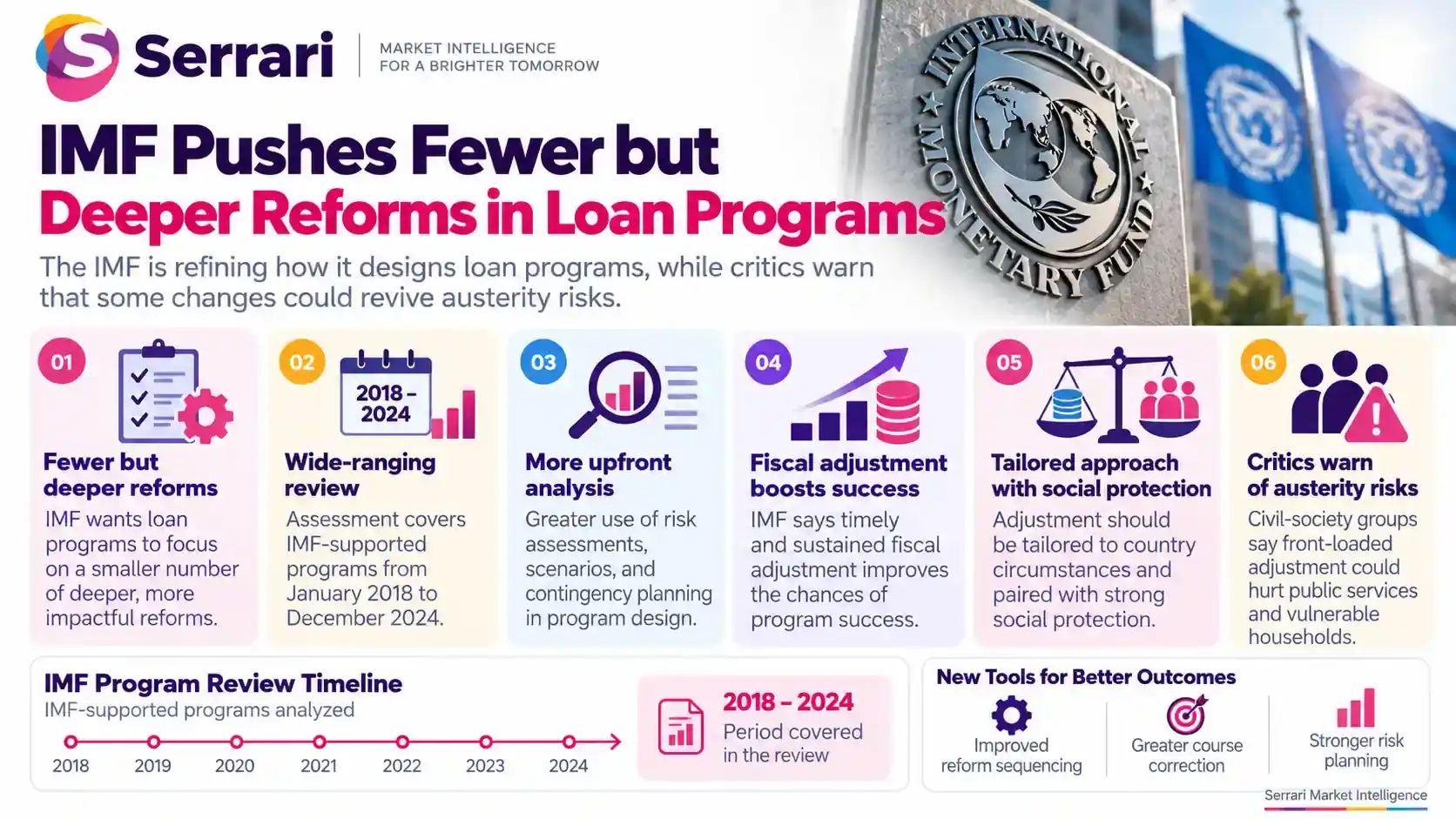
- The IMF wants loan programs to concentrate on fewer but deeper structural reforms.
- The review examined IMF-supported programs from January 2018 to December 2024.
- Programs will make greater use of risk assessments, scenarios and contingency planning.
- The IMF says timely and sustained fiscal adjustment can improve program success.
- Adjustment should be tailored to individual countries and accompanied by growth measures and social protection.
- Civil-society groups warn that front-loaded adjustment could result in harsher austerity.
- The IMF is developing new tools to improve reform sequencing and allow faster course corrections.
- The Executive Board broadly backed the proposed changes.
IMF Wants Loan Programs to Become More Focused
The 2026 program-design review represents the first comprehensive reassessment of the Fund’s lending framework since its previous review covering programs through 2017.
The latest exercise assessed lending arrangements implemented between 2018 and 2024, a period marked by the COVID-19 pandemic, cost-of-living pressures, geopolitical conflicts and major changes in global financing conditions.
The IMF concluded that its programs generally responded quickly to successive shocks, but some countries still struggled to restore medium-term external stability.
To improve future outcomes, the Fund wants governments and program teams to avoid overloaded reform agendas and instead concentrate on fewer but deeper reforms that are considered critical to restoring economic stability.
The goal is to sequence reforms more carefully while taking account of institutional capacity and the ability of governments to implement multiple policy changes simultaneously.
Fiscal Adjustment Becomes the Main Source of Debate
The most controversial element of the review concerns how quickly borrowing countries should improve their public finances.
The IMF found that timely and sustained fiscal adjustment was associated with a greater probability of successful programs. This can involve reducing fiscal deficits through combinations of spending restraint and higher government revenue.
The review therefore supports better calibrated fiscal adjustment where conditions permit, while stressing that the pace should remain feasible and be combined with realistic measures to support growth and adequate social spending.
The Fund’s position is that its financing should support necessary policy adjustment rather than permanently substitute for it.
Civil-society organisations see a significant risk in that approach.
An analysis of IMF-supported programmes found that the median annual budget adjustment required under programmes increased from about 0.21% of GDP during 2012–2017 to 0.85% during 2018–2025.
Critics argue that asking heavily indebted countries to make large adjustments early in a programme could translate into cuts affecting healthcare, education, government employment and social protection.
Context is everything. Stay ahead of shifting trends with today’s market updates, and uncover emerging opportunities using the Serrari Group Market Index and Marketplace. Then, take control of your own financial future by exploring our Money & Life Reset Transformation Blueprint ™ to build stronger habits, create better systems, and design a path toward lasting wealth.
IMF Says Social Impacts Must Be Considered
The Fund rejects the idea that every country should implement the same fiscal strategy.
Its recommendations emphasise greater tailoring of programs to national circumstances, implementation capacity and social conditions.
The Executive Board’s conclusions call for balanced policy adjustment and financing while placing greater emphasis on reforms capable of strengthening growth and economic resilience.
Program assumptions are also expected to become more realistic. That includes closer scrutiny of projected financing, debt sustainability and whether governments can realistically complete the reforms contained in a lending agreement.
The framework will increasingly incorporate scenario analysis and contingency plans so policies can be changed more quickly when unexpected shocks occur.
Critics Fear Return to Structural Adjustment
The debate reflects a longstanding disagreement over the economic and social consequences of IMF conditionality.
Following the review, development campaigners warned against front-loaded adjustment, arguing that rapid fiscal consolidation could place disproportionate burdens on lower-income households.
They have compared the risks with structural-adjustment policies associated with IMF and World Bank programs in earlier decades, when governments in many developing economies were required to sharply reduce expenditures and restructure state institutions.
The IMF’s current position differs in important respects, including its stated emphasis on social spending, country-specific program design and consideration of distributional impacts.
How those safeguards work in practice will ultimately determine whether the new framework produces stronger economic adjustment without undermining essential public services.
New Tools Aim to Improve Program Success
The IMF is also developing a medium-term structural reform tool to help teams identify, prioritise and sequence reforms over several years.
Additional analytical tools will help officials reassess programs when economic conditions change unexpectedly rather than waiting until underlying assumptions have already become unrealistic.
The review also calls for stronger end-of-program assessments, better monitoring and earlier intervention where implementation begins to fall behind.
Implementation of the reforms will initially involve updating operational guidance and developing new analytical templates before the changes are progressively incorporated into individual country programs.
The central question now is how the principle of fewer but deeper reforms will translate into future lending agreements. For governments already facing high debt, expensive borrowing and limited fiscal space, the balance between restoring financial stability and protecting economic growth and essential services will remain critical.
Sources: International Monetary Fund / Reuters / Oxfam International / Jubilee USA Network
Your financial future isn’t something you wait for—it’s something you build.
The real question is: when do you begin?
Move beyond simply staying informed.
Navigate the markets with clarity—track trends through the Serrari Group Market Index, uncover opportunities in the Serrari Marketplace, and build practical knowledge with our Curated Wealth Builder Platform.
Stay connected to what truly matters.
Get daily insights on macro trends and financial movements across Kenya, Africa, and global markets—delivered through the Serrari Newsletter.
Growth opens doors.
Advance your career through professional programs including ACCA, HESI A2, ATI TEAS 7 , HESI EXIT , NCLEX – RN and NCLEX – PN, Financial Literacy!🌟—designed to move you forward with confidence.
See where money is flowing—clearly and in real time.
Track Money Market Funds, Treasury Bills, Treasury Bonds, Green Bonds, and Fixed Deposits, alongside global and African indexes, key economic indicators, and the evolving Crypto and stablecoin landscape—all within Serrari’s Market Index.