
















Kenya’s agriculture, forestry and fishing sector reached Sh4.07 trillion at current prices in 2025, up from Sh3.64 trillion in 2024, while its contribution to national GDP increased from 22.4% to 23.2%. The figures underline agriculture’s continued importance to the economy as county governments expand support for production, livestock, farmer inputs and value chains. However, the sector’s real growth slowed to 3.1% from 4.4% in 2024, reflecting mixed weather conditions and uneven performance across major crops.
Key Overview
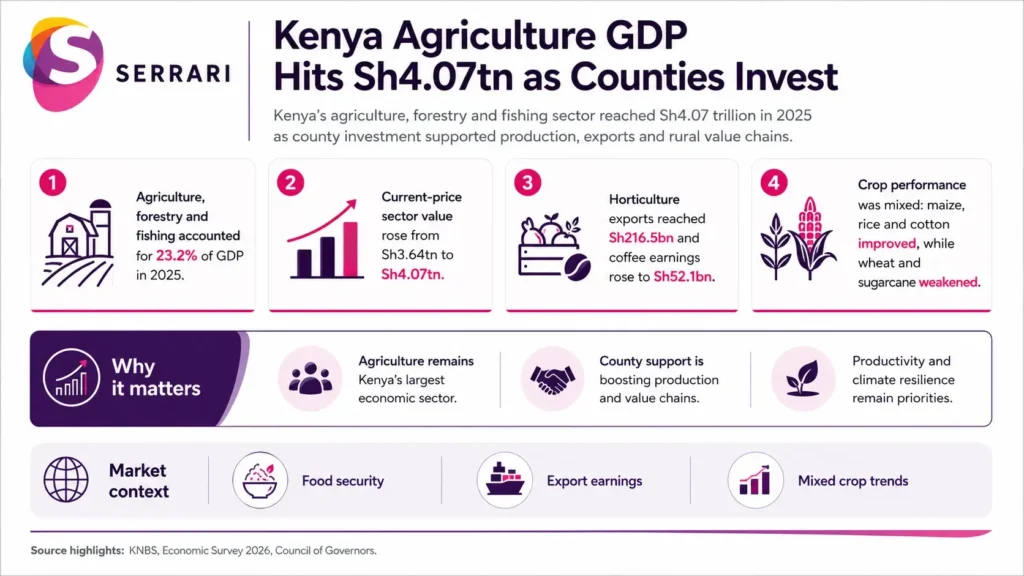
- Agriculture, forestry and fishing accounted for 23.2% of Kenya’s GDP in 2025, up from 22.4% in 2024.
- The sector’s current-price GDP value increased to Sh4.07 trillion from Sh3.64 trillion.
- Real sector growth slowed to 3.1%, compared with 4.4% a year earlier.
- Horticulture export earnings rose to Sh216.5 billion, while unroasted coffee earnings climbed to Sh52.1 billion.
- Tea remained a major foreign-exchange earner at Sh187.1 billion, despite lower output.
- Crop performance was mixed, with maize and irrigated rice improving while wheat and sugarcane weakened.
Agriculture Remains Kenya’s Largest Economic Sector
Kenya’s agriculture, forestry and fishing sector remained the country’s largest contributor to economic output in 2025. According to the 2026 Economic Survey, its share of nominal GDP rose to 23.2%, while the sector’s current-price value increased from Sh3.64 trillion in 2024 to Sh4.07 trillion in 2025.
The Sh4.07 trillion figure represents the sector’s contribution to GDP at current prices rather than the value of marketed farm sales. Recorded marketed agricultural production was about Sh706.0 billion in 2025.
Despite the higher nominal value, real agriculture, forestry and fishing growth slowed to 3.1% from 4.4% in 2024. The moderation reflected uneven weather, including stronger long rains but weaker short rains, which produced mixed results across crop categories.
County governments remain central to agricultural service delivery through functions including crop and livestock support, extension services, local value-chain development and farmer programmes. During the 2026 State of Devolution Address, Council of Governors Chair Ahmed Abdullahi highlighted county investment in agricultural inputs, livestock services and diversification as part of efforts to strengthen food security and rural incomes.
Context is everything. Stay ahead of shifting trends with today’s market updates, and uncover emerging opportunities using the Serrari Group Market Index and Marketplace. Then, take control of your own financial future by exploring our Money & Life Reset Transformation Blueprint ™ to build stronger habits, create better systems, and design a path toward lasting wealth.
Horticulture and Coffee Strengthen Export Earnings
Agricultural exports remained an important source of foreign exchange during 2025. The Economic Survey’s principal export data shows horticulture earnings increasing by 6.3% from Sh203.6 billion in 2024 to approximately Sh216.5 billion in 2025.
Unroasted coffee recorded an even stronger improvement, with export earnings rising by about 35.5% to Sh52.1 billion from Sh38.4 billion. Higher international prices contributed to the increase, while coffee production also improved during the 2024/25 crop season.
Tea continued to rank among Kenya’s most valuable exports, although earnings declined slightly to Sh187.1 billion from Sh189.1 billion. Production fell to 550.4 thousand tonnes in 2025, reflecting the mixed conditions affecting several agricultural value chains.
Fresh horticultural exports also expanded. According to sector data reported from the Economic Survey, export volumes rose 13.8% to 457.9 thousand tonnes, while fresh horticultural earnings increased 5.3% to Sh143.8 billion. This narrower measure excludes processed horticultural products and nuts, explaining why it is lower than the broader Sh216.5 billion horticulture export figure.
Food Production Shows Uneven Gains Across Crops
Domestic production presented a mixed picture in 2025. Maize output increased to 45.8 million bags, supported by favourable long rains, while potato production rose 13.6% to 2.5 million tonnes.
Irrigation also supported rice production. Paddy output from irrigation schemes increased by 6.4% to 303.7 thousand tonnes, helped by a 5.3% expansion in cropped area to 48,379 hectares.
Other staples weakened. Wheat production declined 18.2% to 254.9 thousand tonnes, leaving imports accounting for almost 90% of total wheat supply. Sugarcane production fell by 24.7% to about 7.05 million tonnes, compared with 9.37 million tonnes in 2024.
Cotton, however, continued its recovery, with deliveries increasing from 6.2 thousand tonnes to 8.8 thousand tonnes, supporting efforts to strengthen the domestic textile and apparel value chain.
The uneven performance reinforces the importance of irrigation, improved inputs, extension services, processing infrastructure and climate-resilient farming. Continued coordination between county governments, the national government and private-sector partners will be critical if Kenya is to convert agriculture’s large economic footprint into stronger productivity, food security and export growth.
Sources: Kenya National Bureau of Statistics / State Department for Economic Planning / Council of Governors / The Kenyan Wall Street / The Star / Kenya National Chamber of Commerce and Industry
Your financial future isn’t something you wait for—it’s something you build.
The real question is: when do you begin?
Move beyond simply staying informed.
Navigate the markets with clarity—track trends through the Serrari Group Market Index, uncover opportunities in the Serrari Marketplace, and build practical knowledge with our Curated Wealth Builder Platform.
Stay connected to what truly matters.
Get daily insights on macro trends and financial movements across Kenya, Africa, and global markets—delivered through the Serrari Newsletter.
Growth opens doors.
Advance your career through professional programs including ACCA, HESI A2, ATI TEAS 7 , HESI EXIT , NCLEX – RN and NCLEX – PN, Financial Literacy!🌟—designed to move you forward with confidence.
See where money is flowing—clearly and in real time.
Track Money Market Funds, Treasury Bills, Treasury Bonds, Green Bonds, and Fixed Deposits, alongside global and African indexes, key economic indicators, and the evolving Crypto and stablecoin landscape—all within Serrari’s Market Index.