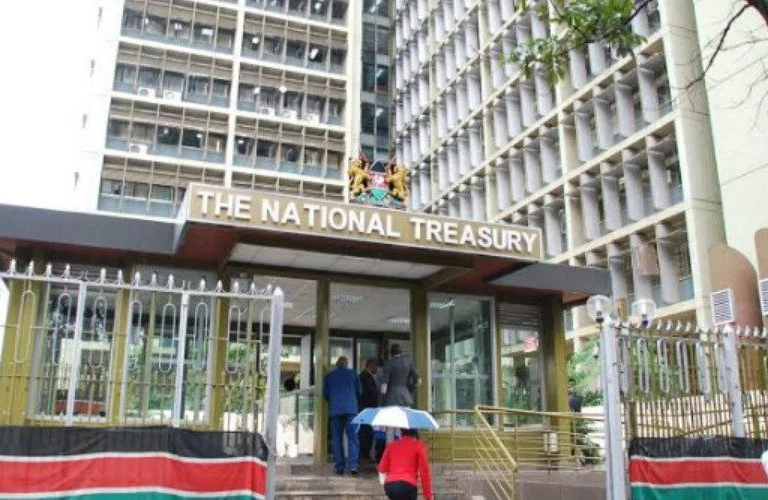
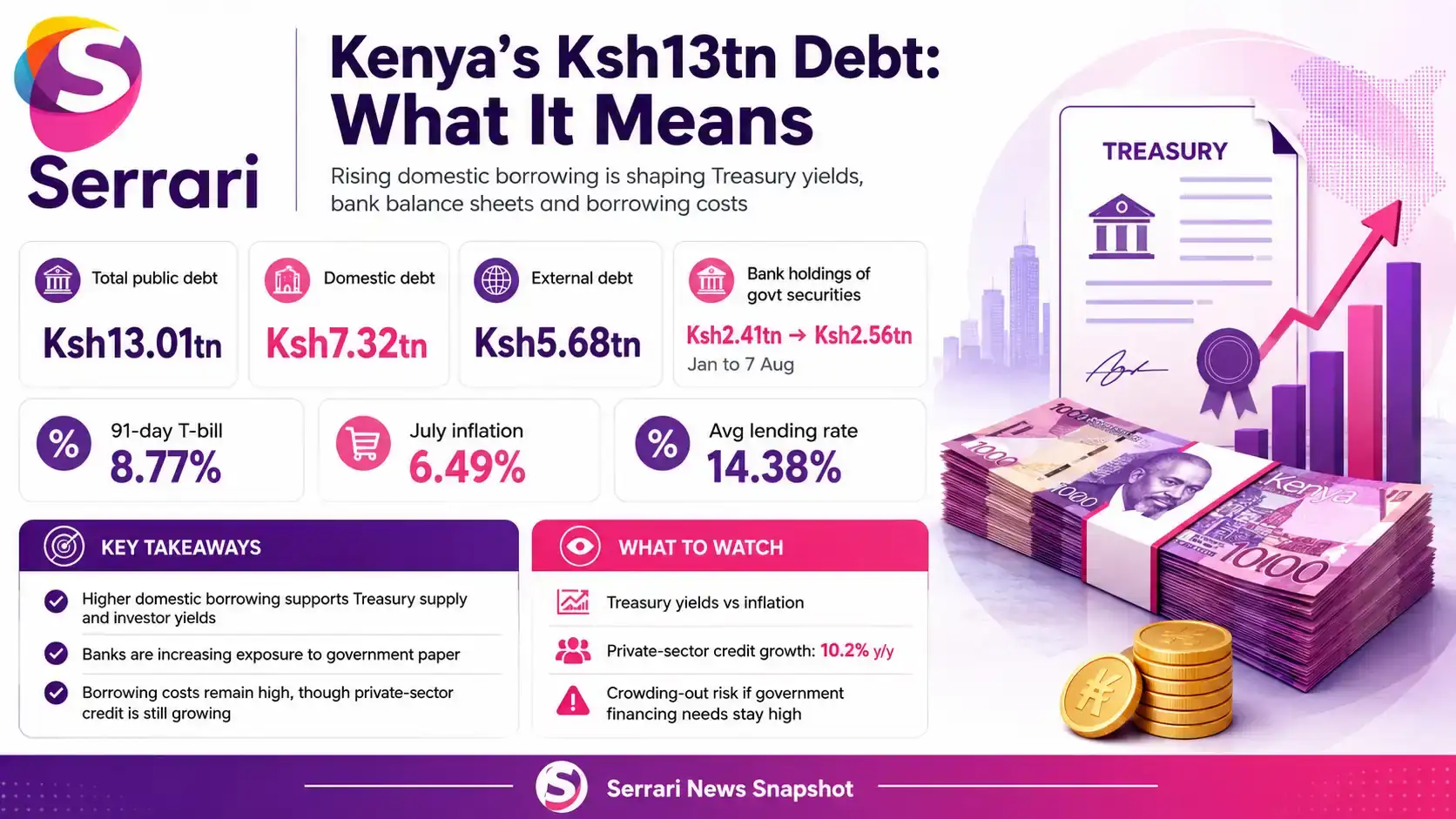
Kenya’s public debt reached Ksh13.01 trillion at the end of June 2026, up from Ksh11.81 trillion a year earlier. Domestic debt accounted for about Ksh7.32 trillion while external debt stood at roughly Ksh5.68 trillion, making the government’s growing reliance on local financing increasingly important for both investors and borrowers.
For investors, heavy domestic borrowing creates a steady supply of Treasury bills and bonds and can support attractive yields. For borrowers, however, the key question is whether rising government demand for local funds eventually makes banks more selective about lending to households and businesses.
Key Overview
- Kenya’s public debt reached Ksh13.01 trillion at end-June 2026.
- Domestic debt stood at about Ksh7.32 trillion, while external debt was roughly Ksh5.68 trillion.
- Commercial banks’ government-securities holdings rose from about Ksh2.41 trillion in January to around Ksh2.56 trillion by August 7.
- The 91-day Treasury bill rate is around 8.77%, compared with July inflation of 6.49%.
- Average commercial-bank lending was 14.38% in June, while savings averaged 3.32% and deposits 6.84%.
- Private-sector credit growth remained strong at 10.2% in July, meaning broad crowding out is not yet evident.
- Kenya’s debt remains classified as sustainable but at high risk of debt distress.
What Ksh13 Trillion Means for Treasury Investors
The end-June debt figures show that domestic borrowing now represents more than half of Kenya’s public debt stock. That matters for investors because continued financing needs generally mean regular issuance of Treasury bills and bonds across different maturities.
The 91-day Treasury bill is yielding roughly 8.77%, while the July inflation reading was 6.49%. The nominal yield is therefore about 2.3 percentage points above inflation before tax and transaction costs, although that simple comparison should not be treated as a guaranteed real return.
Longer-term bonds add another consideration: price risk. When market yields fall, existing bonds carrying higher coupons can appreciate in the secondary market. When yields rise, the market value of lower-coupon bonds can fall. Investors therefore need to consider both income and the possibility of capital gains or losses before maturity.
Sovereign Risk Still Matters Even With Attractive Yields
Government securities are commonly treated as the domestic benchmark for lower-risk shilling investments, but Kenya’s fiscal position still matters. The 2025 debt-management strategy states that public debt is sustainable but remains at high risk of debt distress, while the present value of public debt was above the applicable benchmark.
A more recent assessment of Kenya’s debt statistics reaches the same broad conclusion and highlights the high interest cost of domestic debt as one of the country’s key debt-management challenges.
For investors, “high risk of debt distress” does not mean a default is expected. It means fiscal buffers are more limited and adverse shocks could place greater pressure on debt servicing, refinancing costs or future taxation.
Context is everything. Stay ahead of shifting trends with today’s market updates, and uncover emerging opportunities using the Serrari Group Market Index and Marketplace. Then, take control of your own financial future by exploring our Money & Life Reset Transformation Blueprint ™ to build stronger habits, create better systems, and design a path toward lasting wealth.
Why Rising Government Borrowing Matters to Banks
Commercial banks are central to Kenya’s domestic debt market. Their holdings of government securities increased from about Ksh2.41 trillion in January to roughly Ksh2.56 trillion by August 7, according to weekly banking data cited in recent reporting.
Government securities can be attractive to banks because they provide predictable income, are highly liquid and avoid the borrower-specific credit risk attached to business and household loans. That does not automatically mean banks will stop lending to the private sector, but it creates an important allocation choice when government financing needs are high.
The risk is that sustained Treasury borrowing could eventually compete more strongly with households and companies for available liquidity, particularly if banks can earn acceptable returns from government paper without taking additional credit risk.
Borrowers Are Paying Much More Than Savers Earn
For borrowers, financing remains relatively expensive. Official commercial-bank rate data shows an average lending rate of 14.38% in June, compared with a 6.84% average deposit rate and a 3.32% savings rate.
That spread reflects funding costs, credit risk, operating expenses and bank margins. It also means businesses must generate sufficiently strong returns to justify borrowing at double-digit rates, while households face higher monthly repayment burdens.
There are signs of improvement. At its August meeting, the central bank kept the policy rate at 8.75% and reported that average lending rates had eased further to about 14.3% in July.
Crowding Out Is a Risk, Not Yet the Main Story
Despite rising government borrowing, private-sector credit has continued to recover. Lending to households and businesses grew 10.2% year on year in July, following 10.6% growth in June, a significant turnaround from the contraction recorded in early 2025.
Loan quality has also improved. The gross non-performing-loan ratio fell to about 14.6% in July from 15.4% in April, giving banks somewhat more room to expand lending while maintaining provisions and capital buffers.
The current evidence therefore does not show broad private-sector credit being crowded out. The more important question is what happens if domestic borrowing keeps rising at the same time that demand for business and consumer loans accelerates.
For investors and borrowers alike, Kenya’s Ksh13 trillion debt is no longer just a government-finance statistic. It increasingly influences Treasury yields, bank asset allocation, credit pricing and the wider cost of money across the economy.
Sources: People Daily / Central Bank of Kenya / Kenya National Bureau of Statistics / National Treasury / International Monetary Fund / Business Daily
Your financial future isn’t something you wait for—it’s something you build.
The real question is: when do you begin?
Move beyond simply staying informed.
Navigate the markets with clarity—track trends through the Serrari Group Market Index, uncover opportunities in the Serrari Marketplace, and build practical knowledge with our Curated Wealth Builder Platform.
Stay connected to what truly matters.
Get daily insights on macro trends and financial movements across Kenya, Africa, and global markets—delivered through the Serrari Newsletter.
Growth opens doors.
Advance your career through professional programs including ACCA, HESI A2, ATI TEAS 7 , HESI EXIT , NCLEX – RN and NCLEX – PN, Financial Literacy!🌟—designed to move you forward with confidence.
See where money is flowing—clearly and in real time.
Track Money Market Funds, Treasury Bills, Treasury Bonds, Green Bonds, and Fixed Deposits, alongside global and African indexes, key economic indicators, and the evolving Crypto and stablecoin landscape—all within Serrari’s Market Index.