Fitch Ratings has maintained its “deteriorating” outlook for the global chemicals sector in 2026, arguing that structural oversupply, weak underlying demand and rising production costs continue to outweigh the temporary pricing support created by disruption around the Strait of Hormuz. The effective restriction of normal commercial transit through the strait has tightened supplies of petrochemical feedstocks, chemicals and fertilisers, creating sharply different conditions across North America, Europe, Asia-Pacific and the Middle East.
Key Overview
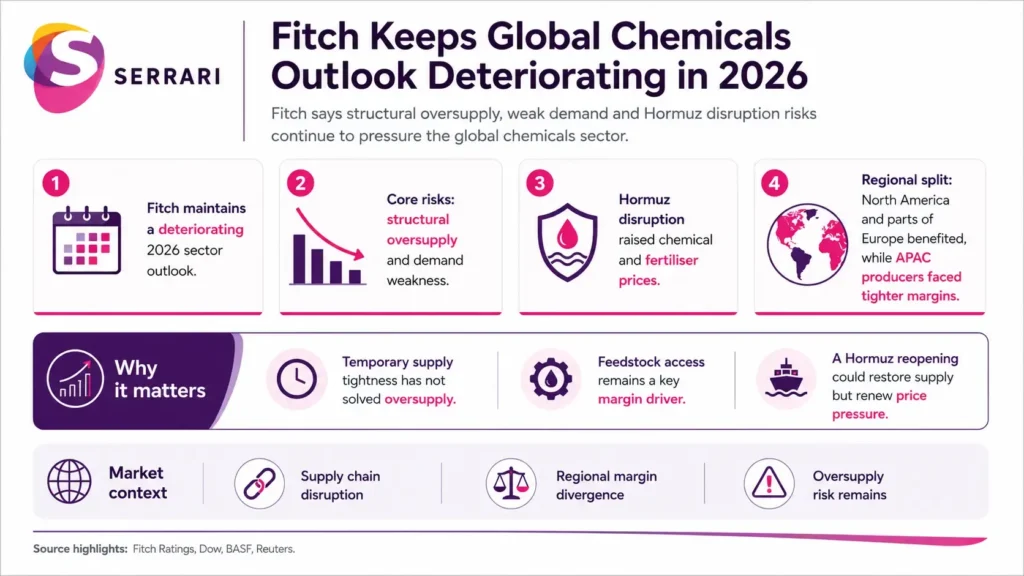
- Fitch has kept its 2026 global chemicals sector outlook at deteriorating.
- Structural overcapacity remains the central long-term pressure on industry profitability.
- Hormuz disruptions have temporarily tightened global chemical and fertiliser supply and raised prices.
- North American producers have benefited from relatively stable domestic feedstock costs, while some European producers have gained from reduced import competition.
- Asia-Pacific producers face a tougher combination of excess capacity, feedstock shortages and weaker margins.
- A reopening of Hormuz could ease supply shortages but also restore competitive pressure from Middle Eastern exports.
Structural Oversupply Still Drives Fitch’s Negative View
According to Fitch’s August 2026 sector assessment, the agency has retained its deteriorating outlook because the global industry remains burdened by excess production capacity and vulnerable demand.
The Middle East conflict has temporarily disrupted that imbalance rather than removed it. Restricted transit through the Strait of Hormuz has constrained shipments of oil, naphtha, liquefied petroleum gases, methanol, fertilisers and other industrial inputs, tightening markets that had previously been oversupplied.
Earlier in the conflict, Fitch noted that Europe and Asia normally source roughly 10%–20% of their polyethylene and polypropylene requirements from the Middle East, while the Gulf produces about one-third of globally traded nitrogen fertilisers. Those dependencies mean that disruptions can quickly affect operating rates, production costs and downstream prices.
The critical issue for the longer-term outlook is what happens when trade flows normalise. A meaningful reopening could restore Middle Eastern chemical exports and ease raw-material shortages, but it could also bring global overcapacity back into sharper focus.
North America and Europe Receive a Temporary Margin Lift
Regional effects have been uneven. North American producers have been relatively well positioned because much of their chemical production relies on domestic natural gas and natural gas liquids, which have been less exposed to the price shock affecting internationally traded feedstocks.
In its second-quarter 2026 results, Dow reported operating EBITDA of $2.31 billion, compared with $703 million a year earlier, supported by higher prices and company cost measures. The company also said Middle East conflict affected volumes in parts of its international operations.
European producers have faced higher energy and feedstock costs, but reduced competition from Middle Eastern and Asian suppliers has supported some product spreads. In its second-quarter earnings release, BASF reported EBITDA before special items of €2.4 billion, up €854 million from the prior-year quarter, with improved contribution margins in several businesses.
That improvement does not necessarily signal a lasting recovery. An earlier European chemicals assessment estimated that the effective closure of Hormuz had removed roughly 15%–20% of global petrochemical feedstocks from the market, temporarily reversing some of the oversupply that had pressured margins.
Context is everything. Stay ahead of shifting trends with today’s market updates, and uncover emerging opportunities using the Serrari Group Market Index and Marketplace. Then, take control of your own financial future by exploring our Money & Life Reset Transformation Blueprint ™ to build stronger habits, create better systems, and design a path toward lasting wealth.
Asia-Pacific and Middle East Producers Face Greater Pressure
Asia-Pacific remains particularly exposed because many petrochemical producers depend heavily on crude, naphtha and other feedstocks sourced from the Middle East. Supply disruptions have forced production curtailments and increased input costs at the same time that the region continues to struggle with substantial excess capacity.
A petrochemical supply-chain assessment found that Middle East disruptions had tightened Asian chemical supplies, reduced operating rates and pushed up costs across the value chain.
Middle Eastern producers face a different challenge. Many retain competitive production economics, but disrupted shipping, restricted access to export routes and risks to regional assets limit their ability to fully benefit from higher global prices.
The result is an unusually fragmented market: North American producers can benefit from feedstock advantages, parts of Europe gain from reduced competition, while Asia-Pacific and Gulf producers bear a greater share of supply-chain stress.
Hormuz Reopening Could Bring Back the Oversupply Problem
The Strait of Hormuz remains the key near-term variable. As of August 7, negotiations over commercial shipping access were still focused on conditions for restoring transit rather than a full return to normal flows.
For chemicals companies, reopening would have two opposing effects. It would improve access to feedstocks, reduce freight and production pressures and help restart curtailed capacity, particularly in Asia. At the same time, returning Middle Eastern volumes could weaken prices and margins by reintroducing supply into markets already facing structural overcapacity.
That trade-off explains why Fitch’s sector view remains negative despite stronger second-quarter results at some Western producers. Temporary supply scarcity has improved conditions for selected companies, but it has not solved the deeper problem of too much capacity chasing fragile global demand.
Sources: Fitch Ratings / Dow / BASF / S&P Global Ratings / Reuters
Your financial future isn’t something you wait for—it’s something you build.
The real question is: when do you begin?
Move beyond simply staying informed.
Navigate the markets with clarity—track trends through the Serrari Group Market Index, uncover opportunities in the Serrari Marketplace, and build practical knowledge with our Curated Wealth Builder Platform.
Stay connected to what truly matters.
Get daily insights on macro trends and financial movements across Kenya, Africa, and global markets—delivered through the Serrari Newsletter.
Growth opens doors.
Advance your career through professional programs including ACCA, HESI A2, ATI TEAS 7 , HESI EXIT , NCLEX – RN and NCLEX – PN, Financial Literacy!🌟—designed to move you forward with confidence.
See where money is flowing—clearly and in real time.
Track Money Market Funds, Treasury Bills, Treasury Bonds, Green Bonds, and Fixed Deposits, alongside global and African indexes, key economic indicators, and the evolving Crypto and stablecoin landscape—all within Serrari’s Market Index.