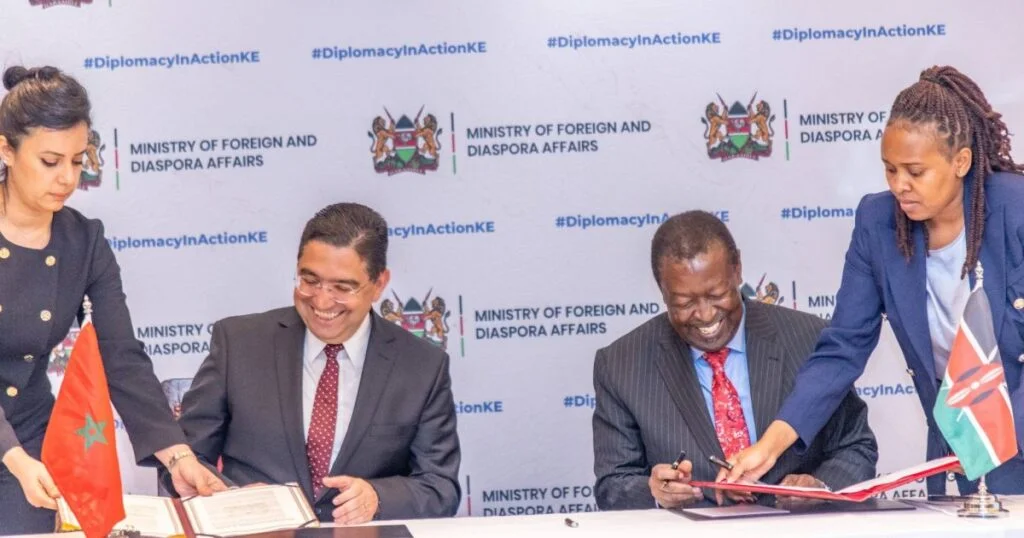
Kenya and Morocco have signed 11 bilateral agreements during the inaugural ministerial session of the Kenya–Morocco Joint Commission for Cooperation (JCC), held in Nairobi. The deals — covering agriculture, health, higher education, fisheries, justice, gender, culture, sports, immigration, wildlife and skills exchange — were signed by Kenya’s Prime Cabinet Secretary and Cabinet Secretary for Foreign and Diaspora Affairs, Musalia Mudavadi, and Morocco’s Minister of Foreign Affairs, African Cooperation and Moroccan Expatriates, Nasser Bourita. The signing marks the most structured cooperation framework yet between the two countries, builds on five earlier memoranda of understanding concluded in Rabat in May 2025, and coincided with Kenya’s explicit endorsement of Morocco’s autonomy plan for Western Sahara — a notable diplomatic pivot that places Nairobi firmly within Rabat’s growing African coalition.
Key Overview
- 11 bilateral instruments signed on the sidelines of the inaugural Kenya–Morocco Joint Commission for Cooperation (JCC) in Nairobi.
- Sectors covered: agriculture, justice, health, fisheries and aquaculture, gender equality, cultural cooperation, higher education, sports, wildlife, and diplomatic visa exemptions, plus a framework agreement on scholarships and expertise-sharing.
- Builds on five MoUs signed in May 2025 in Rabat covering diplomatic training, housing, trade, youth and public-service capacity building.
- Both sides agreed to resume direct flights between Kenya and Morocco under the Bilateral Air Services Agreement.
- Kenya publicly backed Morocco’s autonomy plan for Western Sahara, calling it the “only credible and realistic solution.”
- OCP Group, Morocco’s state fertilizer giant, is expected to move from supplier to local producer in Kenya under fast-tracked blending plant plans.
- The next JCC session will be held in Morocco on dates to be agreed through diplomatic channels.
Markets move fast; don’t get left behind. We’ve paired the Serrari Group Market Index with a curated Marketplace and a comprehensive Wealth Builder Course to ensure you have the data—and the skills—to act on it.
A Structured New Chapter in Kenya–Morocco Relations
The inaugural ministerial session of the Kenya–Morocco Joint Commission for Cooperation convened in Nairobi on Thursday, 9 April 2026, co-chaired by Kenya’s Prime Cabinet Secretary Musalia Mudavadi and Morocco’s Foreign Minister Nasser Bourita. The meeting followed a senior officials’ session held in Rabat from 1 to 3 October 2025, which set the technical groundwork for the ministerial-level signing.
Eleven bilateral instruments emerged from the meeting, spanning agriculture, justice, health, maritime fisheries and aquaculture, gender equality and women’s empowerment, cultural cooperation, higher education, sports, wildlife conservation, and diplomatic visa exemptions. The ministers also adopted a framework agreement covering university scholarships, internships and the exchange of expertise.
“These instruments now lay the groundwork for practical collaboration,” Mudavadi said at the signing. “The true measure of our success will lie in the impact these instruments will have on the lives of our citizens and not just in the documents signed.” He emphasised that effective implementation and monitoring would be essential to ensuring the agreements translate into real-world outcomes rather than bureaucratic paperwork.
For Bourita, the framing was equally ambitious. “Your Excellency, my brother, in following your remarks, I wish to affirm our strong conviction that this joint commission represents a renewed imperative for our bilateral cooperation,” he said, as quoted in the joint communiqué. Morocco-Kenya relations, he added, would “see significant progress in the years to come.”
Building on May 2025’s Rabat Momentum
Thursday’s 11 deals did not emerge in a vacuum. They build on five memoranda of understanding that Mudavadi signed during an official visit to Rabat on 27 May 2025, at the invitation of Bourita. Those earlier MoUs covered diplomatic training, housing, trade cooperation, youth development, and capacity-building for the public service.
During that same May 2025 visit, Kenya for the first time formally expressed support for Morocco’s autonomy plan over Western Sahara, while Morocco pledged to accelerate fertilizer and phosphate exports to Kenya — a move seen as directly supporting Kenya’s food security push. That visit also laid the political foundation on which the broader JCC architecture would later rest.
The inaugural JCC session, therefore, represents the institutionalisation of what had been, until recently, a relatively ad-hoc bilateral relationship. Nairobi and Rabat have now shifted from sporadic diplomatic engagement to a structured commission with periodic ministerial review and a built-in implementation and monitoring mechanism.
Trade, Flights and a Persistent Imbalance
Both governments openly acknowledged that trade flows between them remain modest — and heavily skewed. Bourita and Mudavadi called for action to reduce the trade imbalance, including by expanding market access for agricultural and value-added goods. Mudavadi used his remarks to reaffirm the importance of facilitating mutually beneficial trade within existing African Continental Free Trade Area (AfCFTA) frameworks, and to push for deeper collaboration between the two countries’ business communities.
The officials also agreed to accelerate negotiations toward agreements in ports, avoidance of double taxation, energy, air services, mining, and tourism — a sweeping to-do list that signals the partnership is intended to extend far beyond the 11 instruments signed on Thursday.
On connectivity, both sides placed particular emphasis on the resumption of direct flights between Kenya and Morocco under the Bilateral Air Services Agreement. A direct Nairobi–Casablanca or Nairobi–Rabat air link has long been identified as a prerequisite for serious growth in trade, tourism and people-to-people exchanges. Its absence has forced travellers through European or Gulf hubs — a costly detour for a continent-wide trading relationship that, on paper, ought to be seamless.
Kenya is also keen to boost exports of tea, coffee and fresh horticultural produce to the Moroccan market, with Mudavadi describing Morocco as a strategic partner in advancing Kenya’s economic transformation agenda and South–South cooperation. He noted that the North African kingdom has made significant strides in renewable energy, automotive manufacturing, agro-processing, pharmaceuticals and large-scale infrastructure — all sectors Kenya is actively courting investment in.
Context is everything. While you follow today’s updates, use the Serrari Group Market Index and Marketplace to spot emerging shifts. Need to sharpen your edge? Our Wealth Builder Course turns these insights into a professional-grade strategy.
Fertilizer and the OCP Factor
Agriculture, unsurprisingly, sits at the heart of the emerging partnership. Kenya spends over $3 billion annually on food imports, and fertilizer access has been identified by President William Ruto’s administration as the linchpin of its food sovereignty agenda. Morocco, for its part, controls roughly 70 per cent of the world’s known phosphate rock reserves and is home to OCP Group, the state-linked giant that dominates the African fertilizer value chain.
Morocco’s support to Kenya already includes the provision of affordable fertiliser, technology transfer and investments in local production capacity. “The collaboration is aimed at enhancing productivity and strengthening food security,” Mudavadi said.
But the real game-changer lies in plans to localise production. OCP has operated in Kenya since 2016 through its OCP Africa subsidiary, focusing on distribution and soil-specific fertilizer formulations. Diplomatic signals through 2025 suggest a meaningful escalation is underway: during Mudavadi’s May 2025 Rabat visit, he met senior OCP executives to discuss fast-tracking a fertilizer blending plant in Kenya that would combine imported Moroccan phosphates with local additives. Kenyan Ambassador to Morocco Jessica Gakinya subsequently toured OCP’s flagship complex in Jorf Lasfar in June 2025.
If realised, the Kenya plant could reduce the country’s reliance on fertilizer imports by up to 40 per cent by 2027, improve access for smallholder farmers — especially women, who make up over 60 per cent of Kenya’s smallholder base — and potentially cut fertilizer costs to Kenyan farmers by as much as 30 per cent in the long term, according to analyst estimates tracking the deal.
The stakes are considerable. Retail fertilizer prices in Kenya climbed 150 per cent between 2020 and 2022, denting yields among smallholders who supply most of the country’s domestic food. Locking in a reliable, regionally sourced supply line is a strategic priority that transcends short-term politics. For OCP, the Kenya play also fits a wider African expansion strategy; the group’s first-half 2025 revenue rose 21 per cent to 52.16 billion dirhams (about $5.7 billion), and the company is actively adding specialty-grade capacity across the continent.
Health, Education and Soft Power
The health-sector agreements also deepen an already-substantive relationship. In November 2025, a Moroccan medical mission supported by Her Highness Princess Lalla Asmaa saw 60 Kenyan children receive cochlear implants, alongside donations of surgical kits; Morocco has also supported free eye clinics in Kenya benefiting hundreds of patients. The newly signed cooperation agreements formalise this pipeline of specialised medical treatment and capacity building.
On education, Mudavadi thanked Morocco for the fully sponsored scholarships Rabat offers Kenyan students at undergraduate, master’s and doctoral levels, and noted that the two sides have now concluded additional agreements on scholarships and higher education to institutionalise the academic pipeline.
These tracks are not trivial. Alongside fertilizer diplomacy, Morocco’s soft-power outreach through health, education and cultural engagement has been a core feature of its re-engagement with sub-Saharan Africa since King Mohammed VI’s African tours of the 2000s. From 2008 to 2015, two-thirds of Morocco’s foreign direct investment flowed into African countries, totalling about £1.6 billion, and OCP’s African operations have grown from virtually nothing to commanding a 54 per cent market share across the continent.
The Western Sahara Pivot
Arguably the most politically significant outcome of the JCC was not signed on paper but set out in the joint communiqué. Kenya explicitly welcomed what it called the “growing international consensus” and the momentum driven by King Mohammed VI in favour of the autonomy plan, describing the plan as the “only credible and realistic solution” to the Western Sahara dispute.
Nairobi also affirmed the autonomy option as a “sustainable approach” and expressed willingness to cooperate with like-minded states to promote its implementation. It welcomed the adoption of UN Security Council Resolution 2797, which enshrines autonomy under Moroccan sovereignty as the basis for a political settlement.
This language represents a clear departure from Kenya’s previous, more neutral stance. Kenya had earlier referenced UN Security Council Resolution 2756 (2024) as the framework for resolving the dispute, and at the multilateral level the country still supports the UN-led process as the exclusive mechanism. But by explicitly endorsing the Moroccan autonomy plan as a sustainable and credible solution, Nairobi has effectively joined a growing bloc of African capitals aligning with Rabat’s position — a bloc marked, among other things, by the opening of over 30 consulates in Morocco’s southern provinces.
For Kenyan diplomacy, the pivot carries costs and benefits. It places Nairobi at odds with long-held African Union orthodoxy on self-determination and complicates ties with countries that recognise the Sahrawi Arab Democratic Republic. But it also unlocks a much deeper commercial relationship with one of Africa’s most strategically positioned industrial powers.
Voices From the Table
Kenyan Ambassador to Morocco Jessica Gakinya framed the JCC as a platform to accelerate collaboration in priority areas including ICT, trade and investment, and air connectivity, as well as coordination within multilateral platforms. Moroccan Ambassador to Kenya Abderrazzak Laassel, for his part, highlighted the strong and enduring ties between the two countries, noting that their longstanding mutual respect and solidarity now have the opportunity to be further strengthened through enhanced institutional cooperation.
Principal Secretary for Foreign and Diaspora Affairs Dr Korir SingOei lauded Morocco for its enduring partnership with Kenya, noting that bilateral relations have steadily expanded across economic, political and cultural spheres. He underscored that the JCC provides a structured and forward-looking framework to deepen cooperation, enhance policy coordination and unlock new opportunities for shared growth.
On the Kenyan side, the technical heavy lifting involved Cabinet Secretaries Aden Duale (Health), Julius Migos Ogamba (Education) and Hannah Cheptumo (Gender), who each had a hand in shaping sector-specific agreements. Mudavadi publicly thanked them and their technical teams for advancing “a clear and actionable framework for progress.”
The Implementation Test
For all the choreography of the Nairobi signing, the real test — as Mudavadi himself acknowledged — will be implementation. Bilateral commissions in Africa have a mixed record; grand signing ceremonies have often been followed by institutional drift, with grand agreements withering in the face of implementation gaps.
To guard against this, the two sides adopted the approved minutes of the Joint Commission as a strategic cooperation framework, together with an implementation and monitoring mechanism designed to ensure the coordinated execution of agreed commitments. The next JCC session will be held in Morocco on dates to be agreed through diplomatic channels.
Three benchmarks will signal whether Thursday’s 11 signatures translate into substantive change. First, whether direct flights resume within a realistic timeframe — a concrete, measurable deliverable. Second, whether OCP moves from planning to ground-breaking on a Kenyan blending or manufacturing plant within the next 12 to 18 months. And third, whether Kenyan tea, coffee and horticultural exports actually gain improved market access in Morocco, narrowing what has historically been a lopsided trade relationship.
If those three tests are met, the Kenya–Morocco partnership could become a template for a new generation of African bilateral corridors — one built less on aid or post-colonial ties and more on mutually reinforcing commercial and diplomatic logic. If not, the 11 instruments risk joining a long list of African agreements that looked impressive on signing day and produced little thereafter.
For now, the mood in Nairobi is unambiguously optimistic — and Rabat has reasons of its own to ensure this partnership delivers.
Your financial future isn’t something you wait for—it’s something you build.
The real question is: when do you begin?
Move beyond simply staying informed.
Navigate the markets with clarity—track trends through the Serrari Group Market Index, uncover opportunities in the Serrari Marketplace, and build practical knowledge with our Curated Wealth Builder Course.
Stay connected to what truly matters.
Get daily insights on macro trends and financial movements across Kenya, Africa, and global markets—delivered through the Serrari Newsletter.
Growth opens doors.
Advance your career through professional programs including ACCA, HESI A2, ATI TEAS 7 , HESI EXIT , NCLEX – RN and NCLEX – PN, Financial Literacy!🌟—designed to move you forward with confidence.
See where money is flowing—clearly and in real time.
Track Money Market Funds, Treasury Bills, Treasury Bonds, Green Bonds, and Fixed Deposits, alongside global and African indexes, key economic indicators, and the evolving Crypto and stablecoin landscape—all within Serrari’s Market Index.