Saudi Aramco President and CEO Amin Nasser has warned that the prolonged disruption of the Strait of Hormuz is no longer only an oil-market crisis. Its effects are spreading through energy, shipping and fertilizer supply chains, increasing risks to agricultural production and global food affordability.
Nasser said the global market had lost more than 2.6 billion barrels of oil since the regional conflict began, describing the closure as the largest oil supply shock in history. Despite the disruption, Aramco reported sharply higher second-quarter earnings after redirecting exports through alternative infrastructure and benefiting from stronger prices.
Key Overview
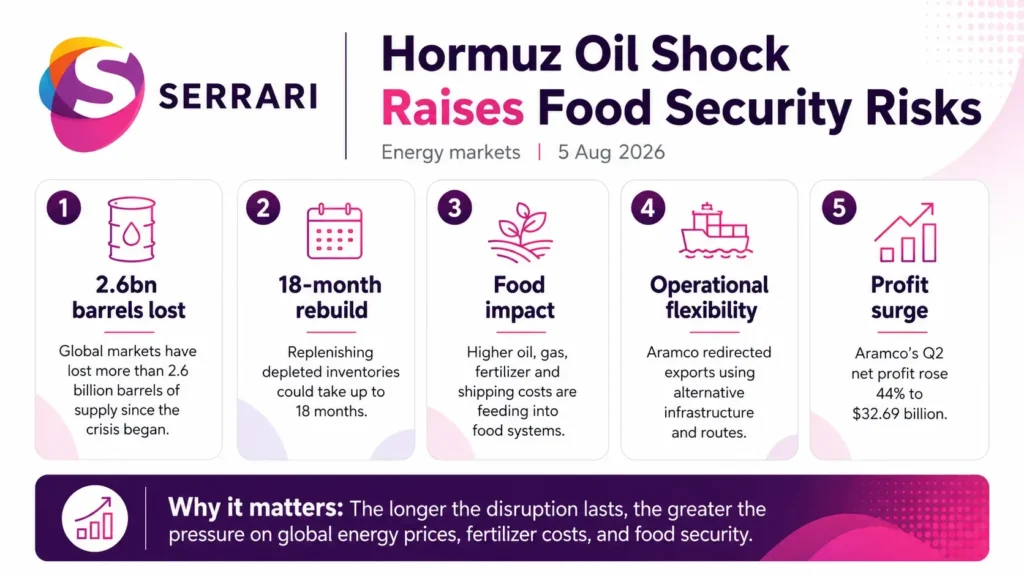
- More than 2.6 billion barrels of oil supply have been lost since the conflict began.
- Rebuilding depleted inventories could take up to 18 months even if the Strait reopened immediately.
- Disrupted oil, gas and fertilizer flows are increasing costs throughout global food systems.
- Aramco used its East-West Pipeline, storage capacity and export terminals to preserve business continuity.
- Second-quarter net profit rose 44% to $32.69 billion, while adjusted net income reached $33.4 billion.
Historic Oil Shock Drains Global Inventories
Nasser’s warning followed the release of Aramco’s half-year results and came as global markets continued to absorb the consequences of sharply reduced shipping through one of the world’s most important energy corridors.
According to the 2.6 billion-barrel supply estimate, the volume removed from the market is equivalent to nearly one month of normal global crude production. Nasser said that even if the Strait reopened immediately, replacing depleted inventories at an average rate of 2.1 million barrels per day could take as long as 18 months.
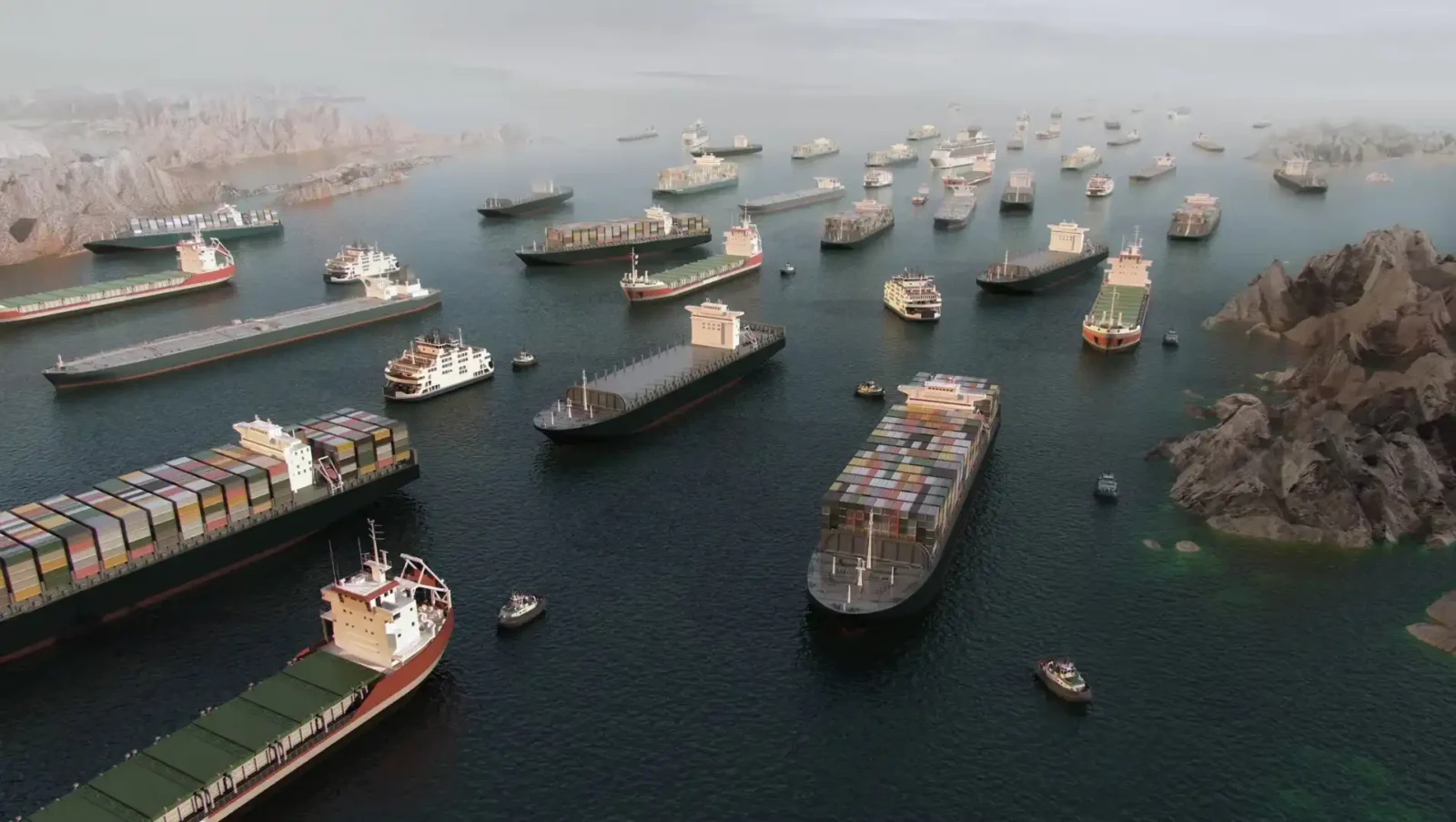
Before the crisis, approximately 20 million barrels per day of crude and petroleum products passed through Hormuz, representing around a quarter of global seaborne oil trade. Available pipeline routes can only redirect a portion of those flows, leaving the market highly exposed to continued disruption.
The crisis has also reduced the industry’s ability to absorb another shock. Refineries are operating at high utilisation rates, inventories have been drawn down and alternative export routes face capacity constraints. Disruption affecting the Red Sea or the Bab el-Mandeb Strait could therefore place additional pressure on global supply.
Context is everything. Stay ahead of shifting trends with today’s market updates, and uncover emerging opportunities using the Serrari Group Market Index and Marketplace. Then, take control of your own financial future by exploring our Money & Life Reset Transformation Blueprint ™ to build stronger habits, create better systems, and design a path toward lasting wealth.
Why the Crisis Threatens Food Security
The connection between Hormuz and food security runs through fuel, natural gas, fertilizers and shipping costs. Modern agriculture relies on diesel for machinery and transport, while natural gas is a major feedstock in nitrogen fertilizer production.
An estimated 30% of global fertilizer trade passed through the Strait in 2024, alongside substantial volumes of liquefied natural gas. Restrictions affecting urea, ammonia, sulphur and phosphate shipments have therefore raised input costs for farmers far beyond the Middle East.
The disruption of fertilizer trade has been particularly significant for import-dependent countries in Africa and Asia. Higher fertilizer prices can cause farmers to reduce application rates, delay planting or cultivate less land, potentially weakening future harvests.
Food prices have already shown pressure. A global commodity assessment found that food prices rose 5% during the two months after the conflict began compared with the preceding two months. Oils and meals increased by 10%, while grain prices rose by 3%.
The risk is greatest for lower-income economies, where governments have limited capacity to subsidise fuel or fertilizer and households spend a larger share of their income on food. Persistent disruption could therefore translate from higher farm costs into weaker production, rising import bills and worsening food insecurity.
Aramco Uses Alternative Infrastructure to Sustain Exports
Aramco said its operational resilience was supported by the East-West Pipeline, storage facilities and multiple export terminals. The pipeline allows crude to move from the kingdom’s eastern production centres to Yanbu on the Red Sea, bypassing Hormuz.
The company’s official half-year results said continued use of this infrastructure helped sustain production and exports despite the unprecedented disruption. Aramco also said it could return production to pre-conflict levels within days and reach maximum sustained capacity of 12 million barrels per day within three weeks if required.
However, alternative routes do not eliminate the wider market shortage. Other Gulf producers remain heavily dependent on Hormuz, and spare pipeline capacity is substantially smaller than the volumes normally carried through the Strait.
Higher Prices Lift Aramco’s Second-Quarter Earnings
Aramco recorded second-quarter net profit of $32.69 billion for the three months to June 30, up 44% from $22.67 billion a year earlier. The increase reflected higher prices for crude oil, refined products and chemicals, despite a decline in total hydrocarbon production.
The company separately reported adjusted net income of $33.4 billion, operating cash flow of $25.4 billion and free cash flow of $12.3 billion. Its gearing ratio increased to 6.2% from 4.8% at the end of the first quarter, while the board declared a $21.9 billion base dividend for payment during the third quarter.
Aramco’s results demonstrate how a major producer with diversified infrastructure can remain profitable during severe market disruption. Nasser’s broader warning, however, is that the economic damage extends beyond oil companies and fuel consumers. The longer Hormuz remains constrained, the greater the threat to fertilizer availability, agricultural costs and global food security.
Sources: Saudi Aramco / Reuters / Saudi Gazette / International Energy Agency / International Food Policy Research Institute / World Trade Organization / World Bank
Your financial future isn’t something you wait for—it’s something you build.
The real question is: when do you begin?
Move beyond simply staying informed.
Navigate the markets with clarity—track trends through the Serrari Group Market Index, uncover opportunities in the Serrari Marketplace, and build practical knowledge with our Curated Wealth Builder Platform.
Stay connected to what truly matters.
Get daily insights on macro trends and financial movements across Kenya, Africa, and global markets—delivered through the Serrari Newsletter.
Growth opens doors.
Advance your career through professional programs including ACCA, HESI A2, ATI TEAS 7 , HESI EXIT , NCLEX – RN and NCLEX – PN, Financial Literacy!🌟—designed to move you forward with confidence.
See where money is flowing—clearly and in real time.
Track Money Market Funds, Treasury Bills, Treasury Bonds, Green Bonds, and Fixed Deposits, alongside global and African indexes, key economic indicators, and the evolving Crypto and stablecoin landscape—all within Serrari’s Market Index.