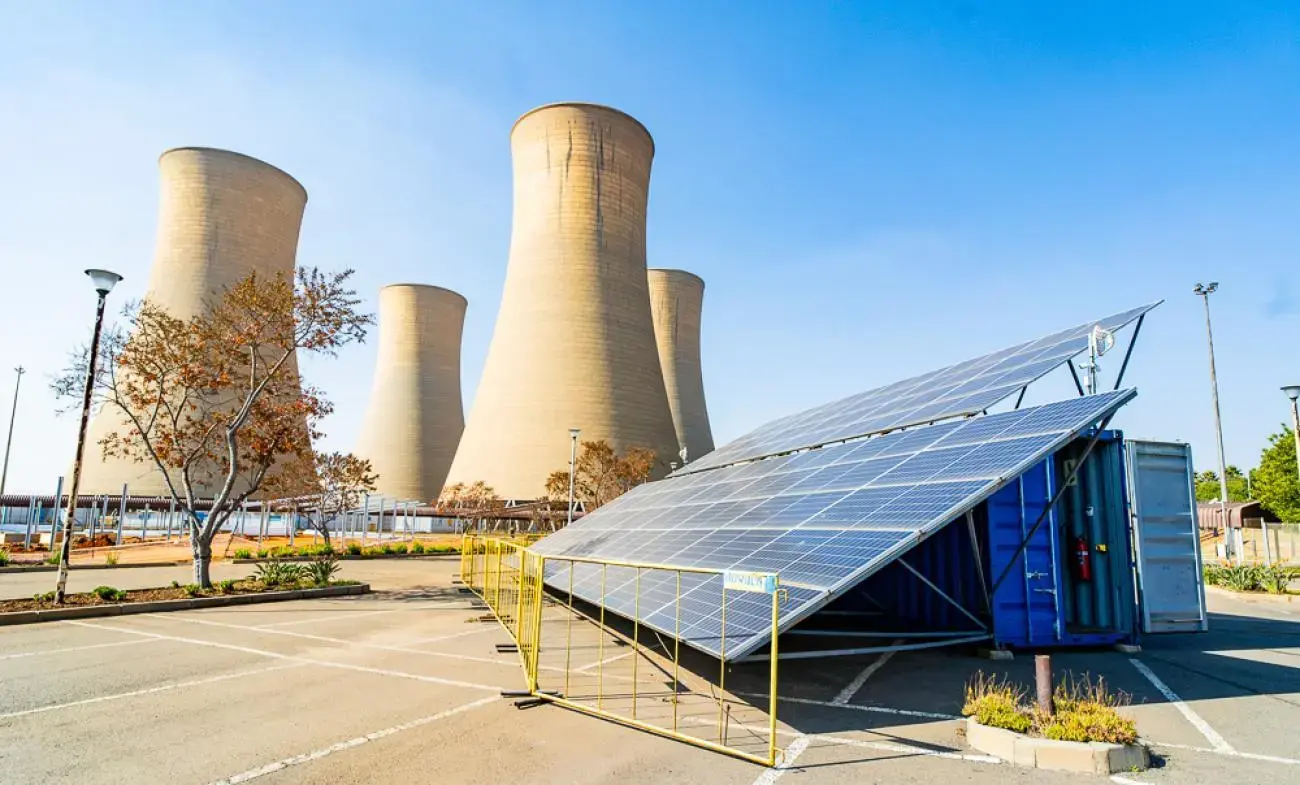
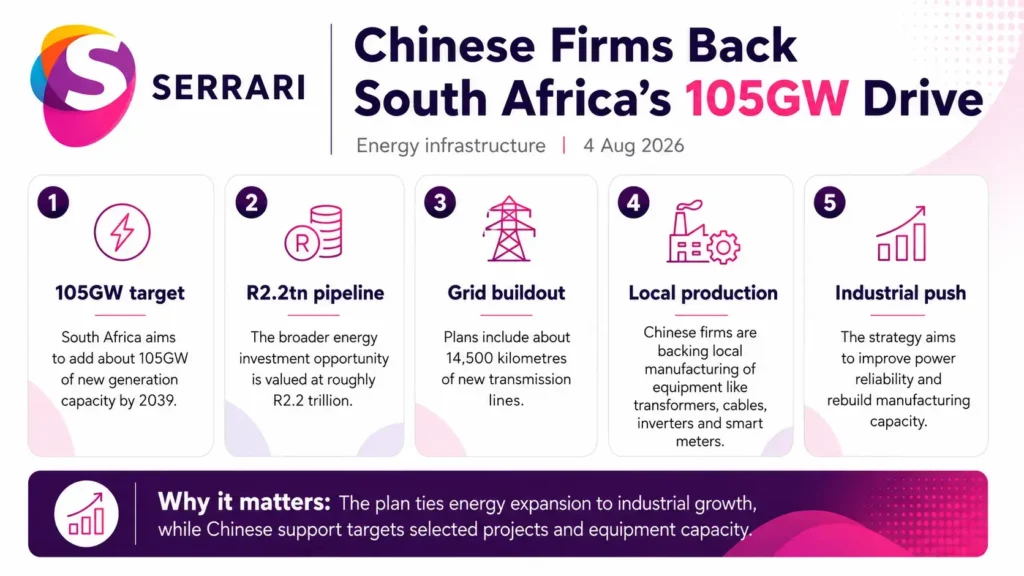
South Africa has secured commitments from Chinese companies to support its long-term electricity expansion and strengthen local manufacturing of critical energy equipment. The initiative forms part of a wider R2.2 trillion investment pipeline designed to add approximately 105GW of generation capacity by 2039.
Pretoria is seeking more than foreign capital. It wants Chinese companies to establish or expand South African production of transformers, cables, pylons, inverters, smart meters and other equipment required for the country’s energy transition.
The available disclosures do not indicate that China has committed to finance the entire R2.2 trillion programme. Instead, Chinese companies have expressed support and made commitments linked to selected projects, equipment production and potential investment partnerships.
Key Overview
- South Africa is promoting an energy investment pipeline valued at approximately R2.2 trillion.
- The programme targets about 105GW of additional electricity capacity by 2039.
- Chinese companies have committed to establishing or expanding local energy-equipment production.
- A separate transmission programme includes about 14,500 kilometres of new power lines.
- Pretoria wants energy investment to support industrial development, employment and reduced import dependence.
Chinese Companies Support South Africa’s Energy Plans
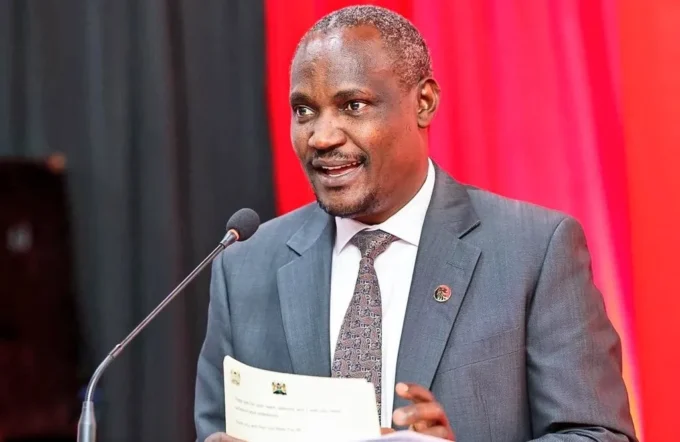
South Africa received firm commitments from Chinese companies during engagements led by Electricity and Energy Minister Kgosientsho Ramokgopa in Beijing.
The South African delegation included representatives from Eskom, the Industrial Development Corporation and the Development Bank of Southern Africa. Discussions focused on generation projects, transmission infrastructure, equipment manufacturing, technology partnerships and project financing.
Chinese companies indicated interest in establishing new operations or expanding existing production capacity in South Africa. Priority equipment includes transformers, electrical wires, transmission pylons, inverters and smart meters.
The commitments are intended to support South Africa’s ability to deliver major electricity projects without depending entirely on imported components. Local production could also shorten supply chains and reduce delays caused by global equipment shortages.
R2.2 Trillion Programme Targets 105GW of Capacity
South Africa presented R2.2 trillion in energy investment opportunities expected to enter the market through 2039.
The pipeline is expected to deliver around 105GW of new generation capacity as the country retires ageing coal-fired plants and develops a more diversified electricity system. Planned investments cover renewable energy, battery storage, gas, nuclear power and other technologies required to maintain reliable supply.
The scale of the programme reflects a change in South Africa’s energy priorities. After years of severe load shedding, the government is moving from emergency interventions towards long-term expansion of generation and network infrastructure.
Reliable electricity is critical to the recovery of South Africa’s manufacturing, mining and commercial sectors. Additional power capacity could also support growing demand from data centres, electric transport systems and other technology-intensive industries.
Context is everything. Stay ahead of shifting trends with today’s market updates, and uncover emerging opportunities using the Serrari Group Market Index and Marketplace. Then, take control of your own financial future by exploring our Money & Life Reset Transformation Blueprint ™ to build stronger habits, create better systems, and design a path toward lasting wealth.
Transmission Expansion Remains Essential
New generation projects cannot operate effectively without enough transmission capacity to connect them to consumers. South Africa is therefore pursuing a separate grid-development programme valued at approximately R440 billion.
The National Transmission Company South Africa’s development programme requires about 14,500 kilometres of new transmission lines and roughly 210 transformers.
Grid limitations have delayed renewable-energy projects in areas with strong wind and solar resources. Several proposed developments cannot connect because nearby substations and transmission corridors have insufficient capacity.
Expanding the network would unlock these projects while improving the movement of electricity between provinces. It would also create long-term demand for conductors, steel structures, transformers, substations and engineering services.
Local Manufacturing Could Rebuild Industrial Capacity
South Africa wants the energy transition to contribute directly to industrial growth. Rather than importing all the equipment required for new projects, the government is encouraging investors to manufacture more components locally.
A localisation partnership between the transmission company and the Industrial Development Corporation aims to strengthen domestic suppliers through procurement coordination, technical support and potential industrial financing.
China is an important partner because its companies hold leading positions in the production of solar panels, batteries, wind-energy equipment and transmission technology. POWERCHINA has also been pursuing large renewable-energy projects across Africa, including South Africa.
If Chinese firms build production facilities locally, South Africa could capture more value from the energy transition. The investments could support skilled employment, technology transfer and the development of local supply chains.
Domestic manufacturing could also position South Africa as a regional production and export hub for energy equipment required by other African countries.
Execution Will Determine the Programme’s Impact
The commitments announced following the China engagements represent early progress, but they are not the same as completed investments or fully financed projects.
Individual developments will still require commercial agreements, regulatory approvals, procurement processes, funding and grid connections. The impact of the initiative should therefore be measured through factories established, financing secured, transmission infrastructure completed and generation capacity connected.
If South Africa successfully combines investment, infrastructure development and local manufacturing, the programme could improve electricity reliability while rebuilding parts of the country’s industrial base.
The strategy could also reduce dependence on imported equipment and strengthen South Africa’s competitiveness as African countries increase investment in power generation, transmission networks and clean-energy technologies.
Sources: Bloomberg / Engineering News / MyBroadband / National Transmission Company South Africa / Industrial Development Corporation / Reuters
Your financial future isn’t something you wait for—it’s something you build.
The real question is: when do you begin?
Move beyond simply staying informed.
Navigate the markets with clarity—track trends through the Serrari Group Market Index, uncover opportunities in the Serrari Marketplace, and build practical knowledge with our Curated Wealth Builder Platform.
Stay connected to what truly matters.
Get daily insights on macro trends and financial movements across Kenya, Africa, and global markets—delivered through the Serrari Newsletter.
Growth opens doors.
Advance your career through professional programs including ACCA, HESI A2, ATI TEAS 7 , HESI EXIT , NCLEX – RN and NCLEX – PN, Financial Literacy!🌟—designed to move you forward with confidence.
See where money is flowing—clearly and in real time.
Track Money Market Funds, Treasury Bills, Treasury Bonds, Green Bonds, and Fixed Deposits, alongside global and African indexes, key economic indicators, and the evolving Crypto and stablecoin landscape—all within Serrari’s Market Index.