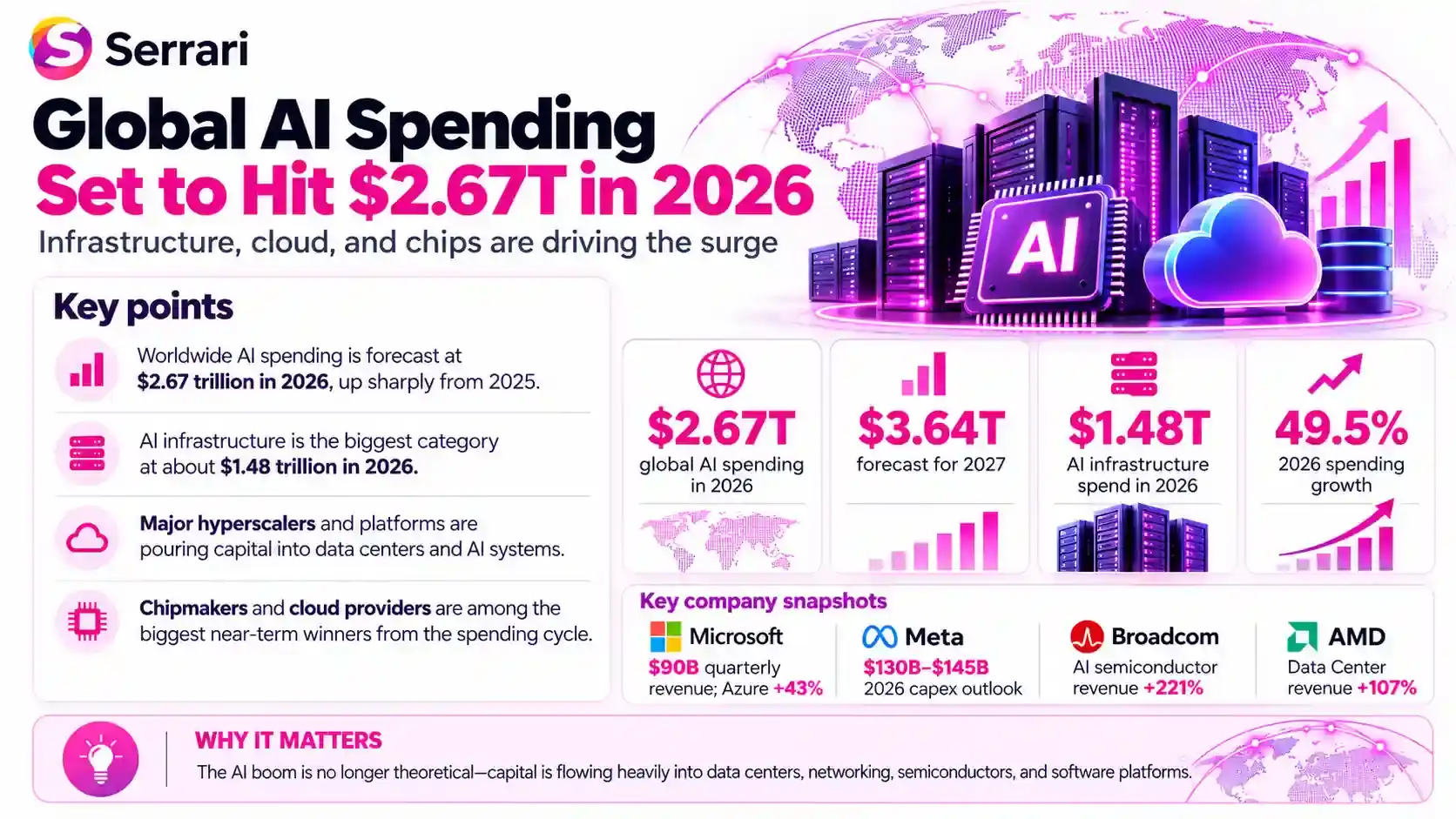
Worldwide spending on artificial intelligence is projected to reach $2.67 trillion in 2026, reflecting a sharp acceleration in investment across data centers, semiconductors, cloud computing and enterprise software.
According to the latest global AI spending forecast, expenditure is expected to increase 49.5% from approximately $1.79 trillion in 2025, before climbing to $3.64 trillion in 2027.
AI infrastructure represents the largest spending category, with projected expenditure of $1.48 trillion in 2026 as technology companies expand the computing capacity required to train and operate increasingly sophisticated AI models.
Major technology companies, including Microsoft, Meta Platforms, Broadcom and Advanced Micro Devices (AMD), are reporting substantial revenue growth or expanding investment commitments as the industry races to build the next generation of AI infrastructure.
Key Overview
- Global AI spending: Forecast to reach $2.67 trillion in 2026, representing 49.5% annual growth.
- 2027 outlook: Worldwide AI expenditure is projected to rise further to $3.64 trillion.
- Infrastructure dominance: AI infrastructure investment is expected to reach $1.48 trillion in 2026, accounting for approximately 56% of total spending.
- Microsoft: Reported quarterly revenue of $90 billion, with Azure and other cloud services growing 43%.
- Meta Platforms: Reported $31.08 billion in quarterly capital expenditure and expects to invest 130billion–145 billion throughout 2026.
- Broadcom: AI semiconductor revenue surged 221% annually to $16.7 billion in its fiscal third quarter.
- AMD: Data Center revenue more than doubled to $6.7 billion in the second quarter of 2026.
AI Infrastructure Takes the Largest Share of Investment
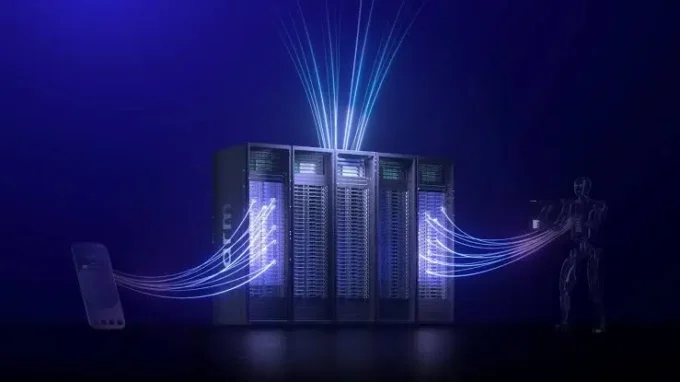
The artificial intelligence investment boom is increasingly concentrated in the physical and digital infrastructure required to operate advanced computing systems.
The September 2026 expenditure projections indicate that AI infrastructure spending will increase from approximately $982 billion in 2025 to $1.48 trillion in 2026, before reaching nearly $1.98 trillion in 2027.
This category includes AI-optimized servers, advanced semiconductors, cloud infrastructure, networking equipment and specialized computing systems.
Large technology companies, commonly known as hyperscalers, are driving much of this growth as they expand data centers to meet anticipated demand for generative AI and automated business applications.
Beyond infrastructure, AI services spending is projected to reach $576 billion in 2026, while AI software spending is expected to total approximately $462 billion.
These figures demonstrate that the investment cycle extends beyond semiconductor manufacturers to cloud providers, software developers and enterprise technology suppliers.
Microsoft and Meta Accelerate AI Infrastructure Expansion
Microsoft continues to benefit from enterprise demand for cloud computing and AI-powered services.
Its fiscal fourth-quarter 2026 results showed revenue increasing 18% to $90 billion, while Microsoft Cloud revenue advanced 27% to $59.3 billion.
Azure and other cloud services recorded 43% revenue growth, reflecting continued demand for cloud infrastructure and AI workloads.
Microsoft also reported that Azure generated more than $100 billion in annual revenue for the first time during fiscal 2026, while Microsoft 365 Copilot exceeded 30 million paid seats.
Meanwhile, Meta Platforms is committing substantial resources to AI infrastructure as it develops advanced models, recommendation systems and consumer-facing AI applications.
According to its second-quarter financial results, Meta generated $60.80 billion in revenue, representing 28% annual growth.
Capital expenditure, including principal payments on finance leases, reached $31.08 billion during the quarter.
The company expects full-year capital expenditure of between $130 billion and $145 billion, highlighting the extraordinary scale of investment required to support its long-term AI strategy.
Context is everything. Stay ahead of shifting trends with today’s market updates, and uncover emerging opportunities using the Serrari Group Market Index and Marketplace. Then, take control of your own financial future by exploring our Money & Life Reset Transformation Blueprint ™ to build stronger habits, create better systems, and design a path toward lasting wealth.
Broadcom and AMD Benefit From Semiconductor Demand
Semiconductor manufacturers are emerging as major beneficiaries of expanding AI computing requirements.
Broadcom reported fiscal third-quarter revenue of $29.6 billion, an 86% increase compared with the previous year.
Its AI semiconductor business generated $16.7 billion, representing 221% annual growth, supported by strong demand for custom AI accelerators and networking components.
Broadcom expects fourth-quarter revenue to reach approximately $34.8 billion, including projected AI semiconductor revenue of $21.7 billion.
The company’s custom chip business has become increasingly important as large cloud providers seek specialized processors capable of improving performance and reducing computing costs.
AMD is experiencing similar momentum across its data center business.
Its second-quarter 2026 earnings showed total revenue climbing 50% to $11.5 billion, supported by accelerating demand for its EPYC processors and Instinct AI accelerators.
Data Center revenue increased 107% to $6.7 billion, making it a significant contributor to AMD’s overall growth.
The company projected third-quarter revenue of approximately $13 billion, with a potential variation of $300 million.
These results illustrate how the AI investment cycle is supporting both general-purpose processors and specialized hardware designed for intensive machine-learning workloads.
Can the AI Investment Boom Sustain Its Momentum?
Despite strong revenue growth across major technology companies, questions remain about the long-term profitability of increasingly expensive AI infrastructure.
A central concern is whether future revenue from AI services will justify the enormous capital commitments being made today.
Recent industry investment analysis highlights the possibility that substantial infrastructure spending could precede measurable productivity improvements and sufficient commercial returns.
Data centers also require significant electricity, cooling systems, land and networking infrastructure, introducing additional operating costs and construction challenges.
For investors, this creates an important distinction between companies earning revenue from current AI infrastructure demand and those investing heavily in anticipation of future customer adoption.
Chipmakers and infrastructure suppliers may benefit directly from near-term equipment purchases, while cloud providers and software developers face greater pressure to convert their investments into sustainable recurring revenue.
AI Spending Outlook for 2027 and Beyond
The projected increase in global AI expenditure to $3.64 trillion in 2027 suggests that the current investment cycle could continue well beyond 2026.
AI infrastructure alone is expected to approach $2 trillion annually, while spending on AI services, software and automated agents is also forecast to expand.
However, higher expenditure does not necessarily guarantee corresponding gains in profitability, productivity or share prices.
The next phase of AI development will increasingly depend on whether businesses can translate substantial investments in computing capacity into commercially valuable products and measurable financial returns.
For investors, the key indicators will include capital expenditure efficiency, revenue growth, AI service adoption, operating margins and the ability of technology companies to generate sustainable cash flows from their expanding infrastructure.
Sources
Gartner / Microsoft / Meta Platforms / Broadcom / AMD / Reuters / Wall Street Investor
Your financial future isn’t something you wait for—it’s something you build.
The real question is: when do you begin?
Move beyond simply staying informed.
Navigate the markets with clarity—track trends through the Serrari Group Market Index, uncover opportunities in the Serrari Marketplace, and build practical knowledge with our Curated Wealth Builder Platform.
Stay connected to what truly matters.
Get daily insights on macro trends and financial movements across Kenya, Africa, and global markets—delivered through the Serrari Newsletter.
Growth opens doors.
Advance your career through professional programs including ACCA, HESI A2, ATI TEAS 7 , HESI EXIT , NCLEX – RN and NCLEX – PN, Financial Literacy!🌟—designed to move you forward with confidence.
See where money is flowing—clearly and in real time.
Track Money Market Funds, Treasury Bills, Treasury Bonds, Green Bonds, and Fixed Deposits, alongside global and African indexes, key economic indicators, and the evolving Crypto and stablecoin landscape—all within Serrari’s Market Index.