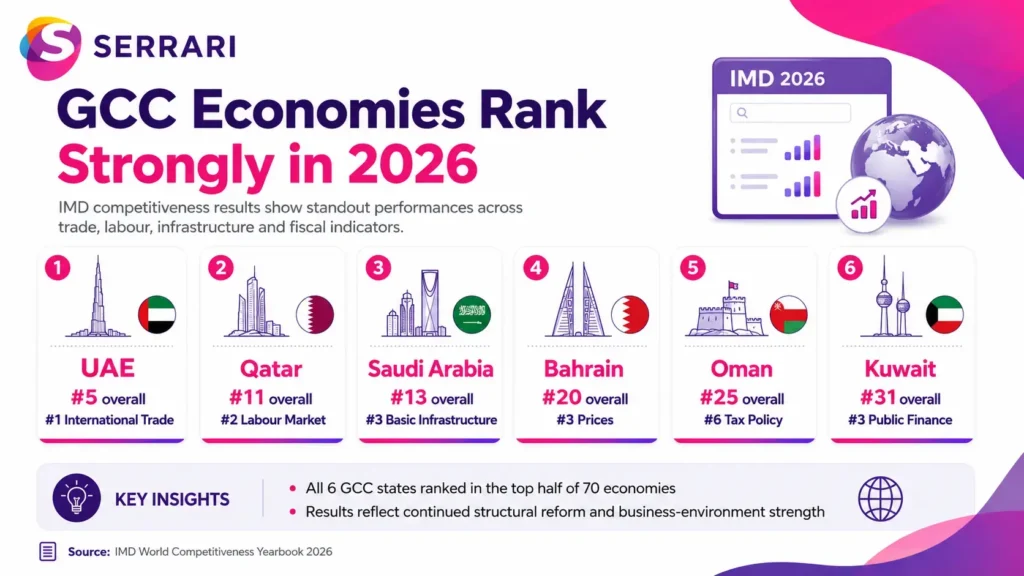
Gulf Cooperation Council economies strengthened their standing in the 2026 IMD World Competitiveness Ranking, with all six member states placing within the leading half of the 70 economies assessed. The United Arab Emirates ranked fifth globally, followed by Qatar in 11th place, Saudi Arabia in 13th, Bahrain in 20th, Oman in 25th and Kuwait in 31st.
Beyond the overall rankings, every GCC country secured a notable position in at least one major competitiveness indicator. The results highlighted regional strengths in international trade, labour markets, price stability, infrastructure, public finance and tax policy.
Key Overview
- The UAE ranked fifth overall and first in the Economic Performance factor.
- Qatar placed 11th overall and second in the Labour Market sub-factor.
- Saudi Arabia ranked 13th overall and third in Basic Infrastructure.
- Bahrain placed 20th overall and third in the Prices sub-factor.
- Oman ranked 25th overall and sixth in Tax Policy.
- Kuwait placed 31st overall and third in Public Finance.
- The 2026 ranking assessed 70 economies using statistical data and an executive survey.
UAE Leads the Gulf’s Overall Performance
The UAE remained the GCC’s highest-ranked economy, taking fifth place globally behind Singapore, Hong Kong, Switzerland and Taiwan. It also ranked first worldwide in the broader Economic Performance factor and led the International Trade sub-factor, according to the 2026 competitiveness results.
Its performance reflects a combination of trade connectivity, diversified business activity, transport links and policies designed to attract investment and international talent. The UAE also placed first in several individual measures, including employment, government-policy adaptability and air-transport quality.
Qatar followed in 11th place overall. It ranked second globally in the Labour Market sub-factor under Business Efficiency, highlighting strong results in areas connected to workforce conditions, labour-market effectiveness and the ability of businesses to access talent.
Saudi Arabia advanced to 13th globally, placing it among the highest-ranked large economies in the report. Its third-place position in Basic Infrastructure reflects sustained investment in roads, utilities, logistics, urban development and other systems supporting economic activity.
Context is everything. Stay ahead of shifting trends with today’s market updates, and uncover emerging opportunities using the Serrari Group Market Index and Marketplace. Then, take control of your own financial future by exploring our Money & Life Reset Transformation Blueprint ™ to build stronger habits, create better systems, and design a path toward lasting wealth.
Bahrain, Oman and Kuwait Record Specialist Strengths
Bahrain ranked 20th overall and achieved third place in the Prices sub-factor under Economic Performance. The result indicates comparatively strong price stability and cost conditions, although the sub-factor covers several measures and should not be interpreted as a single inflation ranking.
Oman placed 25th globally and sixth in Tax Policy under Government Efficiency. Its position points to the relative competitiveness of its tax framework, including the balance between government revenue requirements and the investment environment.
Kuwait ranked 31st overall while securing third place in Public Finance. The sub-factor evaluates areas such as fiscal balances, government debt and management of public resources, making Kuwait’s performance particularly notable despite its lower position in the headline ranking.
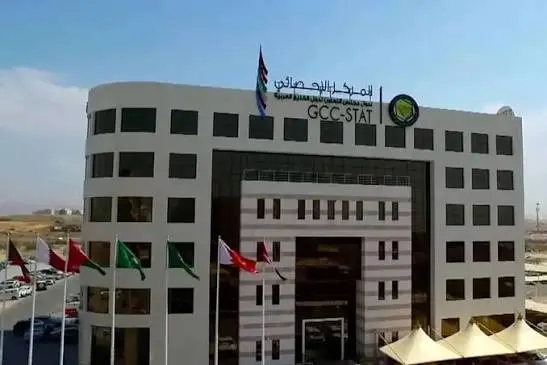
The original GCC-focused report attributed the indicator results to data released by the GCC Statistical Center and based on the IMD World Competitiveness Yearbook 2026.
How the Competitiveness Ranking Is Calculated
The ranking measures much more than gross domestic product or headline economic growth. IMD groups its assessment into four equally weighted factors: Economic Performance, Government Efficiency, Business Efficiency and Infrastructure. Each factor is divided into five sub-factors, creating 20 areas of comparison.
According to the official methodology, statistical indicators account for two-thirds of the overall ranking. In 2026, this hard-data component covered 172 criteria collected from international, national and regional institutions.
The remaining third came from an executive survey conducted between February and April 2026. Approximately 6,900 respondents assessed competitiveness conditions across the participating economies, producing another 92 criteria.
This combination means the results capture both measurable economic outcomes and business perceptions. It also means that a country can perform strongly in individual indicators while ranking lower overall because weaknesses elsewhere offset those advantages.
Structural Reform Drives Regional Gains
The GCC results reflect years of investment in infrastructure, fiscal reform, digital government, logistics, tourism and private-sector development. Gulf states have also sought to reduce their dependence on hydrocarbons by expanding financial services, advanced manufacturing, technology, transport and renewable energy.
The UAE’s top-five position shows how trade openness and institutional adaptability can translate into broad competitiveness. Qatar’s labour-market strength supports its strategy of attracting specialised workers, while Saudi Arabia’s infrastructure ranking aligns with its large-scale economic transformation projects.
For Bahrain, Oman and Kuwait, the specialist rankings demonstrate different sources of competitiveness rather than a single regional model. Bahrain stands out in price stability, Oman in tax policy and Kuwait in public finance.
However, high rankings do not remove longer-term challenges. GCC economies still face exposure to energy-market cycles, regional geopolitical risks, rising living costs, workforce nationalisation pressures and the need to build more productive private sectors.
The 2026 results therefore represent both recognition of progress and a benchmark for future reform. Maintaining strong positions will depend on whether Gulf economies can convert infrastructure investment, fiscal capacity and institutional efficiency into sustainable productivity and diversified growth.
Sources: IndexBox / International Institute for Management Development / The National / Qatar National Planning Council
Your financial future isn’t something you wait for—it’s something you build.
The real question is: when do you begin?
Move beyond simply staying informed.
Navigate the markets with clarity—track trends through the Serrari Group Market Index, uncover opportunities in the Serrari Marketplace, and build practical knowledge with our Curated Wealth Builder Platform.
Stay connected to what truly matters.
Get daily insights on macro trends and financial movements across Kenya, Africa, and global markets—delivered through the Serrari Newsletter.
Growth opens doors.
Advance your career through professional programs including ACCA, HESI A2, ATI TEAS 7 , HESI EXIT , NCLEX – RN and NCLEX – PN, Financial Literacy!🌟—designed to move you forward with confidence.
See where money is flowing—clearly and in real time.
Track Money Market Funds, Treasury Bills, Treasury Bonds, Green Bonds, and Fixed Deposits, alongside global and African indexes, key economic indicators, and the evolving Crypto and stablecoin landscape—all within Serrari’s Market Index.