
















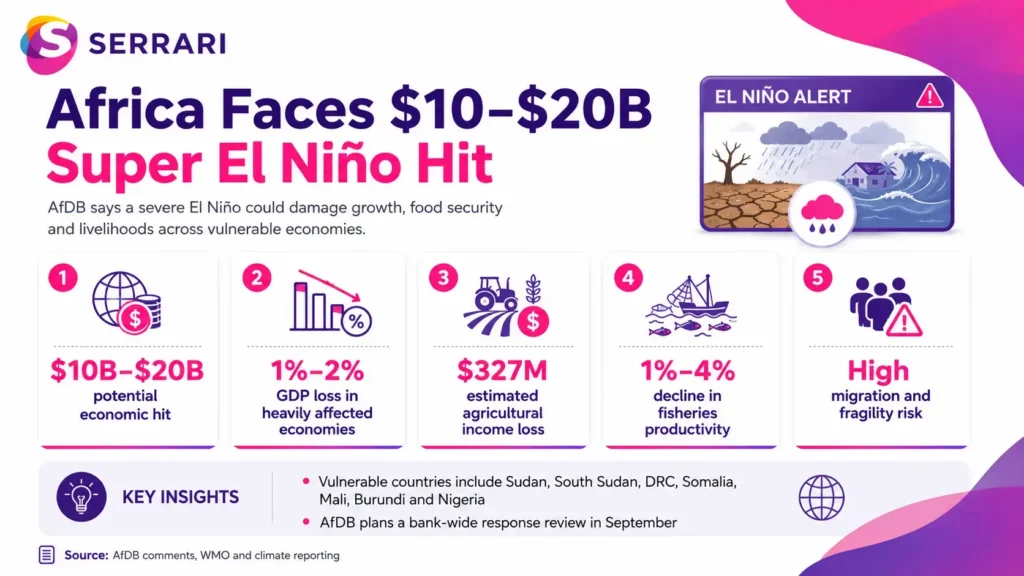
A potentially exceptionally strong El Niño could impose combined economic losses of between $10 billion and $20 billion on severely affected African economies, according to the African Development Bank’s Director for Climate Change and Green Growth, Anthony Nyong.
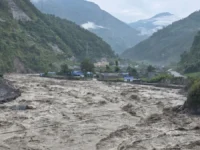
The estimate assumes average gross domestic product reductions of 1% to 2% in the countries hit hardest by droughts, floods and storms. Beyond lost output, the event could damage infrastructure, weaken food and water security, strain government finances and accelerate migration from vulnerable regions.
Key Overview
- AfDB estimates a $10 billion to $20 billion economic impact across affected African countries.
- GDP in the most exposed economies could decline by an average of 1% to 2%.
- Agricultural income losses are estimated at approximately $327 million.
- Fisheries productivity could decline by between 1% and 4%.
- Sudan, South Sudan, Somalia, Mali, Burundi, Nigeria and the Democratic Republic of Congo are among the countries identified as especially vulnerable.
- AfDB plans a bank-wide assessment in September covering existing and proposed investments.
Strong El Niño Raises Africa’s Economic Risk
The AfDB’s economic warning is the first public estimate from a major multilateral development bank of the potential African losses associated with the developing event.
Nyong said the most heavily affected countries could lose an average of 1% to 2% of GDP. The estimate does not include a country-by-country breakdown and should therefore be understood as a risk scenario rather than a confirmed final cost.
The World Meteorological Organization reported in June that there was an 80% probability of El Niño developing during June to August 2026, with probabilities near or above 90% that it would continue until at least November.
A subsequent seasonal climate update indicated rapid development into a strong event during July to September. Forecast models showed sea-surface temperature anomalies potentially exceeding 2°C in key parts of the equatorial Pacific.
Although these conditions support warnings of an unusually powerful El Niño, its eventual peak strength and regional effects remain uncertain. El Niño does not produce identical outcomes everywhere, and its impact depends on timing, intensity and interaction with other climate systems.
Context is everything. Stay ahead of shifting trends with today’s market updates, and uncover emerging opportunities using the Serrari Group Market Index and Marketplace. Then, take control of your own financial future by exploring our Money & Life Reset Transformation Blueprint ™ to build stronger habits, create better systems, and design a path toward lasting wealth.
Food Systems and Rural Incomes Under Pressure
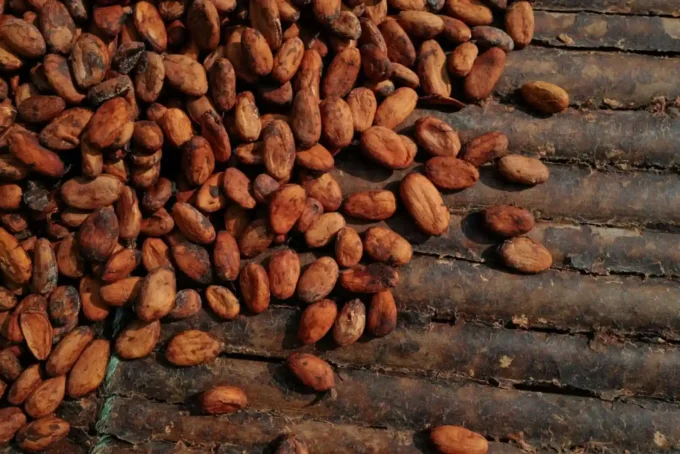
Agriculture is among the sectors facing the most immediate danger. AfDB estimates that African farmers could lose approximately $327 million in income, while severe drought or flooding could disrupt planting, harvesting, livestock production and transport networks.
Food-price increases could intensify hardship for households already spending a high share of their income on basic necessities. The assessment indicated that maize prices could potentially double in heavily affected markets if production and supply chains suffer substantial disruption.
Fishing communities are also exposed. Warmer waters, storms and shifting marine conditions could reduce fisheries productivity by between 1% and 4%, affecting incomes and food security in coastal and lakeside economies.
The Sahel is particularly vulnerable because prolonged drought has already weakened livelihoods and increased competition for water and grazing land. In southern and eastern Africa, stronger storms and flooding could destroy roads, power systems, farms and homes.
Mozambique’s experience following Cyclone Idai in 2019 illustrates how recovery can take years. Even after the immediate humanitarian emergency passes, damaged infrastructure, lost livelihoods and additional public debt can continue to suppress growth.
Climate Shocks Could Worsen Migration and Fragility
AfDB identified Sudan, South Sudan, the Democratic Republic of Congo, Somalia, Mali, Burundi and Nigeria as countries that could face especially severe effects.
Many of these states already contend with conflict, displacement, poverty or weak public services. New shortages of food, water and grazing land could increase competition between communities and force more people to relocate.
Migration may initially occur within national borders or towards neighbouring states. However, prolonged losses of income and repeated climate shocks could contribute to wider regional displacement.
The economic consequences may also extend into financial systems. Governments could be forced to divert limited budgets towards emergency relief and reconstruction, while damaged businesses and farms may struggle to repay loans. Banks holding those loans could then experience higher credit risks.
AfDB Prepares Investment and Financing Response
AfDB plans to hold a bank-wide seminar in September to examine how the event could affect proposed projects and its existing investment portfolio. The institution may restructure projects to help countries respond and seek additional support from mechanisms such as the Green Climate Fund.
The challenge is intensified by the global shortage of adaptation finance. According to the Adaptation Gap Report 2025, developing countries may require between $310 billion and $365 billion annually by 2035 to adapt to climate change.
International public adaptation finance reached only $26 billion in 2023, down from $28 billion a year earlier. That gap leaves countries with limited fiscal space more dependent on borrowing after disasters, potentially increasing debt burdens while slowing investment in healthcare, education and infrastructure.
The AfDB warning highlights the importance of acting before losses occur. Early-warning systems, resilient infrastructure, drought-resistant agriculture, water management and disaster financing can reduce damage, but they require investment before an emergency reaches its peak.
Africa’s eventual economic cost will depend on the strength and duration of El Niño, the regions it affects and how quickly governments and financial institutions respond. The $10 billion to $20 billion estimate is therefore both a warning and a case for accelerating climate-resilience investment.
Sources: Reuters / World Meteorological Organization / United Nations Environment Programme
Your financial future isn’t something you wait for—it’s something you build.
The real question is: when do you begin?
Move beyond simply staying informed.
Navigate the markets with clarity—track trends through the Serrari Group Market Index, uncover opportunities in the Serrari Marketplace, and build practical knowledge with our Curated Wealth Builder Platform.
Stay connected to what truly matters.
Get daily insights on macro trends and financial movements across Kenya, Africa, and global markets—delivered through the Serrari Newsletter.
Growth opens doors.
Advance your career through professional programs including ACCA, HESI A2, ATI TEAS 7 , HESI EXIT , NCLEX – RN and NCLEX – PN, Financial Literacy!🌟—designed to move you forward with confidence.
See where money is flowing—clearly and in real time.
Track Money Market Funds, Treasury Bills, Treasury Bonds, Green Bonds, and Fixed Deposits, alongside global and African indexes, key economic indicators, and the evolving Crypto and stablecoin landscape—all within Serrari’s Market Index.