The STOXX Europe 600 is a broad European equity benchmark covering 600 large-, mid- and small-cap companies across 17 developed European countries and 11 industries, representing nearly 90% of the region’s underlying investable market. That makes the index a useful barometer for the European equity market, but it should not be confused with single-country indexes such as Germany’s DAX, France’s CAC 40 or the UK’s FTSE 100. The ECB decision and eurozone PMI data may affect sectors differently, with banks, property companies, utilities, exporters and highly leveraged companies responding to different combinations of rates, growth and currency signals. (STOXX)
Key Overview
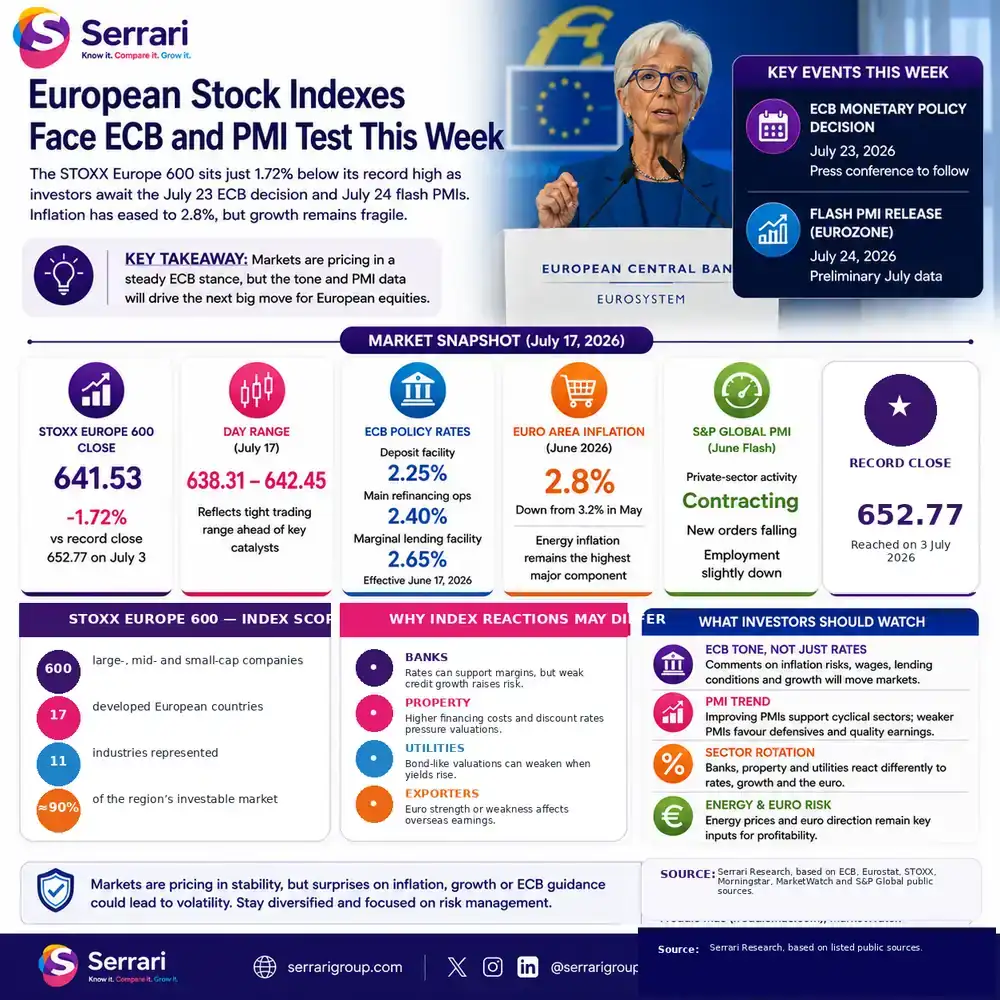
- The STOXX Europe 600 closed at 641.53 on 17 July.
- The index was 1.72% below its 3 July record close of 652.77.
- MarketWatch showed the 17 July day range at 638.31 to 642.45.
- ECB rates currently stand at 2.25% for the deposit facility, 2.40% for main refinancing operations and 2.65% for the marginal lending facility.
- Eurostat confirmed euro-area annual inflation fell to 2.8% in June from 3.2% in May.
- S&P Global’s June flash PMI showed eurozone private-sector business activity still contracting, with new orders continuing to fall.
European Stock Indexes Face ECB and PMI Test This Week
A Market Near Its High Faces a Macro Check
The STOXX Europe 600 is not entering the week from a weak level. Morningstar’s Dow Jones data note shows the index ended the week at 641.53, up 13 of the previous 17 weeks and only 1.72% below its record close. MarketWatch also placed the 17 July close at 641.53, with a day range of 638.31 to 642.45. (Morningstar, Inc.)
That resilience matters because it means valuations are being tested from a position of strength. A disappointing ECB message or weak PMI reading could pressure equities, while a balanced policy tone and improving activity data could support the view that European shares remain close to their highs for a reason.
ECB Rates Are Back in Focus
The ECB’s next monetary-policy meeting begins on 22 July and concludes on 23 July, followed by the press conference in Frankfurt. The ECB’s latest policy decision raised the deposit facility, main refinancing operations and marginal lending facility rates to 2.25%, 2.40% and 2.65%, respectively, with effect from 17 June. (European Central Bank)
That June increase sets up the July question. Investors do not only care whether the ECB changes rates. They will also watch Christine Lagarde’s language around energy prices, wage growth, services inflation, lending conditions and whether the Governing Council sees the June inflation easing as durable.
Inflation Has Cooled, But Not Disappeared
Eurostat confirmed that euro-area annual inflation fell to 2.8% in June from 3.2% in May. That is a relief for markets, but still above the ECB’s 2% objective. The final release also showed EU inflation at 2.9%, down from 3.3% in May, while inflation differed widely across countries. (European Commission)
The component story is important for equities. The flash estimate showed energy inflation remained the highest major component in June, followed by services, food, alcohol and tobacco, and non-energy industrial goods. Energy and services therefore remain central to the ECB’s policy communication and to sector performance. (European Commission)
PMIs Will Test the Growth Story
The second test comes on 24 July, when preliminary July PMI data are expected. S&P Global’s June flash release showed further contraction in eurozone private-sector business activity, sustained falls in new orders and another slight drop in employment. That means July’s flash PMIs will matter because investors need to know whether Europe’s growth weakness is stabilising or extending. (PMI)
For equity markets, this matters as much as the ECB. If inflation cools but activity remains weak, investors may favour defensives and high-quality earnings. If PMIs improve while inflation eases, cyclical sectors may gain support. If PMIs weaken and the ECB sounds hawkish, the combination could be more difficult for the broader index.
Sector Winners and Losers Depend on the Signal
Banks may benefit from higher-for-longer rates if net interest margins remain supported, but they can suffer if tighter policy weakens credit growth or increases loan-loss risk. Property companies and highly leveraged firms are usually more vulnerable to hawkish rate signals because financing costs and valuation discount rates matter heavily.
Utilities can act like bond proxies, so higher yields may pressure valuations. Exporters face a different channel: the euro. If ECB communication supports the currency, exporters may face earnings translation pressure. If the euro weakens, exporters may gain some relief, though global demand still matters.
Context is everything. Stay ahead of shifting trends with today’s market updates, and uncover emerging opportunities using the Serrari Group Market Index and Marketplace. Then, take control of your own financial future by exploring our Money & Life Reset Transformation Blueprint ™ to build stronger habits, create better systems, and design a path toward lasting wealth.
Do Not Treat Europe as One Index
Investors should distinguish the STOXX Europe 600 from the DAX, CAC 40 and FTSE 100. The STOXX Europe 600 is broad and includes companies from 17 countries and 11 industries. The DAX is more exposed to Germany’s industrial cycle, the CAC 40 has heavy luxury and multinational exposure, and the FTSE 100 includes UK-listed global companies, many of which are affected by sterling, commodities and Bank of England policy rather than ECB rates. (STOXX)
This matters because a single ECB decision does not move every European index the same way. Sector mix, currency exposure and domestic economic links can cause different reactions across markets.
Technology Weakness Adds a Second Layer
The macro week comes after renewed global technology pressure. The Guardian’s 17 July market coverage noted a deepening global chip sell-off, with semiconductor weakness spreading across regions. That matters for European indexes because the market’s resilience near record highs is being tested at the same time as high-growth and technology-linked shares face valuation pressure. (The Guardian)
This reinforces the need to separate index-level calm from sector-level stress. A broad benchmark can remain near highs while individual industries rotate sharply.
What Investors Should Watch
Investors should watch four things. First, whether the ECB decision changes the expected policy path. Second, whether Lagarde sounds more worried about inflation or growth. Third, whether July PMIs show new orders improving or weakening further. Fourth, whether sector leadership shifts from banks and defensives toward cyclicals, or the other way around.
They should also refresh index levels before publication or trading decisions if European markets have reopened. This is a preview based on 17 July closing data, not a post-decision reaction.
Conclusion
European Stock Indexes enter the week close to record levels but facing two important macro tests. The STOXX Europe 600 is only 1.72% below its record close, yet the ECB decision and flash PMIs could quickly change the market’s interpretation of inflation, growth and valuation risk.
For investors, the key is not to predict a single outcome. A hawkish ECB, a neutral hold, or a softer policy tone could all affect sectors differently. The July PMI release will then show whether European activity is improving enough to support earnings. In a market this close to its highs, policy language and growth data may matter as much as the index level itself.
FAQs
1. Why are European Stock Indexes important this week?
European Stock Indexes are important this week because investors face two major macro events: the ECB’s 23 July monetary-policy decision and preliminary July eurozone PMI data on 24 July. These releases can affect interest-rate expectations, the euro, bond yields and sector leadership across European equities.
2. What is the STOXX Europe 600?
The STOXX Europe 600 is a broad European equity benchmark with 600 components across 17 developed European countries and 11 industries. STOXX says it represents nearly 90% of the underlying investable market, making it one of the region’s main broad-market indicators. (STOXX)
3. How close is the STOXX Europe 600 to its record?
The STOXX Europe 600 closed at 641.53 on 17 July and was 1.72% below its record close of 652.77 reached on 3 July. That means the index is close to record territory even after a renewed technology-sector sell-off. (Morningstar, Inc.)
4. Which sectors are most sensitive to the ECB decision?
Banks, property companies, utilities, exporters and highly leveraged companies are among the most sensitive sectors. Banks may react to interest-margin expectations, property and utilities to discount rates, exporters to euro movement, and high-debt companies to financing-cost pressure.
5. What should investors watch in the July PMIs?
Investors should watch whether output, new orders, employment and price pressures improve or weaken. June’s flash PMI showed eurozone private-sector activity still contracting and new orders still falling, so July’s release will test whether the growth outlook is stabilising. (PMI)
Sources: ECB, Eurostat, STOXX, Morningstar/Dow Jones Data Talk, MarketWatch, S&P Global, Guardian
Your financial future isn’t something you wait for—it’s something you build.
The real question is: when do you begin?
Move beyond simply staying informed.
Navigate the markets with clarity—track trends through the Serrari Group Market Index, uncover opportunities in the Serrari Marketplace, and build practical knowledge with our Curated Wealth Builder Platform.
Stay connected to what truly matters.
Get daily insights on macro trends and financial movements across Kenya, Africa, and global markets—delivered through the Serrari Newsletter.
Growth opens doors.
Advance your career through professional programs including ACCA, HESI A2, ATI TEAS 7 , HESI EXIT , NCLEX – RN and NCLEX – PN, Financial Literacy!🌟—designed to move you forward with confidence.
See where money is flowing—clearly and in real time.
Track Money Market Funds, Treasury Bills, Treasury Bonds, Green Bonds, and Fixed Deposits, alongside global and African indexes, key economic indicators, and the evolving Crypto and stablecoin landscape—all within Serrari’s Market Index.