

















Ethiopia debt relief reached a major milestone after the government secured an agreement with bondholders to restructure its defaulted $1 billion Eurobond. Backed by IMF backing, the deal introduces a new bond, settles missed interest payments, and advances Ethiopia’s sovereign debt restructuring efforts while supporting long-term debt sustainability.
Key Overview
- Ethiopia restructured its defaulted $1 billion Eurobond.
- A new $880 million bond will replace the existing bond.
- The new bond carries a 6.15% coupon.
- Ethiopia will repay $99.37 million in missed coupons.
- The IMF backed the restructuring agreement.
- Bondholders gained rights to future bond purchases.
- The deal supports Ethiopia’s debt sustainability.
- Investor confidence improved after the announcement.
Ethiopia Debt Relief Advances After Landmark Bondholder Agreement
Ethiopia debt relief efforts have taken a significant step forward after the government reached a landmark restructuring agreement with holders of its defaulted $1 billion Eurobond. The deal removes one of the final obstacles in the country’s long-running debt restructuring process and brings Ethiopia closer to restoring financial stability after years of fiscal pressure.
The agreement represents a major milestone in the government’s broader economic reform programme, which has received support from both the International Monetary Fund and the World Bank. By restructuring its external obligations while maintaining cooperation with creditors, Ethiopia is positioning itself to gradually regain access to international capital markets.
Ethiopia and Bondholders Reach Historic Restructuring Deal
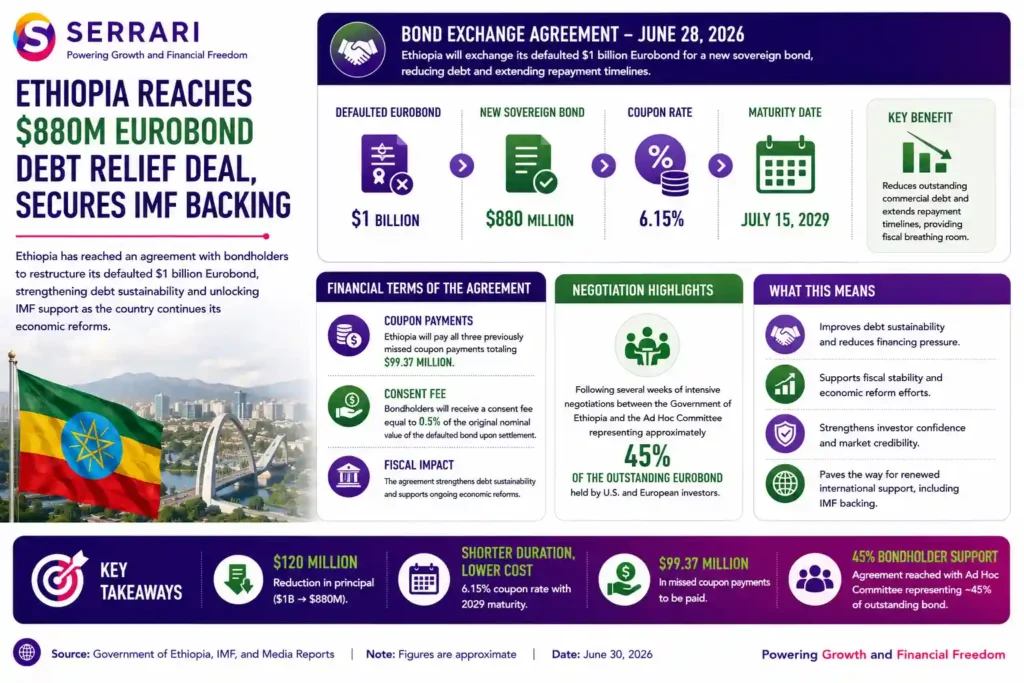
Under the agreement reached on June 28, Ethiopia will exchange its defaulted $1 billion Eurobond for a new $880 million sovereign bond carrying a 6.15 percent coupon and maturing on July 15, 2029.
The restructuring reduces the country’s outstanding commercial debt while extending repayment timelines, providing additional fiscal breathing room as economic reforms continue.
Alongside the bond exchange, Ethiopia committed to paying all three previously missed coupon payments, amounting to $99.37 million. Bondholders will also receive a consent fee equal to 0.5 percent of the original nominal value of the defaulted bond upon settlement.
The agreement follows several weeks of intensive negotiations between the government and the Ad Hoc Committee representing approximately 45 percent of the outstanding Eurobond held by U.S. and European investors.
IMF Backing Strengthens Ethiopia Debt Relief
One of the most important aspects of the agreement is the support it has received from the International Monetary Fund.
As part of the restructuring package, Ethiopia and bondholders agreed to introduce a New Money Warrant, allowing existing investors to subscribe to as much as $1 billion of future Ethiopian sovereign bonds issued at market interest rates.
The Ministry of Finance confirmed that the IMF reviewed the warrant structure and concluded that it remains consistent with Ethiopia’s debt sustainability targets and programme requirements.
The proposal also received a non-objection from the co-chairs of the Official Creditor Committee, subject to approval by the wider committee.
This endorsement is significant because IMF approval provides reassurance that Ethiopia’s restructuring aligns with internationally recognised debt sustainability principles rather than simply postponing repayment obligations.
Context is everything. Stay ahead of shifting trends with today’s market updates, and uncover emerging opportunities using the Serrari Group Market Index and Marketplace. Then, take control of your own financial future by exploring our Money & Life Reset Transformation Blueprint ™ to build stronger habits, create better systems, and design a path toward lasting wealth.
New Bond Structure Supports Debt Sustainability
The proposed future bond under the New Money Warrant would carry a seven-year maturity with an average life of approximately six years.
Rather than requiring a single large repayment at maturity, the principal would be repaid in three equal installments during years five, six and seven. This staggered repayment schedule is designed to reduce refinancing risks while giving Ethiopia greater flexibility in managing its future debt obligations.
The new structure also provides investors with an opportunity to continue supporting Ethiopia once the country’s financial position strengthens, creating a bridge between today’s restructuring and tomorrow’s market access.
The arrangement reflects a growing emphasis on balancing creditor recoveries with sustainable sovereign borrowing practices.
Official Creditors and Bondholders Resolve Key Differences
Negotiations were not without challenges.
Earlier in 2026, the Official Creditor Committee, co-chaired by France and China, rejected preliminary restructuring terms after concluding they did not fully comply with the Comparability of Treatment principle under the G20 Common Framework.
This principle requires commercial creditors to provide debt relief broadly comparable to that offered by official lenders.
Following further discussions, Ethiopia and commercial creditors revised the restructuring package to better align with these requirements while preserving the country’s debt sustainability objectives.
The government also agreed to reimburse the legal fees and restructuring expenses incurred by the Ad Hoc Committee as part of the final settlement.
Market Confidence Improves Following the Agreement
Financial markets responded positively to news of the restructuring agreement.
Ethiopia’s Eurobond rose by 3.125 cents to 108.75 cents on the dollar, reflecting improved investor confidence that one of Africa’s most complex sovereign debt restructurings is approaching completion.
The positive market reaction suggests investors believe the agreement reduces uncertainty surrounding Ethiopia’s external debt while improving prospects for future fiscal stability.
Successful completion of the restructuring may also lower borrowing costs over time as confidence gradually returns to the country’s sovereign credit profile.
Why the Debt Relief Matters for Ethiopia’s Economy
Debt restructuring has become a central pillar of Prime Minister Abiy Ahmed’s wider economic reform agenda.
High external debt servicing obligations have constrained government spending for several years, limiting resources available for infrastructure, healthcare, education and economic development.
By reducing near-term repayment pressures, the restructuring creates additional fiscal space while allowing authorities to continue implementing structural reforms supported by international financial institutions.
Improved debt sustainability could also strengthen Ethiopia’s investment appeal by providing greater confidence in the country’s long-term macroeconomic outlook.
Outlook for Ethiopia’s Return to International Markets
Although the restructuring marks a major achievement, Ethiopia’s recovery process is not yet complete.
The government must continue implementing IMF-supported reforms while securing final approvals from official creditors under the G20 Common Framework.
If these steps proceed successfully, Ethiopia could eventually regain regular access to international capital markets through future sovereign bond issuances, including the potential $1 billion offering envisaged under the New Money Warrant.
For emerging markets facing elevated debt burdens, Ethiopia’s experience demonstrates how coordinated negotiations between governments, commercial investors, official creditors and multilateral institutions can produce restructuring agreements that balance financial stability with investor participation.
Conclusion
The Ethiopia debt relief agreement represents one of the most significant sovereign restructuring milestones in Africa in recent years. By restructuring its defaulted Eurobond, securing IMF backing, settling overdue payments and establishing a framework for future market access, Ethiopia has taken an important step toward restoring debt sustainability and rebuilding investor confidence.
While additional reforms remain necessary, the agreement substantially strengthens Ethiopia’s financial outlook and provides a clearer path toward long-term economic recovery.
FAQs
1. What does Ethiopia’s debt relief agreement involve?
The agreement restructures Ethiopia’s defaulted $1 billion Eurobond by replacing it with a new $880 million bond that matures in 2029 and carries a 6.15 percent coupon. Ethiopia will also repay nearly $99.4 million in missed coupon payments and pay a consent fee to participating investors. The package is designed to reduce immediate debt servicing pressures while maintaining constructive relationships with commercial creditors and supporting the country’s long-term financial recovery.
2. Why is IMF backing important for Ethiopia’s debt restructuring?
The International Monetary Fund plays a critical role in evaluating whether a country’s debt remains sustainable after restructuring. In Ethiopia’s case, the IMF confirmed that the restructuring terms and the proposed New Money Warrant are consistent with the country’s debt sustainability objectives. This endorsement gives confidence to both official creditors and private investors that the restructuring supports economic stability rather than simply delaying future repayment challenges.
3. What is the New Money Warrant included in the agreement?
The New Money Warrant gives existing bondholders the right to subscribe to up to $1 billion in future Ethiopian sovereign bonds once market conditions improve. Rather than providing immediate financing, it creates a pathway for Ethiopia to re-enter international capital markets while allowing current investors to participate in future bond issuances. The proposed future bond would have a seven-year maturity and principal repayments spread over the final three years, reducing refinancing risks.
4. How does the restructuring improve Ethiopia’s economic outlook?
Reducing external debt obligations allows Ethiopia to redirect more financial resources toward economic development while easing pressure on public finances. Combined with ongoing reforms supported by the IMF and World Bank, the restructuring is expected to improve investor confidence, strengthen fiscal stability and enhance the country’s ability to attract future investment. Although challenges remain, the agreement represents an important step toward restoring sustainable economic growth and rebuilding Ethiopia’s standing in international financial markets.
Sources: Reuters, Zawya, The Star
Your financial future isn’t something you wait for—it’s something you build.
The real question is: when do you begin?
Move beyond simply staying informed.
Navigate the markets with clarity—track trends through the Serrari Group Market Index, uncover opportunities in the Serrari Marketplace, and build practical knowledge with our Curated Wealth Builder Platform.
Stay connected to what truly matters.
Get daily insights on macro trends and financial movements across Kenya, Africa, and global markets—delivered through the Serrari Newsletter.
Growth opens doors.
Advance your career through professional programs including ACCA, HESI A2, ATI TEAS 7 , HESI EXIT , NCLEX – RN and NCLEX – PN, Financial Literacy!🌟—designed to move you forward with confidence.
See where money is flowing—clearly and in real time.
Track Money Market Funds, Treasury Bills, Treasury Bonds, Green Bonds, and Fixed Deposits, alongside global and African indexes, key economic indicators, and the evolving Crypto and stablecoin landscape—all within Serrari’s Market Index.